Psychology · Book club
Just Babies: The Origins of Good and Evil book club questions
Here are 12 book club questions for Just Babies: The Origins of Good and Evil by Paul Bloom, ordered to open easily and end somewhere worth arguing about. Copy them, print them, or bring them up one at a time.
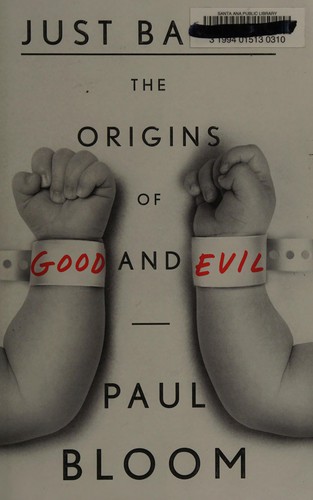
Paul Bloom's central question is how much morality is innate versus learned.
Paul Bloom · 2013 · 4h 45m
Full summary and key takeaways →The 12 questions
- 1.
Bloom argues that the moral sense babies have is genuine but narrow. Looking at your own moral responses, how much of your empathy and fairness extends to people outside your immediate social circle?
- 2.
The preference for helpful over harmful agents appears before language. Does that finding change how you think about the relationship between reasoning and moral intuition in your own ethical judgments?
- 3.
Bloom claims reason, not empathy, is the engine of moral progress. Is that convincing? Can you think of cases where emotional expansion — not reasoning — drove someone to extend moral concern?
- 4.
In-group favoritism is described as innate rather than taught. What institutions or practices in your life most actively counteract that instinct? How effective do you think they are?
- 5.
The book suggests empathy is an unreliable guide because it responds to identifiable individuals and not statistical victims. How does knowing that change how you think about charitable giving or policy support?
- 6.
Disgust is shown to extend easily from biological to social domains. Can you identify a moral judgment you hold that on reflection might be more disgust-based than harm-based?
- 7.
Bloom is skeptical that we can extend our natural empathy to cover everyone equally. Is that a counsel of despair, or a realistic constraint that should shape how we design moral education and institutions?
- 8.
The infant research relies on looking-time and reach studies rather than verbal reports. How much confidence do you have in those methods as evidence for genuine moral evaluation versus mere preference?
- 9.
If the innate moral sense is both genuinely present and genuinely limited, what does that imply about which moral questions we should prioritize teaching versus which ones we can rely on instinct to handle?
- 10.
Bloom writes that humans are neither naturally good nor naturally bad, but something more specific. What is your own default assumption about human nature, and has this book shifted it?
- 11.
The research on infant fairness shows preferences for equal distributions, but in practice children enforce fairness in ways that favor their own group. At what age does this tension between fairness principle and in-group favoritism resolve in your experience, if it does?
- 12.
If you accepted Bloom's view that empathy is morally unreliable, what would you change about how you make decisions about who to help?
How to run the discussion
- Pick six to eight, not all of them. An hour of real discussion covers fewer questions than anyone expects, and racing the list is what makes a book club feel like homework.
- Open with what people noticed, not what they concluded. Asking for a verdict first hardens opinions before anyone has heard each other.
- Let the disagreement run. The questions below that split a room are the ones worth the time; the ones everyone answers the same way can be skipped.
- Ask the quiet person a specific question. A direct, narrow question is far easier to answer than an open invitation to contribute.
Themes worth steering toward
If the conversation stalls, these are the threads that usually restart it.
Common questions
What are good book club questions for Just Babies: The Origins of Good and Evil?
Here are 12 book club questions for Just Babies: The Origins of Good and Evil by Paul Bloom, ordered to open easily and end somewhere worth arguing about. The strongest openers ask what each reader noticed rather than what they concluded, and the discussion usually turns on moral development, human nature, empathy.
How long should a book club discussion of Just Babies: The Origins of Good and Evil last?
Most groups run 60 to 90 minutes of actual discussion. That is roughly six to eight questions, not all of them, so pick the ones that suit your group rather than working down the list in order.
What are the main themes in Just Babies: The Origins of Good and Evil?
Moral development, Human nature, Empathy, Evolution and morality, Infant psychology. Those are the threads most likely to divide a room, which makes them the useful places to steer a discussion that has gone quiet.
Picking the next one? See books like Just Babies: The Origins of Good and Evil or questions for other book club picks.
