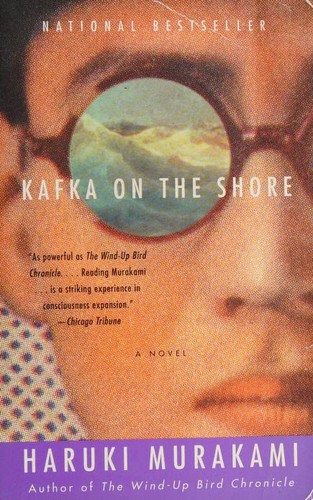
Talk to Kafka on the Shore like its author wrote you back.
Get the ideas that fit your life — not generic summaries.
- Chat with the book
- Audiobook-style main ideas
- Adapts to your life and goals
- Helps you take action
What it argues
Kafka on the Shore runs two parallel narratives that eventually, obliquely, converge. Kafka Tamura is fifteen years old and has run away from his Tokyo home to escape a curse his father placed on him — that he will kill his father and sleep with his mother and sister. He ends up in a private library in Takamatsu, where he encounters a woman named Saeki who may or may not be his mother, and another named Oshima who becomes his guide. Meanwhile, Nakata is an elderly man in Tokyo who lost his memory and much of his mind in a mysterious wartime incident and can now talk to cats. He is being drawn, with no understanding of why, toward the same library and the same metaphysical event.
The novel operates in the space where the unconscious meets waking life — which is to say, where ordinary reality starts to come apart. Raining fish and raining leeches. Cats that converse about the weather. A spirit in a painting. A mysterious stone that can open an entrance between worlds. Murakami is drawing on Kafka (the Metamorphosis-era strangeness, the implacable dream-logic), on Greek tragedy, and on Japanese folk religion, mixing them with the usual signifiers of his particular world: jazz, whiskey, Raymond Carver, Johnnie Walker as a sinister figure.
What it gets right
- 1.
The novel's dream-logic is not a failure of plotting but a deliberate formal choice: some things cannot be explained because they are not the kind of thing that explains.
- 2.
Kafka's flight from an Oedipal prophecy sets up the central irony — the harder he runs from fate, the more directly he moves toward it.
- 3.
Nakata functions as a kind of innocent through the novel's chaos: the man who lost his intellect but retained something else, a kind of rightness, that guides him where understanding cannot.
What it covers
Who wrote it
Haruki Murakami was born in Kyoto in 1949 and studied drama at Waseda University. He ran a jazz bar in Tokyo before publishing his first novel in 1979. Norwegian Wood (1987) made him a literary celebrity in Japan. His major novels include The Wind-Up Bird Chronicle, Kafka on the Shore, 1Q84, and Killing Commendatore. His work blends Japanese literary tradition with Western pop culture, jazz, and European modernism. He is among the most translated living authors and a perennial Nobel Prize contender.
