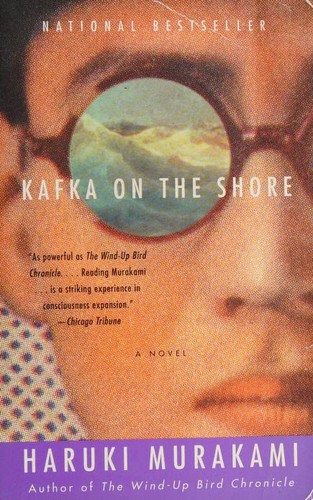
Talk to Kafka on the Shore like its author wrote you back.
Get the ideas that fit your life — not generic summaries.
- Chat with the book
- Audiobook-style main ideas
- Adapts to your life and goals
- Helps you take action
Kafka on the Shore, in detail
Kafka on the Shore runs two parallel narratives that eventually, obliquely, converge. Kafka Tamura is fifteen years old and has run away from his Tokyo home to escape a curse his father placed on him — that he will kill his father and sleep with his mother and sister. He ends up in a private library in Takamatsu, where he encounters a woman named Saeki who may or may not be his mother, and another named Oshima who becomes his guide. Meanwhile, Nakata is an elderly man in Tokyo who lost his memory and much of his mind in a mysterious wartime incident and can now talk to cats. He is being drawn, with no understanding of why, toward the same library and the same metaphysical event.
The novel operates in the space where the unconscious meets waking life — which is to say, where ordinary reality starts to come apart. Raining fish and raining leeches. Cats that converse about the weather. A spirit in a painting. A mysterious stone that can open an entrance between worlds. Murakami is drawing on Kafka (the Metamorphosis-era strangeness, the implacable dream-logic), on Greek tragedy, and on Japanese folk religion, mixing them with the usual signifiers of his particular world: jazz, whiskey, Raymond Carver, Johnnie Walker as a sinister figure.
The novel is long and deliberately refuses resolution. Some threads are abandoned. Some questions receive answers that only open further questions. This is a feature rather than a bug — Murakami believes the unconscious doesn't resolve, and the form enacts the content. For some readers this is the entire point: a novel that functions like a waking dream, evading interpretation precisely as dreams do. For others it is maddening.
Kafka on the Shore requires more patience and tolerance for ambiguity than Norwegian Wood, and arguably more than The Wind-Up Bird Chronicle, which has at least the skeleton of a mystery. If you come in wanting to understand what happened, you will leave partly satisfied and partly not. If you come in willing to be moved and unsettled, this is one of Murakami's most powerful books.
The big ideas
- 1.
The novel's dream-logic is not a failure of plotting but a deliberate formal choice: some things cannot be explained because they are not the kind of thing that explains.
- 2.
Kafka's flight from an Oedipal prophecy sets up the central irony — the harder he runs from fate, the more directly he moves toward it.
- 3.
Nakata functions as a kind of innocent through the novel's chaos: the man who lost his intellect but retained something else, a kind of rightness, that guides him where understanding cannot.
