Leadership Is Language by L. David Marquet is a 2020 business book about communication, leadership, decision-making. Language is not just how leaders communicate decisions — it is a primary mechanism through which the quality of organizational thinking gets determined.
Summary
Leadership Is Language is L. David Marquet's argument that the words leaders use — the specific language patterns of how they ask questions, give instructions, and run meetings — shape the quality of thinking and behavior in their teams more than any strategy or vision. Marquet, who wrote Turn the Ship Around about his experience commanding the USS Santa Fe, extends that work into a broader theory of how linguistic patterns either invite or suppress the cognitive engagement that good decisions require.
The core distinction Marquet draws is between "Redwork" and "Bluework." Redwork is executing — doing the thing, following the plan, being in motion. Bluework is thinking — questioning assumptions, exploring options, reflecting on what's working. Most organizational language is optimized for Redwork: complete the task, hit the number, stay on schedule. But organizations that can never shift into Bluework don't learn, don't adapt, and don't catch their own errors before they compound.
Marquet identifies specific language patterns that keep teams stuck in Redwork: telling people what to think rather than asking what they think, seeking votes rather than independent assessments, using completion rhetoric that shuts down questioning, and defaulting to confidence assertions rather than honest uncertainty expressions. He provides alternatives for each pattern — specific phrasings and practices that invite genuine cognitive engagement. The approach is grounded in the El Faro disaster, a cargo ship that sank in a hurricane with all hands, and Marquet traces the linguistic patterns in the voyage data recorder transcript that show how the crew was repeatedly unable to surface the concerns that might have changed the outcome.
The book is specific enough to be actionable. Readers who finish it tend to become more aware of their own language in the weeks after, noticing the places where they default to rhetorical patterns that close down thinking. The El Faro material is gripping and gives the abstract argument concrete, high-stakes stakes that most business books lack.

Talk to Leadership Is Language like its author wrote you back.
Get the ideas that fit your life — not generic summaries.
- Chat with the book
- Audiobook-style main ideas
- Adapts to your life and goals
- Helps you take action
Key takeaways
- 1.
Language is not just how leaders communicate decisions — it is a primary mechanism through which the quality of organizational thinking gets determined.
- 2.
Redwork (executing) and Bluework (thinking) require different language. Most organizational defaults favor Redwork, which crowds out the reflection and questioning that prevent compounding errors.
- 3.
Asking 'what do you think?' before sharing your own view produces better thinking in the room. Leaders who express opinions first tend to get their opinions reflected back.
- 4.
Coercive language and completion rhetoric ('we just need to push through') shut down the honest uncertainty expressions that surface problems early.
- 5.
Seeking a show of hands for agreement is almost always a bad mechanism for assessing genuine consensus. Independent written assessment before group discussion produces more accurate information.
- 6.
The El Faro disaster illustrates how hierarchical communication patterns — crew members unable to fully surface concerns to authority — compound small problems into catastrophic ones.
- 7.
Certainty language ('we're on track,' 'this will work') may signal confidence but it actively suppresses the doubt-surfacing conversations that catch errors before they matter.
- 8.
Leaders can shift meeting culture dramatically by changing the questions they ask, the order in which they share their views, and whether they invite disagreement explicitly or implicitly discourage it.
Discussion questions
Use these on your own, with a book club, or as chat starters in Superbook. Book club version, ready to copy or print →
- 1.
Marquet argues that leaders who share their opinions first tend to get those opinions reflected back. When have you seen that dynamic in a meeting or conversation?
- 2.
What is the default ratio of Redwork to Bluework in your team or organization? When do you make time for genuine reflection, and what usually crowds it out?
- 3.
Think about the last meeting you ran or attended. What language patterns dominated? Which ones closed down thinking and which ones opened it up?
- 4.
Marquet uses the El Faro disaster as his central case study. What does that example reveal about how hierarchical communication patterns affect safety and performance?
- 5.
When have you held back a concern because the language or tone of the room made it feel unsafe to raise? What would have needed to be different?
- 6.
What's one linguistic habit of your own — a phrase you default to, a question you tend to ask — that might be shutting down honest thinking in your team?
- 7.
Marquet recommends asking for written independent assessments before group discussion. How would that change the dynamics of your most important recurring meetings?
- 8.
What's the difference between asking for agreement and asking for genuine assessment? How do you tell which you're actually getting?
- 9.
How do you express uncertainty at work? Does the culture in your organization reward certainty-signaling in ways that make honest doubt expression risky?
- 10.
Marquet distinguishes between intention and impact in communication. Where in your leadership has the impact of your language been different from your intention?
- 11.
Which of Marquet's specific language recommendations do you find most compelling? Which seem hardest to implement in your context?
- 12.
Marquet argues that changing language is a lever for changing culture. Is that a claim you find plausible, or does it put the cart before the horse?
Themes
Frequently asked questions
-
Do I need to have read Turn the Ship Around first?
No. Leadership Is Language stands on its own. Familiarity with the USS Santa Fe story adds context, but Marquet introduces enough background for readers who haven't read the earlier book. The two books complement each other well if read in either order.
-
Is Leadership Is Language worth reading?
Yes, especially for leaders who want specific, immediately applicable changes to how they run meetings and conversations. The language recommendations are concrete enough to try the next day, and the El Faro case study is compelling enough that the abstract arguments land with genuine weight.
-
What is the Redwork/Bluework distinction?
Redwork is execution — being in motion, following the plan, completing the task. Bluework is thinking — questioning assumptions, exploring alternatives, reflecting on what's working. Marquet argues that effective organizations need deliberate mechanisms for shifting between the two, and that most organizational defaults overcrowd Bluework with Redwork.
-
Who should read Leadership Is Language?
Managers and leaders at any level who run meetings, give feedback, or have responsibility for team culture. Particularly useful for anyone who has noticed that their team tends to agree with them too readily, or whose meetings don't surface the concerns that show up later as problems.
-
How long does it take to read Leadership Is Language?
Around four hours at average reading pace. The El Faro sections read quickly because they're narrative; the prescription chapters are denser but come with clear summaries that make returning to specific guidance easy.
Similar books
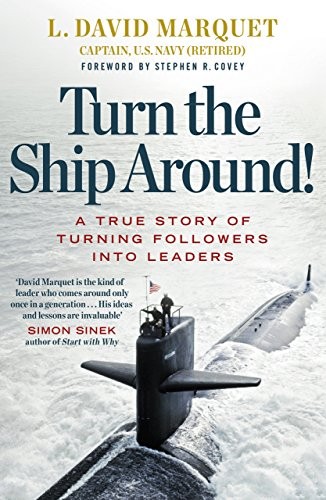
Turn the Ship Around!
L. David Marquet
Dare to Lead
Brené Brown
Crucial Conversations: Tools for Talking When Stakes Are High
Kerry Patterson, Joseph Grenny, Ron McMillan, and Al Switzler
Leaders Eat Last
Simon Sinek
