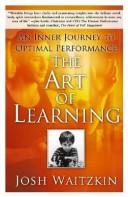
The Art of Learning by Josh Waitzkin is a 2007 self-help book about learning, mastery, mental performance. Entity theorists believe intelligence and talent are fixed. Incremental theorists believe they grow with effort. The entity mindset collapses under adversity; the incremental mindset feeds on it.
Summary
The Art of Learning is Josh Waitzkin's account of how he became a national chess champion as a child and later a world-champion martial artist, and what those two very different disciplines taught him about the structure of high performance. The book is part memoir and part practical framework, moving between Waitzkin's own story and the principles he extracted from it.
The framework is organized around a few core ideas. The most important is the distinction between entity theorists and incremental theorists — borrowed from Carol Dweck's research, though Waitzkin developed parallel insights independently through practice. Entity theorists believe talent is fixed; incremental theorists believe it grows through effort. Waitzkin argues that every competitive environment weeds out entity thinking over time, because the entity theorist collapses when they lose and the incrementalist recovers. This plays out across both his chess career and his transition to tai chi and push hands.
Waitzkin also writes at length about the process of internalizing fundamentals until they disappear — what he calls "making smaller circles." The idea is that beginners focus on broad principles, but experts work to compress technique into the smallest possible trigger that unfolds automatically under pressure. He applies the same logic to emotional regulation, describing how he trained himself to access peak performance states by building anchors: physiological and psychological triggers he could fire on demand in competition.
The book is most compelling as a study in transfer — how principles learned in one domain migrate to another. Waitzkin is genuinely unusual in having achieved elite performance in two radically different competitive disciplines, and the comparison reveals structural similarities that a single-domain account would miss. It is less useful as a how-to manual, and some sections get dense with martial arts terminology that requires patience from readers unfamiliar with the sport. For people interested in the psychology of mastery and high performance, it remains one of the most original first-person accounts available.
Talk to The Art of Learning like its author wrote you back.
Get the ideas that fit your life — not generic summaries.
- Chat with the book
- Audiobook-style main ideas
- Adapts to your life and goals
- Helps you take action
Key takeaways
- 1.
Entity theorists believe intelligence and talent are fixed. Incremental theorists believe they grow with effort. The entity mindset collapses under adversity; the incremental mindset feeds on it.
- 2.
Making smaller circles means compressing large techniques into the smallest possible triggers. Experts don't think through principles in the moment; they've practiced until the right response fires automatically.
- 3.
Building a trigger for peak performance is a trainable skill. Waitzkin describes building specific pre-performance routines that reliably produce his optimal competitive state.
- 4.
Using adversity as fuel is a learnable habit. Waitzkin describes how he trained himself to perform better when provoked or disadvantaged, turning what broke other competitors into an advantage.
- 5.
The transition between domains — chess to martial arts — revealed that principles of mastery are more portable than the skills themselves. What transfers is not technique but the learning process.
- 6.
Slowing down learning deliberately produces faster long-term progress. Rushing to move to advanced material before fundamentals are internalized creates fragile performance.
- 7.
Invest in loss: deliberately losing competitive encounters against stronger opponents is more productive than protecting your record against weaker ones.
- 8.
The soft zone — staying focused through disruption rather than requiring ideal conditions — is what separates performers who are consistent from those who only perform in perfect circumstances.
Discussion questions
Use these on your own, with a book club, or as chat starters in Superbook. Book club version, ready to copy or print →
- 1.
Waitzkin distinguishes entity theorists from incremental theorists. Which orientation do you tend toward under competitive pressure, and how does it show up?
- 2.
Think of a skill you've internalized so thoroughly it's automatic. How did that internalization actually happen — was it deliberate or accidental?
- 3.
Have you ever built a pre-performance routine that reliably gets you into a productive state? What is it, and does it work under real pressure?
- 4.
What would it mean in your field to 'invest in loss' — to deliberately seek out encounters you're likely to lose for the learning they provide?
- 5.
Waitzkin performs best when provoked or disadvantaged. What are the conditions under which you perform best? Are those conditions reliable?
- 6.
He describes the soft zone as the ability to stay focused through disruption rather than requiring ideal conditions. How hard is your current performance zone? What breaks your focus?
- 7.
The book covers the transition from chess to martial arts. Have you ever transferred deep skills from one domain to another? What migrated, and what didn't?
- 8.
What would 'making smaller circles' look like in the skill you're currently developing? What is the minimal cue that unfolds into good execution?
- 9.
Waitzkin describes moments where he was forced to rebuild his game after a major setback. What's a setback in your own learning history that forced a useful rebuild?
- 10.
The book argues that slowing down to master fundamentals is faster in the long run than rushing ahead. Where have you experienced this trade-off personally?
- 11.
Waitzkin's father encouraged him to embrace chess as a journey rather than a destination. How did your early experiences with learning shape the relationship you have with skill development today?
- 12.
What competitive or learning environment in your life currently rewards entity thinking over incremental thinking? What would it take to change that?
Themes
Frequently asked questions
-
Is The Art of Learning worth reading?
Yes, especially for people interested in performance psychology and the structure of mastery. It's unusual in offering a first-person account of elite performance across two radically different domains. Some sections are dense with martial arts detail, but the core ideas about learning and competition hold up regardless of the specific discipline.
-
How long does it take to read The Art of Learning?
Around four to five hours at an average reading pace for the 288-page book. The memoir sections read quickly; the more theoretical chapters reward slower attention.
-
What is the main idea of The Art of Learning?
That the process of becoming excellent at something follows learnable principles — the right mindset under adversity, the deliberate internalization of fundamentals, the training of consistent peak-performance states — and that these principles transfer across domains once understood.
-
How is The Art of Learning different from Grit or Mindset?
It's more personal and applied than either. While Mindset and Grit are primarily research-based arguments with anecdotes, The Art of Learning is a practitioner's memoir that derives principles from direct experience. It's more concrete about what mastery-oriented training actually looks like day to day.
-
Who should read The Art of Learning?
Anyone pursuing a skill to a high level who wants a practical account of what that process actually involves. Particularly useful for competitive performers in any domain — athletes, musicians, chess players, business professionals — who want to understand the psychology of performance under pressure.
Similar books
Peak: Secrets from the New Science of Expertise
Anders Ericsson and Robert Pool
Mastery
Robert Greene
Grit: The Power of Passion and Perseverance
Angela Duckworth
Flow: The Psychology of Optimal Experience
Mihaly Csikszentmihalyi
