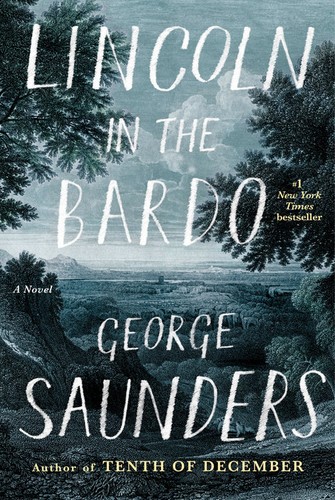
Lincoln in the Bardo by George Saunders is a 2017 literary fiction book about grief and loss, acceptance of death, history and myth. The bardo's ghosts cling to life through elaborate self-deception — Vollman believes he is in a 'sick box,' Bevins that he is simply ill. The novel uses this to examine how long we deny what we already know.
Summary
Lincoln in the Bardo takes place over a single night in February 1862, when President Abraham Lincoln visits the crypt where his eleven-year-old son Willie has just been buried. The "bardo" of the title is the Tibetan Buddhist concept of an intermediate state between death and rebirth, and Saunders populates it with the ghosts of the dead who occupy Oak Hill Cemetery in Georgetown — souls who have not yet accepted that they are dead, clinging to their former lives with increasingly baroque self-deceptions. Into this congregation of the unquiet dead comes the grief of a father who cannot bring himself to leave his son.
The novel is structured in hundreds of short sections, alternating between the voices of three main ghost narrators — Hans Vollman, Roger Bevins III, and the Reverend Everly Thomas — and passages of historical quotation assembled from real and invented sources about Lincoln's life, the party he held the night Willie fell ill, and the war consuming the country. The form is deliberately disorienting, especially at first: you are reading a crowd of voices interrupting each other, providing commentary on events, disagreeing about what they saw. It reads less like a novel than like the transcription of a haunting.
The structural weirdness is not a gimmick. Saunders uses it to argue something about how history is assembled — from competing accounts, selective memories, and the testimony of unreliable observers — and something about the nature of grief, which is also collective, also a babel of competing claims on the dead. The book won the Man Booker Prize in 2017 and generated some of the most divided reviews of any prize-winning novel in recent memory: some critics found it a masterpiece; others found the formal experimentation ultimately exhausting.
It is genuinely hard to read. The first fifty pages are the most disorienting, and readers who power through them are rewarded with one of the most emotionally overwhelming set pieces in recent fiction: Lincoln holding his dead son's body in the crypt while the ghosts, experiencing his grief through his skin, begin to understand something about acceptance. Those who bounce off the form in the first act will not recover their footing later. But for readers willing to meet Saunders on his own terms, this is a book unlike anything else.
Talk to Lincoln in the Bardo like its author wrote you back.
Get the ideas that fit your life — not generic summaries.
- Chat with the book
- Audiobook-style main ideas
- Adapts to your life and goals
- Helps you take action
Key takeaways
- 1.
The bardo's ghosts cling to life through elaborate self-deception — Vollman believes he is in a 'sick box,' Bevins that he is simply ill. The novel uses this to examine how long we deny what we already know.
- 2.
Lincoln's grief is amplified and contextualized by the mass grief of the Civil War, which the novel insists he must hold simultaneously with his private loss.
- 3.
The historical pastiche sections undercut the idea of a single authoritative account of Lincoln — every source contradicts every other, and the 'real' Lincoln emerges from the aggregate noise.
- 4.
Saunders treats the moment of acceptance — of death, of loss, of limitation — as the central moral act, one that requires more courage than fighting or resisting.
- 5.
The novel is funny in ways that should not work alongside its subject matter. The ghosts' misapprehension of their situation has a dark comedy that cuts the grief without defusing it.
- 6.
The collective narration — hundreds of voices commenting on the same event — is a formal argument that consciousness is never individual, that we are always constituted by the voices around us.
- 7.
Willie's choice, ultimately, is about love for his father. The novel suggests that letting go is an act of love rather than abandonment.
- 8.
Saunders returns repeatedly to the question of what public figures owe private grief, and whether Lincoln's ability to hold both is a measure of greatness or a form of damage.
Discussion questions
Use these on your own, with a book club, or as chat starters in Superbook. Book club version, ready to copy or print →
- 1.
The novel's form — hundreds of short sections, competing historical accounts, ghost narrators who are unreliable — is unlike most fiction. Did the structure serve the emotional content for you, or did it get in the way?
- 2.
The ghosts in the bardo believe they are not dead and develop elaborate explanations for their situation. What does Saunders seem to be saying about how people deal with unwanted truths in general?
- 3.
Lincoln is portrayed both through the ghosts' direct experience of him and through a collage of real and invented historical quotations that often contradict each other. What picture of Lincoln emerges? Is it sympathetic?
- 4.
The Civil War is a constant presence — the casualty lists, the wounded at field hospitals, the weight of the nation's dead. How does Saunders balance Lincoln's private grief with this larger grief?
- 5.
Hans Vollman and Roger Bevins III are the novel's most developed ghost narrators. What do they want from their lingering in the bardo, and what prevents them from leaving?
- 6.
The Reverend Everly Thomas suspects, unlike the others, that the bardo may not be a temporary stop. What does this knowledge do to him, and what does the novel do with his doubt?
- 7.
Saunders inserts real historical quotations alongside invented ones, often without signaling which is which. Does this seem like a responsible thing to do with Lincoln's historical legacy, or does it unsettle you?
- 8.
The novel has a strong claim that grief should not be privatized — that Lincoln's grief for Willie and his grief for the war's dead are the same grief. Do you buy that argument?
- 9.
The ending involves Willie making a choice. Was that choice earned by the novel, or did it feel like a sentimental resolution to a formally difficult book?
- 10.
Several critics found the novel's ending conventionally emotional after its formally experimental beginning. Do you think the ending is a betrayal of the novel's ambitions or a fulfillment of them?
- 11.
The ghosts in the bardo are sorted by their particular attachments — to sex, to status, to unfinished business. Which ghost's attachment seemed most comprehensible to you, and why?
- 12.
Saunders has written mostly short stories before this novel. Where do you feel the short-story instinct most clearly — and does it help or hurt the novel's cumulative effect?
Themes
Frequently asked questions
-
Is Lincoln in the Bardo worth reading?
Yes, but you should know what you're getting into. The first fifty pages are demanding — the form is disorienting by design. Readers who push through are typically rewarded with an experience unlike any other recent novel. Readers who need a conventional narrative will struggle throughout.
-
Is Lincoln in the Bardo hard to read?
The prose itself is not hard, but the structure is genuinely unusual. Hundreds of short sections alternate between ghost narrators, historical quotations, and direct scene. The first act requires you to build a mental model of the form before it starts to feel natural. Most readers report the difficulty fading by around page 80.
-
What is the bardo?
A concept from Tibetan Buddhism referring to an intermediate state between death and rebirth. Saunders uses it loosely to create a liminal space where the recently dead linger, not yet ready or willing to move on. You don't need to know anything about Buddhism to follow the novel.
-
Who shouldn't read Lincoln in the Bardo?
Readers who are currently in acute grief may find it too much. The novel is emotionally overwhelming in places, particularly in its treatment of parental loss. Also not suitable for readers who need plot and forward momentum — the entire novel takes place over one night and is more meditation than story.
-
Did Lincoln really visit his son's crypt?
There are historical accounts suggesting Lincoln visited the crypt multiple times after Willie's death, though the details are disputed. Saunders takes this as a premise and builds outward from it, mixing documented history with invented testimony in ways the novel does not always flag.