Health · Book club
Lost Connections book club questions
Here are 12 book club questions for Lost Connections by Johann Hari, ordered to open easily and end somewhere worth arguing about. Copy them, print them, or bring them up one at a time.
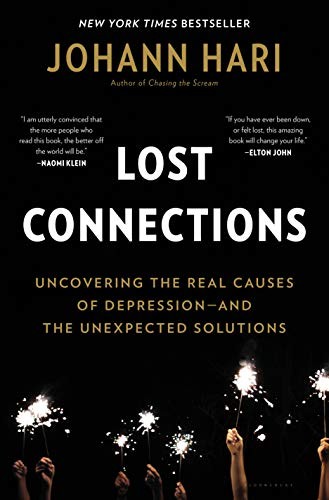
Lost Connections is Johann Hari's argument that depression and anxiety are not primarily chemical imbalances in the brain but responses to social and environmental conditions — disconnection from meaningful work, close relationships, the natural world, a secure future, and status that feels deserved.
Johann Hari · 2018 · 6h 0m
Full summary and key takeaways →The 12 questions
- 1.
Hari argues that antidepressants have been oversold and their efficacy overstated. How does that change how you think about the role of medication in treating depression?
- 2.
He identifies nine social causes of depression. Which of the nine do you think is most underrecognized in public mental health conversations? Which feels most present in your own life?
- 3.
The book argues that depression is often a signal that something needs to change rather than a malfunction to be suppressed. Is that reframing empowering or does it risk adding guilt to an already painful condition?
- 4.
Hari is a journalist making an argument, not a clinician or researcher. How does that affect your confidence in his synthesis of the evidence?
- 5.
He covers social prescribing — doctors prescribing community activities rather than or alongside medication. Does that model seem viable in the healthcare systems you're familiar with?
- 6.
The book argues that economic insecurity and work conditions drive depression at the population level. Does mental health conversation in your experience address those structural determinants?
- 7.
Hari writes from personal experience with depression and antidepressants. Does that personal stake make the book more or less trustworthy as an account of the science?
- 8.
He covers the natural world's effects on mental health. How much time do you spend in nature, and does the evidence about its effects make you want to prioritize it differently?
- 9.
The critics of the book argue that Hari is too dismissive of antidepressants and that his account of the serotonin theory is a strawman. How do you evaluate that critique?
- 10.
Lost Connections calls for collective responses to what it frames as collective problems. Is that politically realistic, or does it shift responsibility away from individuals in ways that don't help people struggling now?
- 11.
Which of the reconnections Hari proposes — to people, to meaningful work, to the natural world, to a hopeful future — seems most achievable for you right now?
- 12.
The book covers how strong social bonds protect against depression even in adverse circumstances. What would strengthening your own social connections actually require?
How to run the discussion
- Pick six to eight, not all of them. An hour of real discussion covers fewer questions than anyone expects, and racing the list is what makes a book club feel like homework.
- Open with what people noticed, not what they concluded. Asking for a verdict first hardens opinions before anyone has heard each other.
- Let the disagreement run. The questions below that split a room are the ones worth the time; the ones everyone answers the same way can be skipped.
- Ask the quiet person a specific question. A direct, narrow question is far easier to answer than an open invitation to contribute.
Themes worth steering toward
If the conversation stalls, these are the threads that usually restart it.
Common questions
What are good book club questions for Lost Connections?
Here are 12 book club questions for Lost Connections by Johann Hari, ordered to open easily and end somewhere worth arguing about. The strongest openers ask what each reader noticed rather than what they concluded, and the discussion usually turns on depression, social connection, mental health.
How long should a book club discussion of Lost Connections last?
Most groups run 60 to 90 minutes of actual discussion. That is roughly six to eight questions, not all of them, so pick the ones that suit your group rather than working down the list in order.
What are the main themes in Lost Connections?
Depression, Social connection, Mental health, Modern society, Antidepressants. Those are the threads most likely to divide a room, which makes them the useful places to steer a discussion that has gone quiet.
Picking the next one? See books like Lost Connections or questions for other book club picks.
