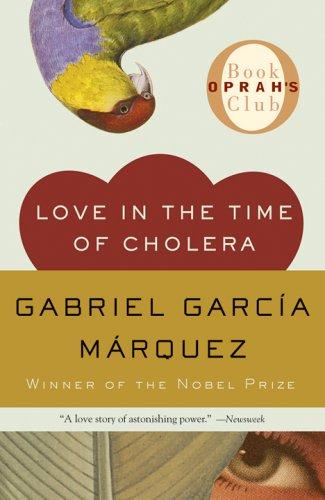
Love in the Time of Cholera by Gabriel García Márquez is a 1985 literary fiction book about love and obsession, aging and time, desire versus contentment. Florentino's obsession with Fermina is simultaneously the most romantic thing in the novel and a kind of refusal to live. The hundreds of affairs he has while 'waiting' complicate the devotion he claims to feel.
Summary
Love in the Time of Cholera begins with the death of Dr. Juvenal Urbino, a distinguished physician in a Caribbean port city in the early twentieth century. At his funeral, Florentino Ariza — now an elderly river-company executive — approaches the widow Fermina Daza and tells her he has waited fifty-three years, seven months, and eleven days for this moment to revive his declaration of love. Fermina, who rejected him for Urbino half a century ago, sends him away in contempt. The novel then moves backward to their youthful romance and the long arc of both their lives — Florentino's decades of waiting, his hundreds of transient affairs, and the marriage between Fermina and Urbino that was complicated, durable, and quietly profound.
The novel is a book about love in all its forms simultaneously: the romantic obsession of youth, the slow-accumulated intimacy of a long marriage, the erotic hunger of the aging body, the self-deception that sustains longing across decades. García Márquez treats Florentino's fifty-three-year vigil as both romantic devotion and pathology, and he refuses to resolve that ambiguity simply. Urbino's marriage to Fermina is presented with equal complexity — not passion but a kind of love that builds through habit, irritation, and profound mutual knowledge.
The prose is warmer and more accessible than One Hundred Years of Solitude — more novelistic in the traditional sense, following characters we can track, in a time and place we can locate. The Caribbean city (modeled on Cartagena) is rendered with sensory richness. The treatment of sex and aging is frank without prurience; García Márquez writes the desires of elderly people as unremarkable facts, which was somewhat unusual in 1985 and remains unusual now.
This is the García Márquez novel most often described as "a love story," but that framing undersells it. It is a novel about what love actually looks like across a full human life — which turns out to be less romantic than Florentino believes and less rational than Urbino assumes. Readers who find magical realism disorienting will find this easier entry. Those who want the full mythic scope of One Hundred Years will find this smaller and more intimate, which is either a limitation or a virtue depending on what you want.
Talk to Love in the Time of Cholera like its author wrote you back.
Get the ideas that fit your life — not generic summaries.
- Chat with the book
- Audiobook-style main ideas
- Adapts to your life and goals
- Helps you take action
Key takeaways
- 1.
Florentino's obsession with Fermina is simultaneously the most romantic thing in the novel and a kind of refusal to live. The hundreds of affairs he has while 'waiting' complicate the devotion he claims to feel.
- 2.
The Urbino-Fermina marriage is the novel's counter-argument to romantic love: less exciting, more true, built on decades of friction and accommodation that produces something deeper than passion.
- 3.
García Márquez treats aging desire without apology. Florentino's seventy-year-old body still wants; the novel refuses to treat this as comic or pathetic.
- 4.
Cholera and lovesickness produce the same symptoms — the novel's title isn't just atmosphere but an argument: that romantic love is a disease with its own fevers and rationalizations.
- 5.
Memory in the novel is selective and self-serving. Florentino's preserved love for Fermina has been built partly on fantasy; the woman he loves for fifty years is partly his own construction.
- 6.
The novel resists the neat resolution of the romantic comedy: getting the girl at the end does not mean everything was worth it, or that the cost was proportionate.
- 7.
Fermina is the novel's least fully interiored character — we see her mostly from outside — which is either a critique of how men love (loving an image rather than a person) or a limitation of the novel's perspective.
- 8.
The river journey at the end, under a quarantine flag, suspends the characters outside ordinary time. García Márquez uses this to ask: what does love mean when there is nowhere left to go?
Discussion questions
Use these on your own, with a book club, or as chat starters in Superbook. Book club version, ready to copy or print →
- 1.
Florentino waits fifty-three years for Fermina while having sex with hundreds of other women. Is he faithful, unfaithful, or neither? Does the novel pass judgment?
- 2.
The Urbino marriage is presented with real complexity — petty quarrels, infidelity, affection, mutual dependence. Was it a good marriage? Was it a better model of love than Florentino offers?
- 3.
García Márquez writes elderly desire without irony. Did it feel true to you, or did it require suspension of disbelief?
- 4.
Fermina is the object of the novel more than its subject. Is she a fully realized character, or does she exist mostly as the mirror for the men's projections?
- 5.
Cholera and love share symptoms in the novel. Is this a metaphor, a joke, or both? What does García Márquez gain by linking them?
- 6.
Florentino tells Fermina 'I have waited for this opportunity for more than half a century.' Is that the most romantic line in the novel, or the most disturbing?
- 7.
The ending is deliberately inconclusive — the boat can't dock anywhere. What is García Márquez saying about where love ends up?
- 8.
Urbino's fatal fall from a ladder trying to catch his parrot is treated as almost farcical. What does that death do to our sense of Urbino as a character and to Fermina's grief?
- 9.
Compared to One Hundred Years of Solitude, this novel is more intimate and less mythic. Does the shift in scale feel like a gain or a loss?
- 10.
Which version of love in this novel — Florentino's romantic obsession, Urbino's companionate marriage, Florentino's transient affairs — feels most honest about how love actually works?
- 11.
The novel is set in a period of recurring cholera epidemics. How does the disease's background presence change the atmosphere?
- 12.
How does this novel hold up as a portrait of love compared to what you've experienced or observed yourself?
Themes
Frequently asked questions
-
Is Love in the Time of Cholera a good love story?
It depends on what you want from a love story. It is deeply romantic in one register and deeply ambivalent in another. It doesn't deliver the clean emotional resolution of a romance novel. What it offers is a long meditation on what love actually looks like across a full life — which is more interesting and more unsettling than a happy ending.
-
Is this easier to read than One Hundred Years of Solitude?
Yes. There are no repeated names, the timeline is more linear, and the cast is smaller. The prose is warm and sensory. Most readers find it significantly more accessible, which makes it a better starting point for García Márquez.
-
What is the cholera in the title?
Cholera is a recurring epidemic in the novel's Caribbean setting, and it also works as a metaphor: the symptoms of cholera and the symptoms of lovesickness are identical in the novel. The title implies that romantic love is a kind of disease — feverish, irrational, sometimes fatal.
-
Who shouldn't read this book?
Readers who find the premise of an elderly man pursuing a woman who rejected him creepy may not warm to Florentino. The novel asks you to hold ambivalence about him throughout. Those who want a clear romantic hero or a conventionally happy resolution will be frustrated.
-
Has it been adapted for film?
Yes. A 2007 film directed by Mike Newell, starring Javier Bardem as Florentino Ariza, received mixed reviews. Most critics felt it captured the novel's surface beauty but not its interior complexity.