Science · Book club
Mathematics: Its Content, Methods and Meaning book club questions
Here are 12 book club questions for Mathematics: Its Content, Methods and Meaning by Aleksandrov, Kolmogorov & Lavrent'ev, ordered to open easily and end somewhere worth arguing about. Copy them, print them, or bring them up one at a time.
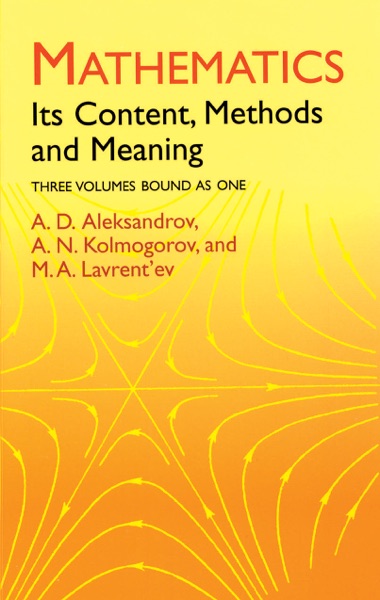
Mathematics: Its Content, Methods and Meaning is a three-volume survey of mathematics compiled by a group of eminent Soviet mathematicians, originally published in Russian in 1956 and translated into English by the American Mathematical Society in 1963.
Aleksandrov, Kolmogorov & Lavrent'ev · 1963 · 30h 0m
Full summary and key takeaways →The 12 questions
- 1.
The editors argue that mathematics should be understood as a whole, not as isolated techniques. Do you find that aspiration realistic for a working scientist or engineer, or is specialization inevitable?
- 2.
Kolmogorov's sections on probability theory helped establish it as a rigorous branch of mathematics rather than applied common sense. Why did that formalization matter, and what did it cost?
- 3.
The work was originally written in the Soviet Union in the 1950s. Does the intellectual tradition of the authors — committed to both rigor and philosophical engagement — differ from the Western mathematical tradition you're familiar with?
- 4.
Richard Feynman reportedly admired this work. What do you think a physicist would find here that standard physics education doesn't provide?
- 5.
The book is three volumes and 1,400 pages. Is that scope a strength or an obstacle? What would a shorter version lose?
- 6.
The writing quality varies by contributor. Which sections did you find most accessible, and which most demanding? Does that variation itself tell you something about the fields they cover?
- 7.
The relationship between pure and applied mathematics is a recurring theme. Can you think of a recent example where abstract mathematics found an unexpected application?
- 8.
The book treats the philosophy of mathematics — what mathematics is, whether mathematical objects exist — as a serious subject. Is that a question you find interesting, or does it feel like a distraction from actual mathematics?
- 9.
Mathematics was written during the Cold War by Soviet mathematicians for a Soviet audience. Are there ways in which the ideological context shaped the presentation?
- 10.
The sections on foundations — set theory, mathematical logic — address paradoxes that undermined naive intuitions about infinity. Has encountering those paradoxes changed how you think about mathematical certainty?
- 11.
How does reading a comprehensive survey like this compare to learning mathematics through a more specialized text or a course? What does breadth provide that depth doesn't?
- 12.
If you were to recommend one chapter of this work to a non-mathematician, which would it be and why?
How to run the discussion
- Pick six to eight, not all of them. An hour of real discussion covers fewer questions than anyone expects, and racing the list is what makes a book club feel like homework.
- Open with what people noticed, not what they concluded. Asking for a verdict first hardens opinions before anyone has heard each other.
- Let the disagreement run. The questions below that split a room are the ones worth the time; the ones everyone answers the same way can be skipped.
- Ask the quiet person a specific question. A direct, narrow question is far easier to answer than an open invitation to contribute.
Themes worth steering toward
If the conversation stalls, these are the threads that usually restart it.
Common questions
What are good book club questions for Mathematics: Its Content, Methods and Meaning?
Here are 12 book club questions for Mathematics: Its Content, Methods and Meaning by Aleksandrov, Kolmogorov & Lavrent'ev, ordered to open easily and end somewhere worth arguing about. The strongest openers ask what each reader noticed rather than what they concluded, and the discussion usually turns on mathematics, logic, history of science.
How long should a book club discussion of Mathematics: Its Content, Methods and Meaning last?
Most groups run 60 to 90 minutes of actual discussion. That is roughly six to eight questions, not all of them, so pick the ones that suit your group rather than working down the list in order.
What are the main themes in Mathematics: Its Content, Methods and Meaning?
Mathematics, Logic, History of science, Mathematical structure, Foundations. Those are the threads most likely to divide a room, which makes them the useful places to steer a discussion that has gone quiet.
Picking the next one? See books like Mathematics: Its Content, Methods and Meaning or questions for other book club picks.
