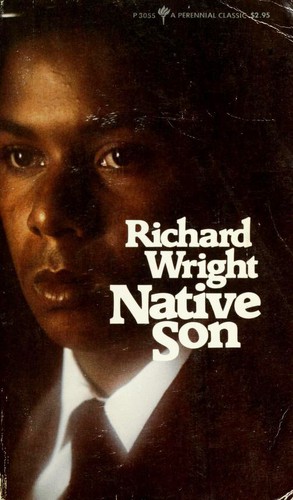
Native Son by Richard Wright is a 1940 literary fiction book about racism and structural violence, fear and rage, identity and dehumanization. Wright argues that Bigger's violence is the logical outcome of a society that systematically denied him every other form of self-expression — this is not an exculpation but an indictment.
Summary
Richard Wright's 1940 novel opens on a rat. Bigger Thomas, a twenty-year-old Black man in Depression-era Chicago, kills a rat with a skillet in the one-room apartment he shares with his mother and siblings. It's the first of many killings in the book, and Wright intends the parallel to be uncomfortable. Bigger has been offered a job as chauffeur for the Dalton family, wealthy white liberals whose philanthropy and racism occupy the same easy conscience. What follows in Book One ("Fear") builds with cold inevitability toward an act of violence that destroys Bigger's life and the lives of people around him.
Wright's argument, developed most explicitly through the Communist lawyer Max's courtroom speech in Book Three, is that Bigger Thomas is not a monster but a product — that a society that denies a person humanity, education, aspiration, and safety should not be surprised when that person expresses himself through violence. This is a deliberately uncomfortable thesis, and Wright doesn't soften it. Bigger is not sympathetic in the conventional sense. He lies, he is cruel, he terrorizes people he claims to care about. Wright insists that understanding him is not the same as forgiving him.
The novel was the first book by a Black author to be a Book-of-the-Month Club main selection, and it sold 215,000 copies in three weeks — extraordinary for 1940. Its power comes from Wright's willingness to occupy Bigger's interiority without distancing himself, to show us the world as Bigger experiences it: a world of white faces and closed doors where his choices are constrained before he makes them. The prose is naturalist and deliberate, closer to Dreiser than to Hurston, and some sections feel padded — particularly Max's speech, which runs long.
This is a hard book. It is supposed to be. Readers who want to understand the rage that runs through twentieth-century Black American writing — and why Wright found Hurston's folk warmth politically inadequate — need to read this. Those who want comfort or redemption won't find it here, and that's the point.
Talk to Native Son like its author wrote you back.
Get the ideas that fit your life — not generic summaries.
- Chat with the book
- Audiobook-style main ideas
- Adapts to your life and goals
- Helps you take action
Key takeaways
- 1.
Wright argues that Bigger's violence is the logical outcome of a society that systematically denied him every other form of self-expression — this is not an exculpation but an indictment.
- 2.
The Dalton family's liberalism is treated as a form of blindness: their philanthropy coexists with owning the slums Bigger's family lives in. Wright is harsh on well-meaning white people.
- 3.
Bigger experiences a perverse sense of freedom after the killing — the act, however terrible, is the first choice he has made that no one else scripted for him.
- 4.
Max's courtroom speech is Wright's most direct political statement in the novel, arguing that American society created Bigger Thomas and then prosecuted him for being what it made him.
- 5.
The novel was a direct challenge to the Harlem Renaissance's tradition of presenting Black subjects in ways palatable to white literary taste.
- 6.
Naturalism shapes the structure: Bigger's choices are conditioned by environment to such a degree that the novel raises hard questions about free will and moral responsibility.
- 7.
The three-part structure — Fear, Flight, Fate — maps onto Bigger's psychological states as much as his physical circumstances.
- 8.
Wright's own experience of the Great Migration, growing up in Mississippi and moving North, grounds the novel in observed reality rather than abstraction.
Discussion questions
Use these on your own, with a book club, or as chat starters in Superbook. Book club version, ready to copy or print →
- 1.
Wright presents Bigger as a product of his environment without asking us to like him. Is that a defensible artistic choice, or does it undermine the novel's moral case?
- 2.
The Dalton family is both liberal and exploitative — they donate to Black organizations while owning the buildings Black families rent. Is Wright's portrait of them fair, or is it a caricature?
- 3.
Max argues that society created Bigger Thomas. After reading his speech, do you find that argument compelling? Does the novel as a whole support it or complicate it?
- 4.
Bigger tells Jan and Mary that he doesn't hate white people, he's just scared. What distinction is Wright making between fear and hatred, and why does it matter?
- 5.
The killing of Mary Dalton is accidental in a specific sense — but Wright doesn't treat it as random. What does the accident reveal about the structure of the situation Bigger is in?
- 6.
James Baldwin criticized Native Son for making Bigger Thomas a symbol rather than a person — for reducing him to his circumstances. Having read the novel, do you think that criticism is accurate?
- 7.
How does the rat in the opening scene function once you've finished the book? Is it too heavy-handed, or does Wright earn the parallel?
- 8.
Bigger's relationship with Bessie — and what he does to her — is one of the most disturbing parts of the novel. How does it affect your reading of his character and Wright's argument?
- 9.
The novel was published in 1940 and sold immediately and widely. What does that tell us about what white American readers in 1940 were willing to see?
- 10.
Wright and Hurston publicly disagreed about what Black literature should do. Having read both (or at least knowing their positions), whose argument seems more right to you?
- 11.
The ending refuses redemption. Was that the right choice artistically? What would it mean for the novel if Bigger had a moment of genuine remorse or insight?
- 12.
The novel is set in Chicago but its roots are in the Deep South. How does the geography of the Great Migration shape what the novel is about?
Themes
Frequently asked questions
-
Is Native Son still worth reading?
Yes, though it demands something from the reader. Its argument about structural racism and the conditions that produce violence remains uncomfortable and relevant. The prose is naturalist and methodical rather than beautiful, but Wright's unflinching commitment to his thesis gives the book its power.
-
Is Native Son hard to read?
Emotionally more than technically. The prose is clear, but the events are brutal and Wright withholds the usual novelistic consolations. The courtroom section in Book Three is the densest and slowest part of the book.
-
What is the relationship between Native Son and Their Eyes Were Watching God?
Wright reviewed Hurston's novel negatively in 1937, criticizing its folk humor and lack of political engagement. The two books represent opposite poles of 1930s Black American literature — Hurston interested in interior life and community, Wright interested in structural oppression and its consequences.
-
Is there a film adaptation?
Two. A 1951 film starred Wright himself as Bigger Thomas. A 2019 film directed by Rashid Johnson starred Ashton Sanders. Neither is definitive; the 2019 version modernizes the setting.
-
Who shouldn't read this book?
Readers looking for a redemptive arc or a sympathetic protagonist in the conventional sense will be frustrated. The novel is deliberately bleak, and its violence — particularly toward Bessie — is disturbing. Wright intends discomfort as the point.
Similar books
Between the World and Me
Ta-Nehisi Coates
The Fire Next Time
James Baldwin
Just Mercy: A Story of Justice and Redemption
Bryan Stevenson
The New Jim Crow: Mass Incarceration in the Age of Colorblindness
Michelle Alexander
