Talk to Negotiating the Impossible like its author wrote you back.
Get the ideas that fit your life — not generic summaries.
- Chat with the book
- Audiobook-style main ideas
- Adapts to your life and goals
- Helps you take action
Negotiating the Impossible, in detail
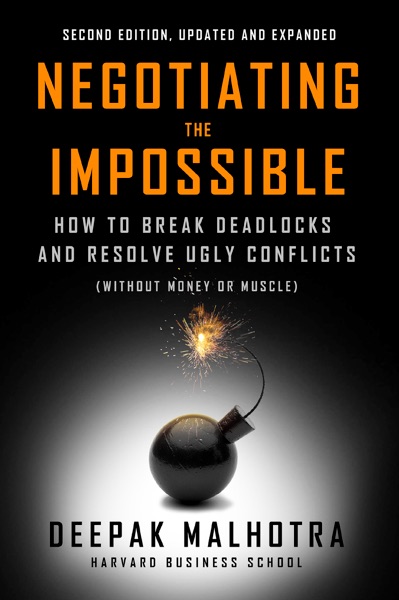
Deepak Malhotra is a professor at Harvard Business School who has spent decades studying how people resolve conflicts that appear completely intractable. Negotiating the Impossible draws on historical case studies — the end of the Cuban Missile Crisis, the negotiations that concluded the US Civil War, the settlement of labor strikes, the peace deals after major wars — to extract principles that apply to any high-stakes negotiation.
The book's organizing claim is that negotiators who succeed in seemingly impossible situations almost always use one of three approaches: they reframe the problem so the other side can say yes without losing face; they shift who is at the table and on what terms; or they use process and sequencing strategically rather than jumping to the substance. Malhotra calls these the three levers — framing, process, and empathy — and illustrates each with multiple cases where negotiators either discovered them accidentally or deployed them with skill.
One of the book's best-running examples is the end of the baseball players' strike in 1994–95. Malhotra traces how the stalemate ended not through concessions on substance but through a reframing of how the dispute would be resolved. The same pattern recurs in the 1962 Cuban Missile Crisis, where Kennedy and Khrushchev found a way to de-escalate that let both sides claim they had not capitulated. Malhotra's argument is that ego and face-saving are not irrational noise in negotiation — they are often the central variable.
The book is aimed at practitioners more than theorists. Each chapter ends with clear principles drawn from the case. The cases themselves range from labor negotiations to diplomatic history, which makes the book unusually broad. Readers looking for a systematic framework may find it less structured than Getting to Yes, but the historical depth gives the principles more texture. Malhotra is particularly good on the role of process — when to go slow, when to build in ambiguity, when to sequence concessions — which most negotiation books treat as secondary.
The big ideas
- 1.
Framing matters as much as substance. A deal that fails because the other side can't accept it without losing face often succeeds if you reframe what accepting it means.
- 2.
Process is a negotiation tool. How and when you discuss issues — the sequence, the forum, the pace — can unlock agreements that direct bargaining over substance cannot reach.
- 3.
Empathy is not softness. Understanding why the other side needs what they say they need, rather than just what they are asking for, is how you find solutions that satisfy both parties without either making unnecessary concessions.
