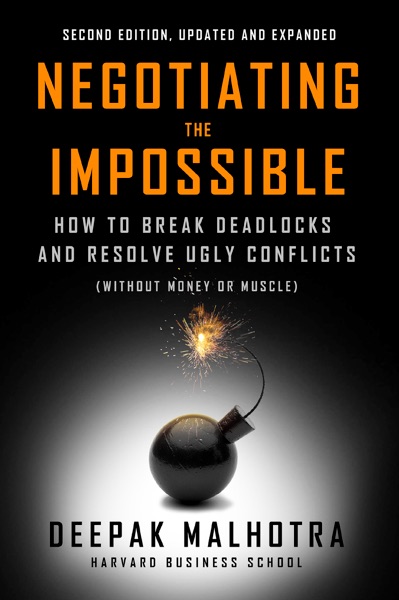
Negotiating the Impossible by Deepak Malhotra is a 2016 business book about negotiation, conflict resolution, strategy. Framing matters as much as substance. A deal that fails because the other side can't accept it without losing face often succeeds if you reframe what accepting it means.
Summary
Deepak Malhotra is a professor at Harvard Business School who has spent decades studying how people resolve conflicts that appear completely intractable. Negotiating the Impossible draws on historical case studies — the end of the Cuban Missile Crisis, the negotiations that concluded the US Civil War, the settlement of labor strikes, the peace deals after major wars — to extract principles that apply to any high-stakes negotiation.
The book's organizing claim is that negotiators who succeed in seemingly impossible situations almost always use one of three approaches: they reframe the problem so the other side can say yes without losing face; they shift who is at the table and on what terms; or they use process and sequencing strategically rather than jumping to the substance. Malhotra calls these the three levers — framing, process, and empathy — and illustrates each with multiple cases where negotiators either discovered them accidentally or deployed them with skill.
One of the book's best-running examples is the end of the baseball players' strike in 1994–95. Malhotra traces how the stalemate ended not through concessions on substance but through a reframing of how the dispute would be resolved. The same pattern recurs in the 1962 Cuban Missile Crisis, where Kennedy and Khrushchev found a way to de-escalate that let both sides claim they had not capitulated. Malhotra's argument is that ego and face-saving are not irrational noise in negotiation — they are often the central variable.
The book is aimed at practitioners more than theorists. Each chapter ends with clear principles drawn from the case. The cases themselves range from labor negotiations to diplomatic history, which makes the book unusually broad. Readers looking for a systematic framework may find it less structured than Getting to Yes, but the historical depth gives the principles more texture. Malhotra is particularly good on the role of process — when to go slow, when to build in ambiguity, when to sequence concessions — which most negotiation books treat as secondary.
Talk to Negotiating the Impossible like its author wrote you back.
Get the ideas that fit your life — not generic summaries.
- Chat with the book
- Audiobook-style main ideas
- Adapts to your life and goals
- Helps you take action
Key takeaways
- 1.
Framing matters as much as substance. A deal that fails because the other side can't accept it without losing face often succeeds if you reframe what accepting it means.
- 2.
Process is a negotiation tool. How and when you discuss issues — the sequence, the forum, the pace — can unlock agreements that direct bargaining over substance cannot reach.
- 3.
Empathy is not softness. Understanding why the other side needs what they say they need, rather than just what they are asking for, is how you find solutions that satisfy both parties without either making unnecessary concessions.
- 4.
The best negotiators expand the pie before dividing it. Looking for issues that matter differently to each party — tradeoffs both sides would actually prefer — is more reliable than arguing over a fixed resource.
- 5.
Face-saving is a rational constraint, not an irrational obstacle. Deals that ignore the other side's need to appear strong or principled to their own constituents tend to collapse in implementation even when they succeed in signing.
- 6.
Changing who is at the table changes what is possible. Back-channel conversations, the involvement of third parties, and changes in the level of seniority involved have repeatedly broken impossible deadlocks.
- 7.
Timing and sequencing of concessions matter enormously. A concession made too early reads as weakness; the same concession made after demonstrating resolve reads as generosity.
- 8.
Historical cases show that negotiators often don't know they have solved a problem until later. Building in ambiguity and allowing each side to interpret an agreement favorably can be a legitimate strategy, not a failure of clarity.
Discussion questions
Use these on your own, with a book club, or as chat starters in Superbook. Book club version, ready to copy or print →
- 1.
Malhotra argues that framing can unlock deals that substance cannot. Think of a negotiation or disagreement in your own life that failed. Was there a reframing that might have worked?
- 2.
The book makes a case that process is itself a strategic variable. In your experience, have you seen sequencing or timing determine the outcome of a negotiation more than the content of the offers?
- 3.
Malhotra treats face-saving as a rational constraint on the other side. When have you felt that constraint yourself — where you couldn't accept something you wanted because of what accepting it would signal?
- 4.
The three levers are framing, process, and empathy. Which one do you think you're weakest at, and why?
- 5.
The historical cases in the book often involve back-channels and secret conversations that ran parallel to formal negotiations. Is that kind of duality available to you in disputes you typically face?
- 6.
Malhotra says expanding the pie — finding tradeoffs both sides prefer — is more reliable than fighting over a fixed resource. Can you think of a recent conflict where this approach was available but not taken?
- 7.
The book argues that deadlines and constraints can create opportunities rather than just pressure. When has a real constraint helped you close a deal or resolve a disagreement you'd been stuck on?
- 8.
How do you distinguish between genuine empathy toward the other side and just being naive about their intentions? Malhotra treats these as distinct; what's the practical difference?
- 9.
The Cuban Missile Crisis case turns on Kennedy and Khrushchev finding a way to de-escalate without either appearing to back down. What role does ego typically play in negotiations you're involved in?
- 10.
Malhotra says some of the best deals involve strategic ambiguity — each side can interpret the outcome favorably. Is that honest? When does it help and when does it create future problems?
- 11.
Which historical case in the book do you find most applicable to something you're dealing with now, and why?
Themes
Frequently asked questions
-
How does Negotiating the Impossible compare to Getting to Yes?
Getting to Yes is more systematic and framework-driven; Negotiating the Impossible is more case-driven and historical. Malhotra's book assumes you already know the basics and focuses on the hardest cases — where standard principled negotiation isn't enough. They complement each other well.
-
Is Negotiating the Impossible worth reading?
Yes, especially if you've read the standard negotiation canon and want something more sophisticated. The historical cases are genuinely illuminating and Malhotra draws principles from them that apply to everyday negotiations, not just diplomatic crises.
-
What is the main idea of Negotiating the Impossible?
That seemingly intractable conflicts can almost always be broken with one of three tools: reframing the problem, changing the process or sequencing of negotiations, or deepening empathy for what the other side truly needs. Substance-level bargaining is often the least powerful lever.
-
Who should read this book?
Managers, lawyers, HR professionals, diplomats, and anyone who regularly has to reach agreement with resistant parties. The historical scope means it's also engaging for readers who aren't practitioners — the stories hold up on their own.
-
How long does it take to read Negotiating the Impossible?
About four to five hours at average reading pace. The chapters are case-study based and read quickly. It works well to read a case, pause, and think about where the principle applies before moving on.
Similar books
Never Split the Difference
Chris Voss
Getting to Yes: Negotiating Agreement Without Giving In
Roger Fisher and William Ury
Influence: The Psychology of Persuasion
Robert B. Cialdini
Thinking, Fast and Slow
Daniel Kahneman
