Talk to Never Split the Difference like its author wrote you back.
Get the ideas that fit your life — not generic summaries.
- Chat with the book
- Audiobook-style main ideas
- Adapts to your life and goals
- Helps you take action
Never Split the Difference, in detail
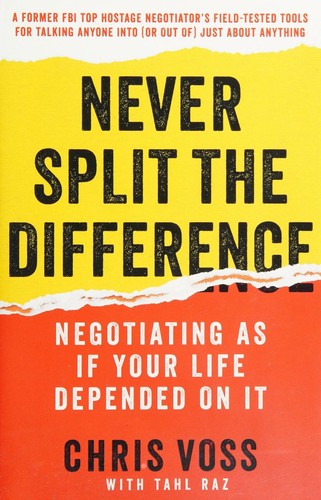
Never Split the Difference is Chris Voss's argument that the rational, compromise-based negotiation frameworks taught in business schools miss something fundamental about how people actually make decisions. Voss spent more than two decades as an FBI hostage negotiator, and the book draws on that career to make a case that emotion, not logic, is the engine of every negotiation — and that the tools for working with emotion are learnable.
The central techniques are clustered around active listening. Tactical empathy means demonstrating that you understand the other party's perspective, not necessarily agreeing with it. Mirroring — repeating the last few words someone says — keeps them talking and surfaces information. Labeling emotions ("It sounds like you're frustrated by this") neutralizes them rather than escalating them. Together these techniques create the paradox the book keeps returning to: the more thoroughly you make the other side feel heard, the more control you gain over the conversation.
Voss is skeptical of "yes." A quick yes can mean nothing. "No" is safer: it gives the other person a sense of control and opens a real negotiation. Calibrated questions — open-ended questions starting with "how" or "what" rather than "why" — force the other side to do the problem-solving work. The Ackerman model gives a precise system for price negotiation: set a target, start below it, and make a series of diminishing counter-offers at specific percentages. The final number should be odd to signal you've reached your limit.
The book has real limits worth naming. Many of the techniques assume a negotiation where you hold or can create leverage, and the FBI hostage scenarios that anchor each chapter are dramatic in ways that don't map cleanly onto salary talks or vendor contracts. Voss also has a tendency to present his methods as universal, where the evidence is mostly anecdotal. But the core insight — that skilled negotiators are primarily skilled listeners who control the emotional temperature of a conversation — is both well-argued and practically useful. The specific scripts and formulas give readers something to rehearse, which most negotiation books do not.
The big ideas
- 1.
Tactical empathy is not about agreeing with the other side. It means demonstrating you understand their perspective well enough that they feel genuinely heard — which gives you far more influence than a logical counterargument.
- 2.
Mirroring works because people are drawn to what is familiar. Repeat the last one to three words someone says, then stay silent. They almost always keep talking and reveal more than they intended.
- 3.
Labeling emotions defuses them. Saying 'It sounds like you're worried about the timeline' acknowledges a feeling without endorsing it, and the person usually confirms and elaborates rather than escalating.
