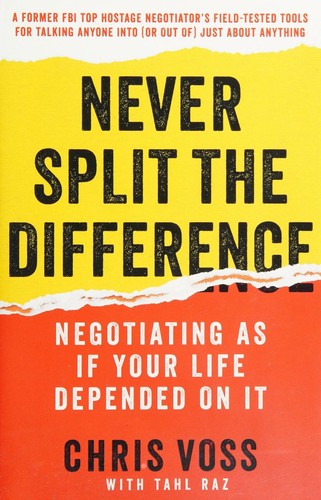
Never Split the Difference by Chris Voss is a 2016 business book about negotiation, persuasion, communication. Tactical empathy is not about agreeing with the other side. It means demonstrating you understand their perspective well enough that they feel genuinely heard — which gives you far more influence than a logical counterargument.
Summary
Never Split the Difference is Chris Voss's argument that the rational, compromise-based negotiation frameworks taught in business schools miss something fundamental about how people actually make decisions. Voss spent more than two decades as an FBI hostage negotiator, and the book draws on that career to make a case that emotion, not logic, is the engine of every negotiation — and that the tools for working with emotion are learnable.
The central techniques are clustered around active listening. Tactical empathy means demonstrating that you understand the other party's perspective, not necessarily agreeing with it. Mirroring — repeating the last few words someone says — keeps them talking and surfaces information. Labeling emotions ("It sounds like you're frustrated by this") neutralizes them rather than escalating them. Together these techniques create the paradox the book keeps returning to: the more thoroughly you make the other side feel heard, the more control you gain over the conversation.
Voss is skeptical of "yes." A quick yes can mean nothing. "No" is safer: it gives the other person a sense of control and opens a real negotiation. Calibrated questions — open-ended questions starting with "how" or "what" rather than "why" — force the other side to do the problem-solving work. The Ackerman model gives a precise system for price negotiation: set a target, start below it, and make a series of diminishing counter-offers at specific percentages. The final number should be odd to signal you've reached your limit.
The book has real limits worth naming. Many of the techniques assume a negotiation where you hold or can create leverage, and the FBI hostage scenarios that anchor each chapter are dramatic in ways that don't map cleanly onto salary talks or vendor contracts. Voss also has a tendency to present his methods as universal, where the evidence is mostly anecdotal. But the core insight — that skilled negotiators are primarily skilled listeners who control the emotional temperature of a conversation — is both well-argued and practically useful. The specific scripts and formulas give readers something to rehearse, which most negotiation books do not.
Talk to Never Split the Difference like its author wrote you back.
Get the ideas that fit your life — not generic summaries.
- Chat with the book
- Audiobook-style main ideas
- Adapts to your life and goals
- Helps you take action
Key takeaways
- 1.
Tactical empathy is not about agreeing with the other side. It means demonstrating you understand their perspective well enough that they feel genuinely heard — which gives you far more influence than a logical counterargument.
- 2.
Mirroring works because people are drawn to what is familiar. Repeat the last one to three words someone says, then stay silent. They almost always keep talking and reveal more than they intended.
- 3.
Labeling emotions defuses them. Saying 'It sounds like you're worried about the timeline' acknowledges a feeling without endorsing it, and the person usually confirms and elaborates rather than escalating.
- 4.
No is not a dead end. Voss argues that 'no' gives the other side a sense of control and begins a real negotiation, while a quick 'yes' often means nothing and closes off information.
- 5.
Calibrated questions — 'What is the biggest challenge you're facing here?' or 'How am I supposed to do that?' — put the problem-solving burden on the other side and reveal their constraints without confrontation.
- 6.
The Ackerman model gives a disciplined system for price negotiation: set a target price, start at 65% of it, then counter at 85%, 95%, and finally 100%, with each increment shrinking and the last number deliberately odd.
- 7.
Bending reality means anchoring the other side's reference point before numbers are discussed. Loss aversion is stronger than gain motivation, so framing a deal in terms of what they stand to lose is usually more persuasive than what they stand to gain.
- 8.
The most dangerous negotiating move is a compromise. Splitting the difference often leaves both sides with something that doesn't work for either of them, when a creative solution could have satisfied both parties' real needs.
Discussion questions
Use these on your own, with a book club, or as chat starters in Superbook. Book club version, ready to copy or print →
- 1.
Voss claims emotion drives every negotiation, even ones that look purely rational. Can you think of a recent disagreement where the emotional dynamic was actually doing more work than the stated facts?
- 2.
Tactical empathy requires accurately perceiving the other side's perspective, not just performing sympathy. What's the difference, and how would you know when you're doing one versus the other?
- 3.
When was the last time someone made you feel truly heard in a disagreement? What specifically did they do, and what effect did it have on your willingness to move?
- 4.
Voss is suspicious of 'yes' and thinks 'no' is often a healthier place to start. Does this match your experience in professional or personal negotiations?
- 5.
Think of a negotiation you handled badly. Which of Voss's techniques — mirroring, labeling, calibrated questions — might have changed the outcome, and how?
- 6.
The Ackerman model requires discipline: specific numbers, specific percentages, a deliberately odd final offer. Does following a rigid script feel manipulative to you, or just prepared?
- 7.
Voss argues that most people are either accommodators, asserters, or analysts in negotiation style. Which are you, and what does your style cost you?
- 8.
Many of the book's examples come from high-stakes hostage situations. How well do those lessons translate to the lower-stakes negotiations in your life — salary talks, contractor disputes, household decisions?
- 9.
Voss says skilled negotiators are primarily skilled listeners. What would change in your next difficult conversation if listening were the primary goal rather than making your case?
- 10.
The book argues against splitting the difference as a solution. Think of a past compromise you made. Was there an alternative that would have served both sides' underlying needs better?
- 11.
Calibrated questions are designed to make the other side solve your problem without feeling directed. Is there a situation in your professional life where that technique would be more useful than a direct request?
- 12.
Voss advocates being hard-nosed in ways that can feel uncomfortable for people who prize politeness or consensus. How do you think about the line between skilled negotiation and manipulation?
Themes
Frequently asked questions
-
Is Never Split the Difference worth reading?
Yes, particularly if you negotiate in professional settings and have found polite, compromise-oriented approaches leave you worse off. The techniques are specific and scriptable in a way that most negotiation books are not. If you're already well-read on behavioral psychology, some of the underlying science will feel familiar, but the application to negotiation is sharper than most.
-
How long does it take to read Never Split the Difference?
Around five hours at a normal reading pace for the 288-page book. The chapters are structured around a single technique each, which makes it easy to read in short sessions and practice one concept before moving to the next.
-
What is the main idea of Never Split the Difference?
Negotiation is not a logic problem. It's an emotional process, and the negotiator who understands and manages the emotional state of both parties will reach better outcomes than one who simply has the stronger rational case. Techniques like tactical empathy, mirroring, and calibrated questions are practical tools for doing that.
-
Who should read Never Split the Difference?
Anyone who negotiates regularly — in sales, procurement, management, or any role with a significant relationship-management component. It's also useful for anyone who struggles with conflict avoidance, as it reframes assertiveness as a form of respect rather than aggression.
-
What's the most actionable idea in the book?
Mirroring. Repeat the last two or three words someone says and then stay quiet. It costs nothing, keeps the conversation open, and surfaces information the other side wasn't planning to share. Most people can use it in the next conversation they have.
-
How does this book compare to Getting to Yes?
Getting to Yes is principled negotiation: focus on interests not positions, use objective criteria, separate people from problems. Voss thinks this is too rational. His approach treats emotion as the primary lever. The two books are compatible in practice but represent genuinely different theories of what negotiation is.
Similar books
Influence: The Psychology of Persuasion
Robert B. Cialdini
Thinking, Fast and Slow
Daniel Kahneman
How to Win Friends and Influence People
Dale Carnegie
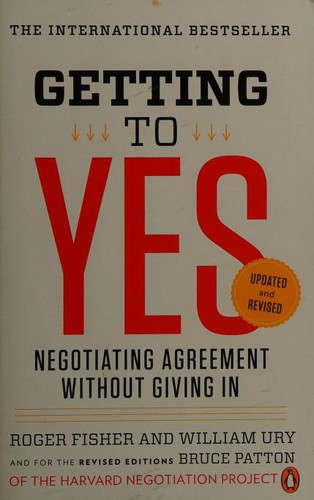
Getting to Yes: Negotiating Agreement Without Giving In
Roger Fisher and William Ury
Never Split the Difference vs.
Deciding between two books? Never Split the Difference vs How to Win Friends and Influence People .
