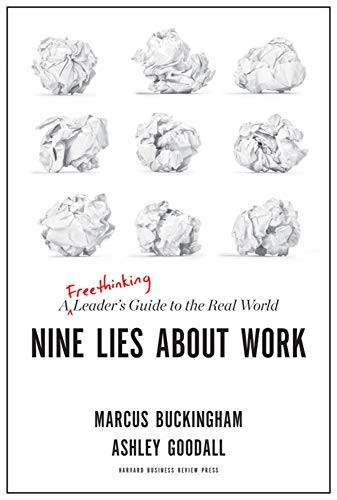
Nine Lies About Work by Marcus Buckingham and Ashley Goodall is a 2019 business book about management, employee engagement, strengths. Most performance ratings say more about the rater's own style and biases than about the person being rated — a phenomenon Buckingham and Goodall call the idiosyncratic rater effect.
Summary
Nine Lies About Work challenges nine assumptions that dominate how organizations are designed and managed — assumptions Buckingham and Goodall argue are not just wrong but actively harmful. The nine lies cover topics ranging from cascading goals and 360-degree feedback to the idea that people care which company they work for and that leadership is a coherent set of traits that can be assessed and developed uniformly.
The book's most provocative arguments concern performance management. Buckingham and Goodall attack the validity of most performance ratings, arguing that ratings reveal more about the rater than the person being rated — a phenomenon backed by their own research at Deloitte and ADP. The idea that a manager can objectively assess someone's competence against a standard is, they claim, largely fiction; what actually drives performance is the specific relationship between a team member and their direct manager, and whether that manager can see and deploy each person's unique strengths.
Several chapters focus on what the authors call the "real world of work": the experience of being on a small team whose members know and trust each other, where the specificity of that team — not the company's culture or values or brand — is what produces engagement and performance. They argue that HR's obsession with culture, alignment, and organizational-level interventions misses the fact that people's work experiences are almost entirely mediated by their immediate team and manager.
The writing is engaging and the research is selectively but convincingly deployed. Buckingham and Goodall are polemicists as much as analysts, and some of the nine "lies" are framed more sharply than the evidence strictly requires. But the arguments are substantive, and the challenge to standard HR orthodoxy — cascading goals, competency frameworks, 360-degree feedback, uniform leadership models — is worth engaging with seriously. The book is most valuable for HR professionals, senior leaders, and managers who want to understand why so much of what organizations do in people management doesn't seem to work.
Talk to Nine Lies About Work like its author wrote you back.
Get the ideas that fit your life — not generic summaries.
- Chat with the book
- Audiobook-style main ideas
- Adapts to your life and goals
- Helps you take action
Key takeaways
- 1.
Most performance ratings say more about the rater's own style and biases than about the person being rated — a phenomenon Buckingham and Goodall call the idiosyncratic rater effect.
- 2.
People don't primarily care which company they work for; they care about their team. Engagement is a team-level phenomenon, not an organization-level one.
- 3.
Cascading goals — translating organizational strategy into individual objectives — are a management ritual that rarely produces alignment in practice.
- 4.
360-degree feedback aggregates other people's ratings, which means it aggregates their idiosyncrasies. It measures something, but not what it claims to measure.
- 5.
The best teams are not defined by following the same playbook but by strong, stable relationships — members who know each other, trust each other, and feel safe taking risks.
- 6.
Leadership is not a universal set of traits or competencies that can be defined and developed the same way across all people. The most effective leaders are highly idiosyncratic.
- 7.
Strengths — patterns of thought and feeling that, when applied to specific tasks, produce near-perfect performance — are more predictive of excellence than the absence of weaknesses.
- 8.
The real driver of team performance is the frequency and quality of check-ins between a manager and team member, not annual reviews or formal feedback systems.
- 9.
Culture is too often used as an explanation for organizational performance when the actual mechanism is the specific practices and relationships at the team level.
Discussion questions
Use these on your own, with a book club, or as chat starters in Superbook. Book club version, ready to copy or print →
- 1.
Buckingham and Goodall say performance ratings reveal more about raters than ratees. Has your experience with performance reviews supported or challenged that claim?
- 2.
The book argues that engagement is a team-level phenomenon. How would your organization's approach to engagement change if it took that seriously?
- 3.
Which of the nine lies feels most embedded in your current organization, and what would it cost to stop believing it?
- 4.
The idiosyncratic rater effect suggests that 360-degree feedback is measuring rater style, not employee competence. What would you use instead to make people development decisions?
- 5.
Buckingham and Goodall argue that the best leaders are highly idiosyncratic, not paragons of some universal model. How does that sit with your organization's leadership development program?
- 6.
The book makes a distinction between work and the experience of work. Which lie, in your view, most damages the actual daily experience of the people in your organization?
- 7.
They argue that organizational culture is largely irrelevant to how people experience work — what matters is their immediate team. Do you believe that? What evidence do you have either way?
- 8.
Cascading goals are described as a ritual that rarely produces alignment. What alternative does your organization use, and how well does it actually work?
- 9.
The authors' research comes largely from Deloitte and ADP. What limitations does that sample impose on the book's claims?
- 10.
Which of the nine lies do you think is most fiercely defended by senior leaders in organizations you've worked in, and why?
- 11.
The book is polemical — the authors are making a case, not just reporting research. Which arguments feel most persuasively supported, and which feel most overstated?
- 12.
If you accepted all nine of the book's arguments, what would you stop doing in your organization tomorrow, and what would you start doing instead?
Themes
Frequently asked questions
-
Is Nine Lies About Work worth reading for HR professionals?
Yes, particularly for those designing or defending performance management systems, competency frameworks, or engagement surveys. Even if you disagree with some arguments, the challenge to standard practice is substantive and backed by real research. It's most useful as a provocation that forces you to articulate why you do what you do.
-
How long does it take to read Nine Lies About Work?
Around five hours. The chapters are self-contained and vary in density — some engage deeply with research, others are more discursive. Most readers find a handful of chapters particularly resonant and return to those, rather than re-reading the whole book.
-
What are the nine lies?
People care which company they work for; the best plan wins; the best companies cascade goals; the best people are well-rounded; people need feedback; people can reliably rate other people; people have potential; work-life balance matters most; leadership is a thing. Each is explored as an assumption that shapes management practice without adequate evidence.
-
Who should read Nine Lies About Work?
HR leaders, managers of managers, organizational psychologists, and anyone who has wondered why so much of what organizations do in people management seems to produce so little. Also useful for people who feel their annual review process is more ritual than useful, and want to understand why.
-
Is this book anti-management?
No — it's anti-orthodoxy. Buckingham and Goodall are arguing for management that pays more attention to the specifics of individuals and teams, and less attention to uniform systems applied from above. They believe good management matters enormously; they're skeptical of the tools most organizations use to produce it.
Similar books
First, Break All the Rules
Marcus Buckingham and Curt Coffman
Multipliers
Liz Wiseman
The Making of a Manager
Julie Zhuo
Drive: The Surprising Truth About What Motivates Us
Daniel H. Pink
