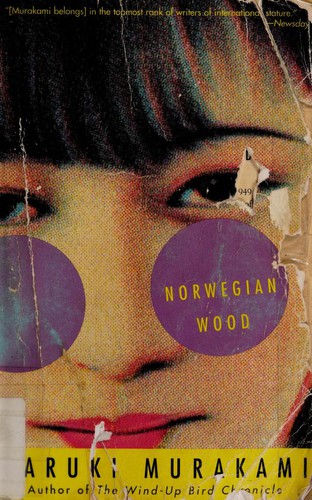
Talk to Norwegian Wood like its author wrote you back.
Get the ideas that fit your life — not generic summaries.
- Chat with the book
- Audiobook-style main ideas
- Adapts to your life and goals
- Helps you take action
What it argues
Norwegian Wood is Murakami's most straightforwardly realist novel and his most personal — a coming-of-age story set in late 1960s Tokyo, narrated by Toru Watanabe, who is recalling the year he was nineteen and the two women who shaped him. Naoko was the girlfriend of Toru's best friend Kizuki, who killed himself at seventeen. After Kizuki's death, Toru and Naoko find each other — not in the ordinary sense of falling together, but in the sense of two people who are each other's only witness to a grief no one else can share. Midori is almost Naoko's opposite: noisy, alive, demanding, funny, and deeply appealing in ways that feel like a threat to Toru's loyalty to the dead.
The novel is about grief as a landscape — the way loss can become a place you move into and eventually must decide whether to leave. Naoko is increasingly unable to function in the world; she retreats to a sanatorium in the mountains that Murakami renders as a kind of beautiful, still anteroom to disappearance. Toru visits her. He also keeps failing not to fall for Midori, which the novel frames as a moral problem even as it presents it as inevitable.
What it gets right
- 1.
Grief in Norwegian Wood is not a crisis but a climate — the novel captures the way loss can become the atmosphere you live in rather than an event you move through.
- 2.
Naoko's retreat from life is presented with sympathy but not romanticization: Murakami understands that depression and damage can look like depth, and he resists that confusion while also not denying its appeal.
- 3.
Midori is the novel's most fully alive character — demanding, funny, and moral in a way that has nothing to do with conventionality. She is what the world outside grief looks like.
What it covers
Who wrote it
Haruki Murakami was born in Kyoto in 1949 and studied drama at Waseda University. He ran a jazz bar in Tokyo before publishing his first novel in 1979. Norwegian Wood (1987) made him a literary celebrity in Japan. His other major novels include The Wind-Up Bird Chronicle, Kafka on the Shore, IQ84, and Killing Commendatore. His work blends Japanese literary tradition with American jazz, film noir, and European modernism. He is a perennial Nobel Prize contender and one of the most translated living authors.
