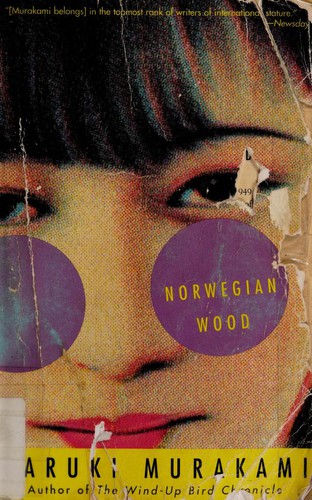
Norwegian Wood by Haruki Murakami is a 1987 literary fiction book about grief and loss, coming of age, mental illness. Grief in Norwegian Wood is not a crisis but a climate — the novel captures the way loss can become the atmosphere you live in rather than an event you move through.
Summary
Norwegian Wood is Murakami's most straightforwardly realist novel and his most personal — a coming-of-age story set in late 1960s Tokyo, narrated by Toru Watanabe, who is recalling the year he was nineteen and the two women who shaped him. Naoko was the girlfriend of Toru's best friend Kizuki, who killed himself at seventeen. After Kizuki's death, Toru and Naoko find each other — not in the ordinary sense of falling together, but in the sense of two people who are each other's only witness to a grief no one else can share. Midori is almost Naoko's opposite: noisy, alive, demanding, funny, and deeply appealing in ways that feel like a threat to Toru's loyalty to the dead.
The novel is about grief as a landscape — the way loss can become a place you move into and eventually must decide whether to leave. Naoko is increasingly unable to function in the world; she retreats to a sanatorium in the mountains that Murakami renders as a kind of beautiful, still anteroom to disappearance. Toru visits her. He also keeps failing not to fall for Midori, which the novel frames as a moral problem even as it presents it as inevitable.
Murakami wrote Norwegian Wood in a style quite different from his other work — there are no talking cats, no alternate worlds, no surrealist ruptures. The prose is quieter, more melancholy, more conventional in structure. This is his Catcher in the Rye, his Norwegian Wood is The Beatles song that plays at the novel's opening — a piece of music that releases pure nostalgia, a specific grief for something you can barely name. The title is precisely right.
It became a phenomenon in Japan on publication, selling four million copies. Western readers came to it largely after Murakami's more fantastical work and often find it either more or less accessible as a result. Those who bounced off Kafka on the Shore or The Wind-Up Bird Chronicle may find Norwegian Wood an easier entry point. Those who love his magical realism may miss it here. Either way, this is a sadder book than it first looks, and the sadness keeps its shape long after you've finished.
Talk to Norwegian Wood like its author wrote you back.
Get the ideas that fit your life — not generic summaries.
- Chat with the book
- Audiobook-style main ideas
- Adapts to your life and goals
- Helps you take action
Key takeaways
- 1.
Grief in Norwegian Wood is not a crisis but a climate — the novel captures the way loss can become the atmosphere you live in rather than an event you move through.
- 2.
Naoko's retreat from life is presented with sympathy but not romanticization: Murakami understands that depression and damage can look like depth, and he resists that confusion while also not denying its appeal.
- 3.
Midori is the novel's most fully alive character — demanding, funny, and moral in a way that has nothing to do with conventionality. She is what the world outside grief looks like.
- 4.
Toru's loyalty to the dead is the novel's central moral question: at what point does faithfulness become self-destruction, and what does it owe to the living?
- 5.
The sanatorium where Naoko lives is one of Murakami's most resonant settings — a place of stillness and beauty that is also a kind of end-stage.
- 6.
The 1960s student movement backdrop is present but deliberately marginal — Toru is indifferent to politics, which is itself a kind of characterization.
- 7.
Music functions throughout the novel as a vehicle for emotional memory — the Beatles song of the title arrives as pure nostalgia, a grief that doesn't attach to a specific thing.
- 8.
The novel ends not with resolution but with Toru, having lost what he had, in a nowhere-place calling to Midori. Whether she can save him is left genuinely open.
Discussion questions
Use these on your own, with a book club, or as chat starters in Superbook. Book club version, ready to copy or print →
- 1.
Toru is drawn to Naoko partly because they share the same grief and partly because her damage feels like depth. Is that self-deception on his part, and does the novel judge him for it?
- 2.
Midori is often read as the novel's argument against grief — the embodiment of life continuing. Does that reading reduce her, or is it what the novel actually intends?
- 3.
The sanatorium is physically beautiful and spiritually terminal. What is Murakami saying by making Naoko's world so aesthetically appealing?
- 4.
Reiko is a fascinating side character — a musician with her own complicated history. What function does she serve in the novel that Naoko or Midori cannot?
- 5.
Norwegian Wood is deliberately not a magical realist novel. What does Murakami gain by working in straight realism here, and what does he give up?
- 6.
The student protest movement happens in the background while Toru remains detached. Is that detachment a character flaw, a historical comment, or both?
- 7.
How does the novel treat suicide? Does it romanticize it, resist it, or genuinely reckon with it as a phenomenon that spreads through social proximity?
- 8.
Toru is not a fully realized character in the way Naoko or Midori are — he's more of a consciousness through which we experience the other two. Is that a structural choice that works?
- 9.
Compare this novel to The Catcher in the Rye as a coming-of-age story about grief and social alienation. What does Murakami's version do differently?
- 10.
The novel was written in the late 1980s and set in the late 1960s. How does that retrospective distance shape the emotional texture of the narration?
- 11.
The last line puts Toru in a nowhere-place calling Midori's name. What does that image finally mean?
- 12.
Norwegian Wood was Murakami's first major bestseller. What do you think it gave Japanese readers in 1987 that they hadn't seen before?
Themes
Frequently asked questions
-
Is Norwegian Wood a good entry point to Murakami?
It depends on what you want from Murakami. Norwegian Wood is his most realistic novel — no magic, no alternate worlds. If you want a melancholy coming-of-age story about grief and love, it's an excellent entry point. If you've heard Murakami described as surrealist and are coming for that, you'll need to look at Kafka on the Shore or The Wind-Up Bird Chronicle instead.
-
What is Norwegian Wood about, without spoilers?
A young man in 1960s Tokyo navigates two relationships while living in the shadow of his best friend's suicide: one with a woman retreating from the world, another with a woman insisting on it. It's a novel about grief, loyalty to the dead, and whether you can choose to return to life.
-
Is Norwegian Wood sad?
Yes, and quietly so. The sadness accumulates slowly and doesn't announce itself. By the end, the weight of the novel's losses is considerable. It's not a harrowing read but it lingers.
-
Who shouldn't read Norwegian Wood?
Readers who need narrative momentum — this is a slow, interior novel. Also, those seeking Murakami's characteristic surrealism will not find it here. And readers sensitive to depictions of suicide and mental illness should be aware that both are central to the story.
-
Is there a film adaptation?
Yes. A 2010 film directed by Tran Anh Hung, starring Kenichi Matsuyama and Rinko Kikuchi, received mixed reviews. Most Murakami readers feel the novel's atmospheric interior quality is difficult to translate to screen.