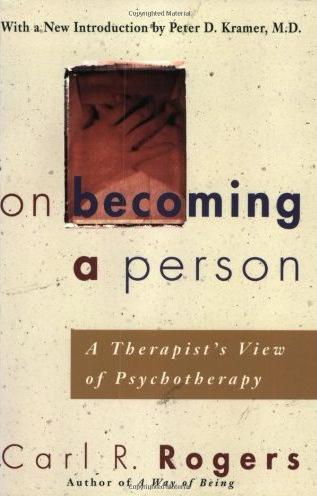
On Becoming a Person: A Therapist's View of Psychotherapy by Carl R. Rogers is a 1961 psychology book about self-actualization, empathy, psychotherapy. The therapeutic relationship matters more than technique. Unconditional positive regard, empathy, and congruence from the therapist are the active ingredients of change.
Summary
Carl Rogers wrote this book in 1961 as an attempt to communicate his therapeutic approach to readers outside the consulting room. Rogers was the founder of client-centered therapy, and the ideas here — that the therapist's unconditional positive regard, empathy, and congruence are the active ingredients of healing — were genuinely radical at the time. Freudian analysis was the dominant model; Rogers proposed that what mattered wasn't interpretation or technique but the quality of the relationship itself.
The book is assembled from lectures and papers Rogers gave throughout the 1950s, so it doesn't read as a linear argument. It circles similar themes from different angles: the conditions for therapeutic change, the nature of the fully functioning person, what it means to learn, how creativity emerges, and whether the sciences of behavior are compatible with human freedom. The writing is careful and personal. Rogers draws on case material from clients he worked with, and the examples ground abstract ideas in specific encounters.
The most lasting contribution is the framework Rogers calls the "necessary and sufficient conditions" for therapeutic change: the therapist must be genuine (congruent), must communicate empathic understanding, and must hold unconditional positive regard for the client. Rogers argued these conditions, when met, were enough — and that technique without them was useless. This challenged not just psychoanalysis but the behavioral models that were emerging at the same time.
On Becoming a Person is not a self-help manual and it's not a clinical textbook. It's a philosophical account of what it means to grow as a human being. It's most rewarding for readers willing to sit with ideas rather than extract action points. Therapists, educators, and anyone drawn to humanistic thought will find it rich. Readers looking for concrete behavioral strategies will find it frustrating.
Talk to On Becoming a Person: A Therapist's View of Psychotherapy like its author wrote you back.
Get the ideas that fit your life — not generic summaries.
- Chat with the book
- Audiobook-style main ideas
- Adapts to your life and goals
- Helps you take action
Key takeaways
- 1.
The therapeutic relationship matters more than technique. Unconditional positive regard, empathy, and congruence from the therapist are the active ingredients of change.
- 2.
Unconditional positive regard doesn't mean approval of everything. It means accepting the person as a whole without making that acceptance conditional on behavior.
- 3.
Congruence — being genuine rather than playing a professional role — is the first condition. A therapist who is performing empathy rather than experiencing it produces nothing.
- 4.
The 'fully functioning person' is not a destination but a direction: toward openness to experience, existential living in the present, increasing trust in one's own organism.
- 5.
Rogers believed psychological problems arise when people internalize conditions of worth — messages that love is contingent on being a certain way. Healing reverses this.
- 6.
Empathy means entering the client's private world with accuracy and checking whether you got it right. It's not sympathy, not agreement, and not reassurance.
- 7.
The same conditions that produce therapeutic growth apply in education, leadership, and parenting. Any helping relationship is improved by these three qualities.
- 8.
Rogers challenged the idea that the expert therapist knows what's best for the client. His model places the locus of evaluation inside the person, not in the professional's interpretation.
Discussion questions
Use these on your own, with a book club, or as chat starters in Superbook. Book club version, ready to copy or print →
- 1.
Rogers argues that unconditional positive regard — accepting someone without conditions — is both rare and transformative. Who in your life has offered that to you, and what effect did it have?
- 2.
Think of a relationship where you perform a role rather than showing up genuinely. What would change if you let down that performance?
- 3.
Rogers says psychological distress often comes from internalizing others' conditions of worth — learning that love is conditional. Where have you absorbed that lesson, and is it still running?
- 4.
The book was written in 1961. Which of Rogers's ideas feel more relevant now than they would have then, and which feel more contested?
- 5.
Rogers applies his conditions to education, not just therapy. Think of a teacher or mentor who helped you grow. Were congruence, empathy, or positive regard present in that relationship?
- 6.
What's the difference between empathy as Rogers describes it — accurate perception of another's inner world — and sympathy or agreement?
- 7.
Rogers believed people have a natural tendency toward growth if the environment permits it. Where in your life is the environment impeding rather than permitting that tendency?
- 8.
The fully functioning person lives more in the present and trusts their organism more than their internalized rules. Where do you over-rely on rules at the expense of experience?
- 9.
Rogers is explicit that he distrusts expertise when it places the locus of evaluation outside the person. Do you agree? When is external evaluation necessary?
- 10.
The book is assembled from lectures and papers rather than written as a single argument. How does that structure affect how you engage with Rogers's ideas?
- 11.
Rogers's framework was considered radical in 1961. Which ideas in psychology that feel similarly radical right now do you expect to look obvious in sixty years?
- 12.
If you were to describe your own 'conditions of worth' — the beliefs you hold about what you must be or do to deserve love — what would they be?
Themes
Frequently asked questions
-
Is On Becoming a Person worth reading?
Yes, though not for quick takeaways. Rogers writes carefully and personally, and the ideas have influenced how therapy, education, and even management are practiced today. It's most rewarding for readers interested in humanistic psychology, the philosophy of the self, or the foundations of therapeutic practice.
-
What is On Becoming a Person about?
It's Rogers's account of what good therapy looks like, why it works, and what it means to grow as a person. The central argument is that three conditions — empathy, congruence, and unconditional positive regard — are sufficient for therapeutic change when genuinely present in a relationship.
-
Who should read On Becoming a Person?
Therapists, counselors, teachers, and anyone in a helping role will find it most directly applicable. Readers interested in humanistic psychology or the philosophy of personal development will also find it rewarding. People looking for a practical self-improvement manual should look elsewhere.
-
How long is On Becoming a Person?
Around 420 pages, roughly six hours at average reading pace. Because the book is assembled from separate lectures and papers, it can be read non-linearly — individual chapters stand well on their own.
-
What's the difference between Rogers's approach and Freudian therapy?
Rogers placed the authority inside the client rather than in the analyst's interpretations. He argued that technique and theory matter less than the quality of the relationship. Freud's model was hierarchical and expert-driven; Rogers's was collaborative and relationship-centered.