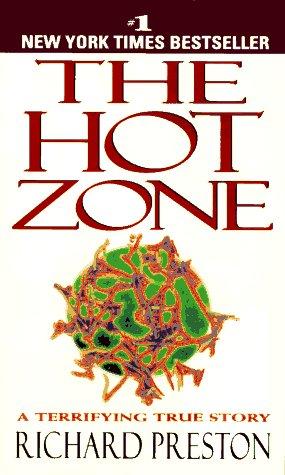
The Hot Zone by Richard Preston is a 1994 science book about infectious disease, epidemics, biosafety. Filoviruses like Ebola and Marburg cause hemorrhagic fever with fatality rates up to 90 percent in some outbreaks and have no proven treatment.
Summary
The Hot Zone is Richard Preston's account of the discovery of filoviruses — Marburg and Ebola — and, more urgently, the 1989 outbreak of a closely related virus in a primate facility in Reston, Virginia, twenty miles from Washington DC. Preston writes it as a work of narrative nonfiction that reads at the pace of a thriller, though the material is real and the technical grounding is solid enough to give it genuine weight.
The book opens with graphic accounts of the first known Ebola cases in Africa in the 1970s, using visceral clinical detail to establish what the virus does to the human body. These early chapters are deliberately shocking. Preston's argument, implicit throughout, is that the gap between our ordinary sense of safety and the actual fragility of our biosecurity systems is vast. A virus that kills 90 percent of those it infects and liquefies internal tissue is not a movie monster; it's a natural object that existed for millions of years before humans encountered it, and it doesn't need intention to spread.
The Reston outbreak is the book's center of gravity. Ebola Reston turned out to be airborne among monkeys but not lethal to humans — a near-miss so dramatic that it borders on implausible. Preston follows the Army team that entered the building in biohazard suits, the epidemiologists trying to identify the source, and the lab workers who were exposed and survived without knowing what they'd been exposed to. The bureaucratic hesitation, the military chain of command, and the near-breakdowns are rendered in detail that makes the institutional fragility feel completely credible.
Preston is not a virologist, and some scientists have criticized the book for sensationalizing the science. The viral hemorrhagic fever descriptions in the opening sections are intense to the point of being lurid. But as a document about how little stood between a potentially catastrophic event and ordinary suburban life, and about the limits of biosafety protocols under operational conditions, The Hot Zone holds up. It shaped the public conversation about emerging infectious disease for decades.
Talk to The Hot Zone like its author wrote you back.
Get the ideas that fit your life — not generic summaries.
- Chat with the book
- Audiobook-style main ideas
- Adapts to your life and goals
- Helps you take action
Key takeaways
- 1.
Filoviruses like Ebola and Marburg cause hemorrhagic fever with fatality rates up to 90 percent in some outbreaks and have no proven treatment.
- 2.
The 1989 Reston outbreak put an airborne filovirus variant twenty miles from Washington DC. It was lethal to monkeys but not, fortunately, to humans.
- 3.
Biosafety Level 4 protocols are the highest level of biological containment, and the Army team's operation in Reston revealed how difficult they are to maintain under field conditions.
- 4.
These viruses emerged from rainforest ecosystems. Encroachment on those ecosystems increases the probability of future spillover events.
- 5.
The reservoir host of Ebola remains uncertain decades after the first outbreak. Not knowing where the virus lives between outbreaks makes prevention difficult.
- 6.
Human response to outbreak risk is highly institutionalized and therefore slow. The Reston operation involved turf battles and bureaucratic delays even as exposure was ongoing.
- 7.
Exponential spread requires only a change in transmission route. The fact that Ebola Reston didn't transmit efficiently to humans was luck, not design.
- 8.
The psychological and physical toll on people who work inside hot zones — in biohazard suits, in close contact with lethal agents — is rarely discussed but significant.
Discussion questions
Use these on your own, with a book club, or as chat starters in Superbook. Book club version, ready to copy or print →
- 1.
Preston writes about Ebola in highly visceral terms. Did that technique make the science more or less credible to you? What does sensationalism cost a nonfiction account?
- 2.
The Reston outbreak involved multiple failures of communication and institutional coordination. What kind of system would have caught these failures earlier?
- 3.
Given that the reservoir host of Ebola is still not confirmed, what does it say about public health preparedness that we've had this knowledge gap for decades?
- 4.
Preston argues that human expansion into tropical ecosystems is the underlying driver of emerging infectious disease. Where does individual behavior intersect with that structural argument?
- 5.
The Army researchers entered a building with an unknown filovirus in suits that had a non-trivial failure rate. Would you have done it? What's the right way to make that kind of risk decision?
- 6.
How has reading this book — published in 1994 — changed or confirmed your understanding of how COVID-19 unfolded more than two decades later?
- 7.
The people who were exposed in Reston and survived didn't know what they'd been exposed to until later. What ethical obligations do institutions have to disclose exposure in real time?
- 8.
Preston's descriptions of hemorrhagic fever are clinically graphic. Do you think that detail serves a public health purpose, or does it primarily serve to frighten?
- 9.
The Reston virus was airborne among monkeys. How do you think about the role of luck in the outcomes of outbreak events?
- 10.
What's the gap between the level of biosafety infrastructure described in this book and what you'd expect the government to have in place now?
- 11.
If the Reston outbreak had involved a human-lethal airborne strain, what do you think would have happened? What does the book suggest about containment capacity?
- 12.
Preston ends on an ambivalent note about the rainforest and the virus as natural forces. What's your reaction to that framing?
Themes
Frequently asked questions
-
Is The Hot Zone a true story?
Yes. It's a work of narrative nonfiction. The events — the original African Ebola and Marburg outbreaks and the 1989 Reston incident — are real. Preston uses reconstructed dialogue and some dramatic framing, which has drawn criticism from scientists who felt he overstated certain details.
-
How accurate is The Hot Zone scientifically?
The broad picture is accurate but some scientists have criticized the descriptions of hemorrhagic fever as more extreme than the clinical reality. The Reston outbreak and its near-miss qualities are real. Treat the opening clinical chapters as evocative rather than textbook-precise.
-
Who should read The Hot Zone?
People interested in infectious disease, biosecurity, or narrative science writing. It's also useful background reading for understanding how public health and military institutions interact during outbreak events. It reads quickly despite its technical subject matter.
-
How does The Hot Zone relate to COVID-19?
It doesn't cover COVID-19, published twenty-five years before that pandemic. But the institutional failures and the gap between scientific understanding and institutional response it documents turned out to be highly predictive of what happened in 2020. Many readers returned to it after COVID hit.
-
What is the main argument of The Hot Zone?
That the barriers between dangerous viral reservoirs and human populations are thinner than most people imagine, that biosafety infrastructure is more fragile than it appears, and that the 1989 Reston near-miss was not an anomaly but a preview.