Science · Book club
Peak: Secrets from the New Science of Expertise book club questions
Here are 12 book club questions for Peak: Secrets from the New Science of Expertise by Anders Ericsson and Robert Pool, ordered to open easily and end somewhere worth arguing about. Copy them, print them, or bring them up one at a time.
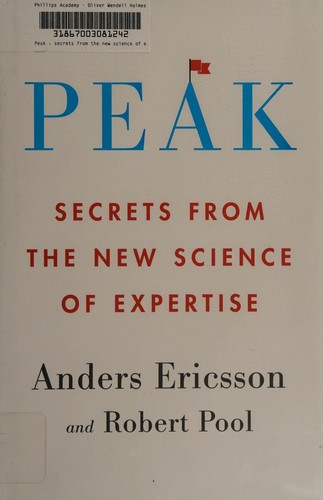
Peak is Anders Ericsson's definitive account of deliberate practice — the specific type of focused, feedback-driven training that, more than any other factor, determines how expert people become in demanding fields.
Anders Ericsson and Robert Pool · 2016 · 5h 20m
Full summary and key takeaways →The 12 questions
- 1.
Think of a skill you've practiced for years without major improvement. Which of Ericsson's criteria for deliberate practice is missing from how you practice it?
- 2.
Ericsson argues that talent is mostly a story we tell to explain differences that are actually the result of different amounts and types of practice. Where have you used talent as an explanation — for yourself or for others — that might not be accurate?
- 3.
What does your mental representation of expert performance look like in the domain most important to you? How detailed and accurate is it?
- 4.
What would it mean, specifically, to practice your most important skill at the edge of your current ability? What exactly is that edge?
- 5.
Ericsson describes the plateau effect: performance becomes automatic and ceases to improve. Where in your professional or personal skills are you plateaued?
- 6.
He says short, intense, concentrated practice sessions outperform long, comfortable ones. How does that compare to how you currently spend your practice time?
- 7.
What feedback mechanism do you have on your most important skill? If the feedback is slow, vague, or absent, what would you change to get better information sooner?
- 8.
Gladwell's 10,000-hour rule popularized Ericsson's research but oversimplified it. How has this misreading affected how people in your field think about developing expertise?
- 9.
In domains without training traditions — entrepreneurship, parenting, leadership — how would you design deliberate practice? What would the feedback look like?
- 10.
Ericsson says the discomfort of working at the edge of ability is necessary, not a sign that something is wrong. How do you distinguish productive discomfort from unproductive strain in your own learning?
- 11.
Who is the best performer in a domain you care about? What specifically can you observe about their performance that gives you a target for your own mental representation?
- 12.
The book argues that almost any ability is more trainable than we assume. What is something you've believed to be fixed in yourself that might actually be trainable?
How to run the discussion
- Pick six to eight, not all of them. An hour of real discussion covers fewer questions than anyone expects, and racing the list is what makes a book club feel like homework.
- Open with what people noticed, not what they concluded. Asking for a verdict first hardens opinions before anyone has heard each other.
- Let the disagreement run. The questions below that split a room are the ones worth the time; the ones everyone answers the same way can be skipped.
- Ask the quiet person a specific question. A direct, narrow question is far easier to answer than an open invitation to contribute.
Themes worth steering toward
If the conversation stalls, these are the threads that usually restart it.
Common questions
What are good book club questions for Peak: Secrets from the New Science of Expertise?
Here are 12 book club questions for Peak: Secrets from the New Science of Expertise by Anders Ericsson and Robert Pool, ordered to open easily and end somewhere worth arguing about. The strongest openers ask what each reader noticed rather than what they concluded, and the discussion usually turns on deliberate practice, expertise, mastery.
How long should a book club discussion of Peak: Secrets from the New Science of Expertise last?
Most groups run 60 to 90 minutes of actual discussion. That is roughly six to eight questions, not all of them, so pick the ones that suit your group rather than working down the list in order.
What are the main themes in Peak: Secrets from the New Science of Expertise?
Deliberate practice, Expertise, Mastery, Skill acquisition, Learning. Those are the threads most likely to divide a room, which makes them the useful places to steer a discussion that has gone quiet.
Picking the next one? See books like Peak: Secrets from the New Science of Expertise or questions for other book club picks.
