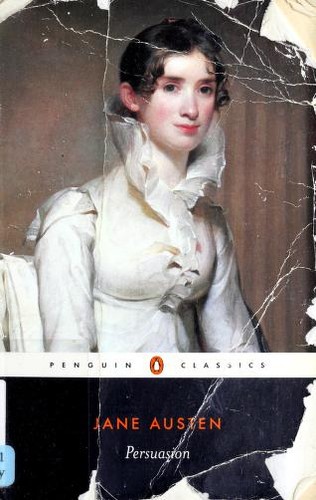
Persuasion by Jane Austen is a 1818 classics book about second chances, regret and constancy, class and social change. The novel's central question is not whether Anne and Wentworth will reunite but whether Anne was wrong to be persuaded — and Austen's answer is nuanced: yielding was understandable, but yielding to bad advice is different from yielding to good judgment.
Summary
Anne Elliot is twenty-seven, no longer considered beautiful by her family, and living with the private knowledge that she turned down Captain Wentworth seven years ago because she was persuaded to — by her godmother, by social pressure, by the reasonable argument that he was too poor and too uncertain a prospect. Wentworth is now wealthy, successful, and has returned to the neighborhood. He has not forgiven her. Persuasion is about what happens in the space between them.
This is Austen's quietest novel, and its quietness is the subject. Anne is a woman who has learned to take up very little room. Her father and sisters treat her as background furniture; she is useful in practical crises and otherwise ignored. The novel watches her carefully — her emotional intelligence, her genuine goodness, the way she processes what she witnesses with clear eyes — and argues that the world has wasted her. Wentworth's initial coldness is partly justified anger and partly the blindness of pride. He thinks he's moved on. He hasn't. Austen tracks both characters' unspoken interior states with unusual delicacy, and the famous letter Wentworth writes near the novel's end ("You pierce my soul") remains the most direct emotional declaration in all of her work.
Persuasion is also Austen's most socially mobile novel. The old gentry — exemplified by Anne's impossibly vain father Sir Walter — are declining, their rents not meeting their ambitions. The naval officers who won the Napoleonic wars are rising, carrying with them a different value system: professional competence, earned status, genuine partnership between men and women. The novel is quietly radical in proposing that this new world is better.
First-time readers sometimes find Persuasion anticlimactic: the external plot is thin, and the reunion between Anne and Wentworth happens mostly through accumulation of small moments. But for readers who have outgrown the idea that romance means drama, the novel is devastating. Austen was gravely ill when she wrote it. The autumnal light is not accidental.
Talk to Persuasion like its author wrote you back.
Get the ideas that fit your life — not generic summaries.
- Chat with the book
- Audiobook-style main ideas
- Adapts to your life and goals
- Helps you take action
Key takeaways
- 1.
The novel's central question is not whether Anne and Wentworth will reunite but whether Anne was wrong to be persuaded — and Austen's answer is nuanced: yielding was understandable, but yielding to bad advice is different from yielding to good judgment.
- 2.
Anne's invisibility to her family is a form of social violence. The novel attends to her interiority with precision and argues that unseen intelligence is still intelligence.
- 3.
Wentworth's letter is a study in suppressed emotion finally breaking through. It works because Austen has spent the entire novel showing what it costs him to suppress it.
- 4.
The naval class represents, for Austen, a meritocracy that the hereditary gentry cannot match. Persuasion is her most pointed critique of inherited privilege.
- 5.
Persuasion is Austen's shortest major novel and also her most emotionally concentrated. The compression is the technique.
- 6.
Female constancy is the virtue the novel tests. Anne's faithfulness to a feeling she can't act on, for seven years, is treated as a kind of moral achievement.
- 7.
Lady Russell, who persuaded Anne to refuse Wentworth, is not a villain. She gave sincere advice that was wrong. The novel is careful about this distinction.
- 8.
The novel suggests that second chances exist but are not guaranteed. The reunion works because both characters have changed in the right ways — and also because of luck.
Discussion questions
Use these on your own, with a book club, or as chat starters in Superbook. Book club version, ready to copy or print →
- 1.
Anne was right to be open to persuasion — Wentworth was an uncertain prospect. But Lady Russell's specific advice was wrong. How do you distinguish good persuasion from bad in the moment?
- 2.
Wentworth spends most of the novel punishing Anne by being conspicuously attentive to other women. Is that cruelty, immaturity, or understandable self-protection?
- 3.
Anne has no money, no looks by her family's standards, and no social power. She is also the most competent and morally serious person in every room she enters. What does the novel do with that gap?
- 4.
The famous letter — 'I can listen no longer in silence. I must speak to you by such means as are within my reach' — arrives in a form (a note written in real-time) that is almost cinematically tense. Does it earn its reputation?
- 5.
Sir Walter Elliot is one of literature's great comic vain men. But his vanity has real consequences for Anne. Does the novel balance the comedy and the damage?
- 6.
Persuasion shows a world where the old gentry is being displaced by naval professionals. Is Austen endorsing that change, mourning it, or both?
- 7.
Anne is persuaded against Wentworth. Later she persuades Captain Harville that women's feelings are more constant than men's. Is there irony in that, given her history?
- 8.
Compare Anne to Elizabeth Bennet. Both are intelligent, underestimated women. But Anne has been worn down by years of disappointment. What does the difference in their situations reveal about what youth and confidence cost?
- 9.
The novel ends quickly after the reunion. Is that abruptness satisfying or does it feel like Austen ran out of steam?
- 10.
If Persuasion were written today with Anne as a man and Wentworth as a woman, would the power dynamics shift meaningfully? What would be lost or gained?
- 11.
Austen died before she could revise Persuasion. Does it feel unfinished? Where would you expect the revision to have gone?
Themes
Frequently asked questions
-
Is Persuasion Austen's best novel?
Many devoted Austen readers say yes. It lacks the comic precision of Pride and Prejudice and the technical ambition of Emma, but it has an emotional depth those novels don't quite reach. It is the one Austen novel that reads like it cost the author something personal.
-
Is Persuasion hard to read?
It's her shortest novel and also her most restrained. The plot is thin and slow by conventional standards. Readers who need witty dialogue and social comedy will find it quieter than expected. Readers comfortable with interiority and accumulation will find it devastating.
-
What is Persuasion about without spoilers?
A woman who, at nineteen, turned down the man she loved because she was persuaded it was the sensible thing to do. Now twenty-seven, she encounters him again. The novel is about whether she can recover what she gave up — and whether she should have given it up at all.
-
Why is Persuasion considered a classic?
Because it takes seriously the question of what it costs a woman to be reasonable in a world that treats her reasonableness as convenient. Anne Elliot is the most psychologically complete of Austen's heroines, and the novel's restrained technique matches her restrained life.
-
Who shouldn't read Persuasion?
Readers expecting the social comedy of Pride and Prejudice will be surprised. Persuasion is melancholy and slow. If you need narrative momentum or witty banter to stay engaged, start with another Austen and return to this one later.