Business · Book club
Playing to Win: How Strategy Really Works book club questions
Here are 11 book club questions for Playing to Win: How Strategy Really Works by Roger L. Martin and A.G. Lafley, ordered to open easily and end somewhere worth arguing about. Copy them, print them, or bring them up one at a time.
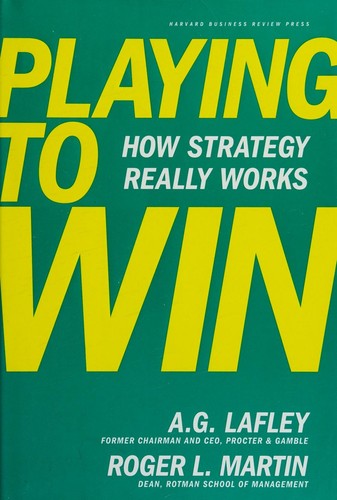
Playing to Win is Roger Martin and A.G.
Roger L. Martin and A.G. Lafley · 2013 · 5h 0m
Full summary and key takeaways →The 11 questions
- 1.
Martin and Lafley define strategy as an integrated set of five choices. What happens when an organization makes coherent choices at one level but incoherent choices at another?
- 2.
Genuine Where to Play choices require explicitly deciding where you are not going to compete. What makes that kind of explicit exclusion politically difficult in most organizations?
- 3.
Can a large, diversified company have a single coherent strategy, or does each business unit require its own strategic cascade? How do the cascades relate to each other?
- 4.
Martin is explicit that strategy requires taking risk and making irreversible commitments. In your experience, what is the cost of avoiding that commitment — of keeping all options open?
- 5.
Apply the five-choice cascade to a business you know well. Where is the cascade coherent, and where does it break down? What is the effect of the incoherence on the business?
- 6.
How to Win must produce a competitive advantage that is specific and defensible. What kinds of competitive advantages are most durable, and which erode fastest in digital markets?
- 7.
The book argues that good strategy requires saying no to attractive options. What's the most significant strategic no you've seen a company make, and what was the effect?
- 8.
Required Capabilities and Management Systems are the bottom two levels of the cascade. Why are they often underdeveloped in strategic plans that are otherwise strong at the top?
- 9.
Martin and Lafley use P&G as the primary case study. What are the limits of that example for companies that are not large consumer goods companies?
- 10.
How does Playing to Win's framework relate to Good Strategy Bad Strategy? Do they agree on what good strategy is, or are there meaningful differences?
- 11.
What is the difference between a strategy and a value proposition? Can you have a compelling value proposition without a coherent strategic cascade behind it?
How to run the discussion
- Pick six to eight, not all of them. An hour of real discussion covers fewer questions than anyone expects, and racing the list is what makes a book club feel like homework.
- Open with what people noticed, not what they concluded. Asking for a verdict first hardens opinions before anyone has heard each other.
- Let the disagreement run. The questions below that split a room are the ones worth the time; the ones everyone answers the same way can be skipped.
- Ask the quiet person a specific question. A direct, narrow question is far easier to answer than an open invitation to contribute.
Themes worth steering toward
If the conversation stalls, these are the threads that usually restart it.
Common questions
What are good book club questions for Playing to Win: How Strategy Really Works?
Here are 11 book club questions for Playing to Win: How Strategy Really Works by Roger L. Martin and A.G. Lafley, ordered to open easily and end somewhere worth arguing about. The strongest openers ask what each reader noticed rather than what they concluded, and the discussion usually turns on strategy, competition, decision-making.
How long should a book club discussion of Playing to Win: How Strategy Really Works last?
Most groups run 60 to 90 minutes of actual discussion. That is roughly six to eight questions, not all of them, so pick the ones that suit your group rather than working down the list in order.
What are the main themes in Playing to Win: How Strategy Really Works?
Strategy, Competition, Decision-making, Organizational design, Innovation. Those are the threads most likely to divide a room, which makes them the useful places to steer a discussion that has gone quiet.
Picking the next one? See books like Playing to Win: How Strategy Really Works or questions for other book club picks.
