Positioning: The Battle for Your Mind by Al Ries and Jack Trout is a 1981 business book about brand positioning, perception, marketing strategy. The marketing battle is fought in the prospect's mind, not in the marketplace. Positioning is about how you are perceived, not about what you objectively offer.
Summary
Positioning, first published in 1981 and revised in 2000, introduced an idea that restructured how strategists think about marketing: the real competition is not in the marketplace but in the customer's mind. Ries and Trout argued that companies face an overcommunicated society, where consumers are bombarded with messages and have developed filters that block out most of what they hear. Breaking through requires not a better product but a better position — a specific slot in the prospect's mental architecture that the brand can own and defend.
The core mechanism is simplicity. In an overcommunicated world, complexity is punished. A brand needs to stand for one thing: a single concept that makes it easy for consumers to file you in the right mental drawer. Avis tried harder. 7UP was the Uncola. Volkswagen was the small car. These positions worked not because they described the products most accurately but because they staked out territory in relation to an existing reference point — usually the market leader. Ries and Trout call this repositioning against the competition: rather than announcing your own strengths, you shift the context in which the leader is judged.
The book moves through several positioning strategies in depth: leader positioning, follower positioning, repositioning the competition, the "against" position, and the challenge of naming products and companies. The naming chapter is particularly useful — Ries and Trout argue that a brand name is a hook that either catches on the rungs of the prospect's mental ladder or slides off. Generic names are hard to position; invented or coined names can be hung anywhere. The chapters on line extension remain prescient: most brand extensions, the authors argue, dilute the original position rather than expand it.
Positioning has dated in some specifics — the competitive landscape it references is 1970s American business, and digital platforms have changed how positions are built and challenged. But the underlying framework is structural rather than tactical, and it transfers. Any strategist who reads this book will find it changes how they evaluate messaging, naming decisions, and competitive responses. The authors are blunter and more quotable than most strategists, which makes the book faster to read and easier to apply.
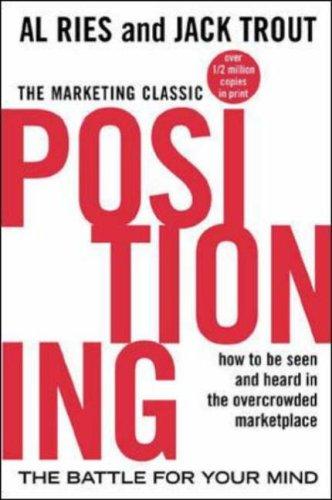
Talk to Positioning: The Battle for Your Mind like its author wrote you back.
Get the ideas that fit your life — not generic summaries.
- Chat with the book
- Audiobook-style main ideas
- Adapts to your life and goals
- Helps you take action
Key takeaways
- 1.
The marketing battle is fought in the prospect's mind, not in the marketplace. Positioning is about how you are perceived, not about what you objectively offer.
- 2.
In an overcommunicated world, the winning strategy is oversimplification. A brand that stands for one clear concept cuts through where complex messages fail.
- 3.
Leaders should reinforce their leadership position, not compete on the challenger's terms. The goal is to own the defining concept in a category.
- 4.
Follower brands are better off finding an unoccupied position than attacking the leader head-on. The 'against' position — defining yourself in relation to the leader — can be very effective.
- 5.
Repositioning the competition means shifting the context in which they are evaluated, not just describing your own advantages. Changing how consumers perceive a rival can be more powerful than promoting yourself.
- 6.
Brand names are tools. A name should function as a hook that attaches to the prospect's mental ladder. Generic names and line extensions tend to weaken this hook.
- 7.
Line extension is almost always a mistake in the long run. Attaching a strong brand to a new product usually dilutes the original while failing to dominate the new category.
- 8.
The first mover advantage is real: the first brand to own a position in a category tends to keep it, even as better products arrive. This is why positioning at launch matters more than almost any subsequent decision.
Discussion questions
Use these on your own, with a book club, or as chat starters in Superbook. Book club version, ready to copy or print →
- 1.
Ries and Trout say the battle for the mind is won through simplicity. What's the single concept your organization or product actually owns in customers' minds right now?
- 2.
The book argues that being first matters more than being better. Where in your industry does this hold true? Where does it break down?
- 3.
Pick a competitor. What is their dominant position in the customer's mind? How would you reposition them — not attack them, but change the context in which they're evaluated?
- 4.
The authors make a strong case against line extension. Has your organization or a company you admire made this mistake? What was the cost?
- 5.
Ries and Trout say you need to start with the prospect's mind, not with the product. How would this shift change how you currently think about messaging or product development?
- 6.
What company today has the clearest, most defensible positioning? What would it take to dislodge them?
- 7.
The book uses 1970s and 80s examples. Which positioning strategies from the book do you think are harder to execute in a digital environment, and which are more effective?
- 8.
The 'against' position — positioning in explicit relation to the market leader — requires courage. What would it look like for your brand to take an 'against' position?
- 9.
The authors argue that repositioning is more effective than simply promoting your own strengths. Do you find this counterintuitive? What makes it difficult to implement in practice?
- 10.
The book suggests that once a position is lost it is very hard to recover. Can you think of a brand that successfully reclaimed a position after losing it?
- 11.
Ries and Trout are deeply skeptical of creativity for its own sake in advertising. How do you reconcile this with your experience of what makes marketing memorable?
- 12.
If you had to pick one positioning principle from this book to apply to your work this week, which would it be and why?
Themes
Frequently asked questions
-
Is Positioning still worth reading today?
Yes. The specific examples are dated, but the framework — that brands compete for mental real estate and that the mind operates on categories and positions — is structural and transfers to any market. Marketers who read this book think differently about competitive strategy, naming, and messaging.
-
How long does it take to read Positioning?
The book runs around 220 pages and takes three to four hours at average reading pace. The chapters are short and each makes a self-contained argument, so it works well in brief reading sessions.
-
What is the difference between Positioning and The 22 Immutable Laws of Marketing?
Positioning introduces the core framework: the idea that marketing is a battle for mental real estate and explains the mechanics of how positions are built and defended. The 22 Immutable Laws applies those ideas in a list format and covers more ground, more briefly. Positioning is the deeper work; the Laws book is the faster reference.
-
Who should read this book?
Founders, brand strategists, product marketers, and anyone responsible for competitive positioning. Particularly useful if you are entering a crowded market, launching a new product, or trying to understand why a well-funded competitor keeps losing to a better-positioned rival.
-
What is the most important idea in Positioning?
That you must start with the prospect's mind, not with your product. The question is not 'what do we want to say?' but 'what slot is available in the prospect's mental architecture, and can we own it?' This reframe changes how you think about everything from naming to messaging to product strategy.
Similar books
The 22 Immutable Laws of Marketing
Al Ries and Jack Trout
This Is Marketing: You Can't Be Seen Until You Learn to See
Seth Godin
Influence: The Psychology of Persuasion
Robert B. Cialdini

Contagious: Why Things Catch On
Jonah Berger
