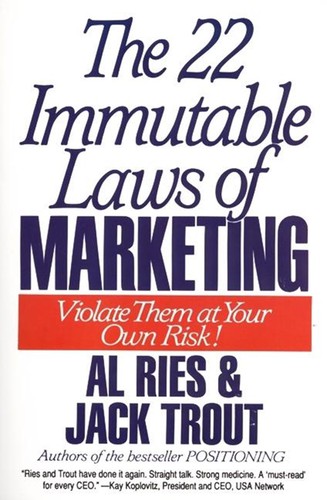
The 22 Immutable Laws of Marketing by Al Ries and Jack Trout is a 1993 business book about marketing strategy, brand positioning, competition. It's better to be first than to be better. The first brand in a category builds a perceptual advantage that is very difficult to overcome, regardless of subsequent product quality.
Summary
Al Ries and Jack Trout published this slim, blunt book in 1993 as a corrective to the marketing industry's habit of ignoring how markets actually behave. Each of the twenty-two laws is stated flatly, explained with examples from real companies, and illustrated with both winners who followed the law and losers who violated it. The premise is that marketing is a battle for perception, not for product superiority, and that most failed campaigns stem from ignoring this fact.
The most foundational laws are the first two. The Law of Leadership states that it is better to be first than to be better — the first brand in a category typically holds a permanent perceptual advantage. The Law of the Category extends this: if you can't be first in an existing category, create a new one where you can be. Together these two laws explain why so many technically superior products fail while inferior first-movers hold dominant positions for decades.
Subsequent laws address the mechanics of that perceptual battle. The Law of the Mind says that being first in the mind matters more than being first to market — you have one shot to establish a position, and once a competitor owns a word in the consumer's mind, displacing them is nearly impossible. The Law of Focus argues that the most powerful concept in marketing is owning a single word: Volvo owns "safety," FedEx once owned "overnight," BMW owns "driving." Companies that try to stand for many things stand for nothing. The Law of Candor is counterintuitive: admitting a weakness can paradoxically strengthen credibility, because consumers trust self-deprecation in a way they never trust boasting.
The book's weaknesses are visible from thirty years out. Some examples are dated, a few laws contradict each other, and the writing can tip into aphorism without nuance. Ries and Trout are also more useful for diagnosing problems than for prescribing solutions — they tell you what not to do with clarity, but the path forward often requires more judgment than the laws supply. Still, the core insight — that marketing operates on perception and that perception has its own laws — holds up. The book is most valuable as a forcing function for honest strategic conversations about where a brand actually stands.
Talk to The 22 Immutable Laws of Marketing like its author wrote you back.
Get the ideas that fit your life — not generic summaries.
- Chat with the book
- Audiobook-style main ideas
- Adapts to your life and goals
- Helps you take action
Key takeaways
- 1.
It's better to be first than to be better. The first brand in a category builds a perceptual advantage that is very difficult to overcome, regardless of subsequent product quality.
- 2.
If you can't be first in a category, create a new category where you can be first. Category creation is often a more powerful move than head-on competition.
- 3.
Being first in the mind matters more than being first to market. Perception is reality in marketing, and whoever establishes the initial impression tends to keep it.
- 4.
The most powerful concept in marketing is owning a single word in the prospect's mind. Brands that stand for many things stand for nothing.
- 5.
Line extension — attaching a strong brand name to a new product — almost always dilutes the original brand over time, even when it appears to succeed short term.
- 6.
Admitting a negative can be turned into a positive. Acknowledging a weakness is disarming and builds credibility that boasting never achieves.
- 7.
Every law has an opposite: for every marketer who benefits from a law, a competitor is hurt by it. Success in marketing requires reading which laws apply in your specific situation.
- 8.
Failure is to be expected and planned for. Companies that refuse to acknowledge failing products and strategies compound the original mistake with resource waste.
Discussion questions
Use these on your own, with a book club, or as chat starters in Superbook. Book club version, ready to copy or print →
- 1.
Ries and Trout say it is better to be first than to be better. Can you think of an example from your own industry where the first mover still dominates despite inferior products?
- 2.
The Law of the Category suggests creating a new category if you can't lead an existing one. What's a recent company that succeeded by defining a category rather than competing in one?
- 3.
Which single word does your organization or product own in customers' minds? Is that word the one you actually want to own?
- 4.
The Law of Line Extension argues that brand stretching almost always backfires long term. Can you name a brand that extended successfully — and one that didn't?
- 5.
The Law of Candor says admitting a weakness strengthens credibility. Where in your business could you be more candid about limitations without undermining confidence?
- 6.
The authors claim that marketing is a battle of perception, not product. Do you agree? Where does this framing break down?
- 7.
The Law of Resources says adequate funding is the final ingredient of marketing success. How does this sit alongside the idea that clever strategy can beat spending?
- 8.
Several of the 22 laws seem to contradict each other. Which pair of laws do you find most in tension, and how would you resolve the conflict in practice?
- 9.
The book was written in 1993. Which laws feel most durable today and which feel most outdated in the context of digital marketing and social platforms?
- 10.
Ries and Trout argue that companies should give up failing strategies rather than persist. What makes it so hard for organizations to actually do this?
- 11.
The Law of Sacrifice says you have to give something up to be strong in something. What would your company or brand need to give up to sharpen its position?
- 12.
The Law of Failure says companies should anticipate and admit failure rather than doubling down. Describe a time when a business you know of violated this law.
Themes
Frequently asked questions
-
Is The 22 Immutable Laws of Marketing still relevant?
The core laws — especially on perception, leadership, and focus — remain as relevant as ever. Some examples and tactical details are dated, and digital platforms have changed the mechanics of category creation. But the underlying principle that markets run on perception rather than product merit still holds.
-
How long does it take to read The 22 Immutable Laws of Marketing?
The book is around 160 pages and takes roughly two to three hours to read. Each law is a self-contained chapter, which makes it easy to read in short sessions or to return to specific laws as reference.
-
What is the main idea of The 22 Immutable Laws of Marketing?
Marketing is a battle for perception, not product quality. The laws describe patterns in how brands gain and lose positions in the customer's mind, and they argue that ignoring these patterns causes most major marketing failures.
-
Who should read this book?
Founders, marketers, and strategists who want a sharp mental model for positioning. The book is most useful for people thinking through brand strategy, naming, and category competition. It's less a how-to guide and more a diagnostic framework for avoiding common strategic errors.
-
What's the most actionable law in the book?
The Law of Focus: figure out what single word your brand can own in the prospect's mind and build everything around that word. Most companies try to stand for too many things. Ruthlessly narrowing the claim is uncomfortable but tends to produce clearer strategy and stronger marketing.
Similar books
Positioning: The Battle for Your Mind
Al Ries and Jack Trout
This Is Marketing: You Can't Be Seen Until You Learn to See
Seth Godin

Contagious: Why Things Catch On
Jonah Berger
Influence: The Psychology of Persuasion
Robert B. Cialdini
