Business · Book club
Positioning: The Battle for Your Mind book club questions
Here are 12 book club questions for Positioning: The Battle for Your Mind by Al Ries and Jack Trout, ordered to open easily and end somewhere worth arguing about. Copy them, print them, or bring them up one at a time.
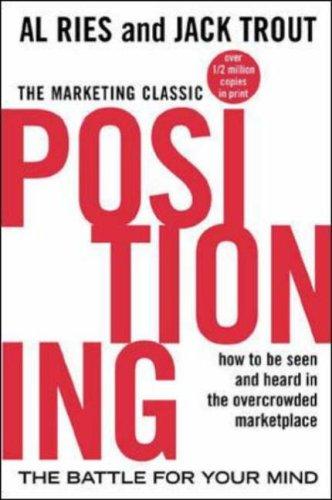
Positioning, first published in 1981 and revised in 2000, introduced an idea that restructured how strategists think about marketing: the real competition is not in the marketplace but in the customer's mind.
Al Ries and Jack Trout · 1981 · 4h 0m
Full summary and key takeaways →The 12 questions
- 1.
Ries and Trout say the battle for the mind is won through simplicity. What's the single concept your organization or product actually owns in customers' minds right now?
- 2.
The book argues that being first matters more than being better. Where in your industry does this hold true? Where does it break down?
- 3.
Pick a competitor. What is their dominant position in the customer's mind? How would you reposition them — not attack them, but change the context in which they're evaluated?
- 4.
The authors make a strong case against line extension. Has your organization or a company you admire made this mistake? What was the cost?
- 5.
Ries and Trout say you need to start with the prospect's mind, not with the product. How would this shift change how you currently think about messaging or product development?
- 6.
What company today has the clearest, most defensible positioning? What would it take to dislodge them?
- 7.
The book uses 1970s and 80s examples. Which positioning strategies from the book do you think are harder to execute in a digital environment, and which are more effective?
- 8.
The 'against' position — positioning in explicit relation to the market leader — requires courage. What would it look like for your brand to take an 'against' position?
- 9.
The authors argue that repositioning is more effective than simply promoting your own strengths. Do you find this counterintuitive? What makes it difficult to implement in practice?
- 10.
The book suggests that once a position is lost it is very hard to recover. Can you think of a brand that successfully reclaimed a position after losing it?
- 11.
Ries and Trout are deeply skeptical of creativity for its own sake in advertising. How do you reconcile this with your experience of what makes marketing memorable?
- 12.
If you had to pick one positioning principle from this book to apply to your work this week, which would it be and why?
How to run the discussion
- Pick six to eight, not all of them. An hour of real discussion covers fewer questions than anyone expects, and racing the list is what makes a book club feel like homework.
- Open with what people noticed, not what they concluded. Asking for a verdict first hardens opinions before anyone has heard each other.
- Let the disagreement run. The questions below that split a room are the ones worth the time; the ones everyone answers the same way can be skipped.
- Ask the quiet person a specific question. A direct, narrow question is far easier to answer than an open invitation to contribute.
Themes worth steering toward
If the conversation stalls, these are the threads that usually restart it.
Common questions
What are good book club questions for Positioning: The Battle for Your Mind?
Here are 12 book club questions for Positioning: The Battle for Your Mind by Al Ries and Jack Trout, ordered to open easily and end somewhere worth arguing about. The strongest openers ask what each reader noticed rather than what they concluded, and the discussion usually turns on brand positioning, perception, marketing strategy.
How long should a book club discussion of Positioning: The Battle for Your Mind last?
Most groups run 60 to 90 minutes of actual discussion. That is roughly six to eight questions, not all of them, so pick the ones that suit your group rather than working down the list in order.
What are the main themes in Positioning: The Battle for Your Mind?
Brand positioning, Perception, Marketing strategy, Competition, Communication. Those are the threads most likely to divide a room, which makes them the useful places to steer a discussion that has gone quiet.
Picking the next one? See books like Positioning: The Battle for Your Mind or questions for other book club picks.
