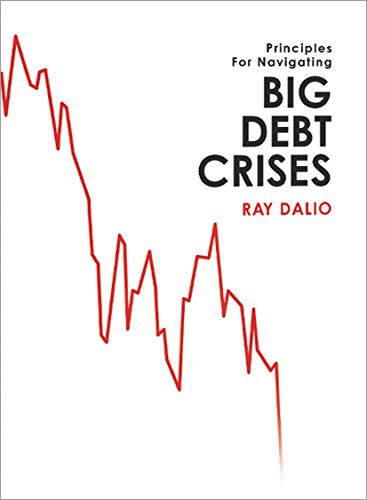
Principles for Navigating Big Debt Crises by Ray Dalio is a 2018 economics book about debt cycles, macroeconomics, financial crises. Debt crises follow a recognizable pattern: expansion, bubble, deleveraging, and either depression or beautiful deleveraging depending on the policy response.
Summary
Principles for Navigating Big Debt Crises is Ray Dalio's attempt to document a template for how major debt crises unfold and how policymakers can manage them. Dalio, founder of Bridgewater Associates, spent decades studying historical debt cycles to understand why economies periodically collapse under their own debt loads and why some recoveries are fast while others drag on for years. The book is unusual among economics texts because it treats financial history empirically: Dalio analyzed forty-eight historical debt crises and distilled a pattern he believes repeats across different countries and time periods.
Dalio distinguishes between two types of debt crises. Deflationary crises occur in currencies that the debtor controls — the central bank can print money, devalue, or restructure debt without losing the ability to make payments. Inflationary crises occur when debt is denominated in a foreign currency or in a domestic currency that the central bank no longer credibly controls. The distinction matters enormously for how a crisis plays out and what policy tools are available. The 2008 financial crisis was deflationary; many emerging market crises are inflationary.
The analytical framework is built around what Dalio calls the "beautiful deleveraging" — the rare, optimal case where debt is reduced through a combination of austerity, debt restructuring, wealth redistribution, and money printing in proportions that prevent either depression or runaway inflation. Getting those proportions right is the challenge. Too much austerity causes a deflationary spiral; too much money printing triggers inflation. The book traces the 2008 crisis as a detailed case study of a deleveraging that, by Dalio's measure, was managed reasonably well by the Federal Reserve.
The final section applies these principles to current conditions, with particular attention to the long-term debt cycle — the multi-decade pattern that Dalio believes now puts the United States and other major economies at a late-stage position. This is the most speculative part of the book and should be read as analysis rather than prediction. The historical section is where the book adds most durable value: forty-eight carefully documented cases that reveal structural patterns invisible to observers watching any single crisis unfold.
Talk to Principles for Navigating Big Debt Crises like its author wrote you back.
Get the ideas that fit your life — not generic summaries.
- Chat with the book
- Audiobook-style main ideas
- Adapts to your life and goals
- Helps you take action
Key takeaways
- 1.
Debt crises follow a recognizable pattern: expansion, bubble, deleveraging, and either depression or beautiful deleveraging depending on the policy response.
- 2.
Deflationary crises (debt in domestic currency) give policymakers more tools than inflationary crises (debt in foreign currency). The distinction shapes every available option.
- 3.
A beautiful deleveraging balances austerity, debt restructuring, wealth redistribution, and money printing in proportions that prevent deflation and hyperinflation simultaneously.
- 4.
Central banks can delay a deflationary crisis but not eliminate the underlying debt burden. Eventually the debt must be reduced through one of the four levers, or all of them.
- 5.
The 2008 crisis was a textbook deflationary deleveraging managed competently at the macro level, even if the distributional outcomes were deeply unequal.
- 6.
Short-term debt cycles (5-8 years) are driven by credit availability. Long-term debt cycles (50-75 years) are driven by the cumulative buildup of debt across many short cycles.
- 7.
Studying many historical cases reveals structural patterns that are invisible when analyzing any single crisis — Dalio's core methodological claim and the book's empirical foundation.
- 8.
Risk parity — holding assets that perform differently across economic environments — is Dalio's portfolio response to the uncertainty that big debt cycles create.
Discussion questions
Use these on your own, with a book club, or as chat starters in Superbook. Book club version, ready to copy or print →
- 1.
Dalio argues that debt crises follow a repeating template. How confident are you that historical patterns actually predict future crises, given how much economic contexts differ?
- 2.
What distinguishes a manageable deleveraging from one that turns into depression or hyperinflation? What conditions make the difference?
- 3.
The book was published in 2018. How has the period since then — including the 2020 pandemic response and subsequent inflation — fit or challenged Dalio's framework?
- 4.
Dalio argues that the long-term debt cycle now puts major economies in a late-stage position. What would you expect to see if that diagnosis is correct?
- 5.
How do you think about the distributional consequences of central bank interventions that prevent depression but also protect asset-holder wealth disproportionately?
- 6.
Dalio says the beautiful deleveraging requires political will to distribute pain. What makes that politically difficult, and are there historical examples where it worked?
- 7.
The book distinguishes between deflationary and inflationary crises. How does the current state of US dollar reserve currency status affect which type a future US crisis would be?
- 8.
How would you change your investment portfolio if you believed we were near the top of a long-term debt cycle?
- 9.
Dalio built this framework as a practitioner managing risk, not as an academic. How does that origin affect how you weigh the analysis?
- 10.
The 2008 crisis is presented as relatively well-managed. Do you agree with that assessment? What would a worse response have looked like?
- 11.
What's the most important thing Dalio's historical case studies reveal that you couldn't learn from reading about a single crisis?
- 12.
Dalio recommends holding a diversified portfolio across economic environments. How realistic is that approach for individual investors without access to alternatives markets?
Themes
Frequently asked questions
-
Who is this book for?
Primarily for people with a serious interest in macroeconomics, economic history, or systematic investment strategy. It requires comfort with economic concepts and is not an introductory text. Policy professionals, institutional investors, and informed general readers are the natural audience.
-
Is this book too long and dense to be worth it?
Part one, the template for big debt crises, is dense but rewarding and around 100 pages. Part two is forty-eight case studies which most readers will dip into selectively. Part three covers the 2008 crisis in detail. Reading part one and one or two case studies is sufficient to get the core value.
-
How does this compare to Dalio's book Principles?
Principles is about management philosophy and personal decision-making. This book is a technical analysis of macroeconomic history. They share Dalio's empirical, pattern-seeking style but are otherwise quite different in subject matter and tone.
-
Was Dalio right about debt cycles?
His framework has real explanatory power for historical crises. Its predictive value for specific future events is harder to assess. The pandemic response and subsequent inflation cycle fit some of his patterns and challenged others. It's best treated as a lens for understanding systemic risk, not a forecast.
-
Is this available free?
Dalio made a digital version available for free on Bridgewater's website and through LinkedIn, which was unusual for a major publication. Physical copies are also widely available.
Similar books
The Big Short: Inside the Doomsday Machine
Michael Lewis
The Black Swan: The Impact of the Highly Improbable
Nassim Nicholas Taleb

Antifragile: Things That Gain from Disorder
Nassim Nicholas Taleb
The Intelligent Investor
Benjamin Graham
