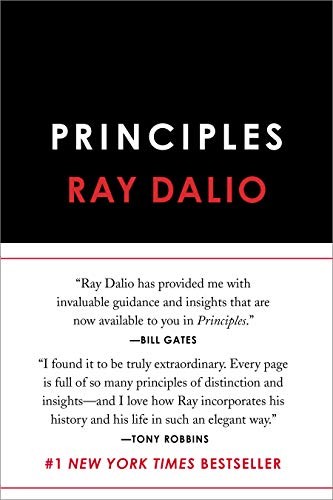
Principles by Ray Dalio is a 2017 business book about leadership, decision-making, organizational culture. Radical truth and radical transparency are the foundation of good decision-making and organizational health. Both require accepting reality as it is, not as you want it to be.
Summary
Principles is Ray Dalio's account of the mental models and management philosophy that he developed over forty years as founder of Bridgewater Associates, the world's largest hedge fund. The book is divided into three sections: a life story of how Dalio developed his principles through success and failure, a set of life principles about how to think and make decisions, and a set of work principles about how to build an organization that consistently makes good decisions.
Dalio's core philosophy centers on two ideas: radical truth and radical transparency. Radical truth means acknowledging reality as it is rather than as you wish it were — including painful realities about your own performance, your organization's failures, and the gaps between your intentions and your results. Radical transparency means making information available to everyone in the organization rather than filtering it through a hierarchical approval process. Both ideas are demanding in practice and have made Bridgewater a famously unusual and polarizing place to work.
The work principles introduce the idea of meritocracy of ideas: the best ideas win, regardless of who has them, based on evidence and logic rather than seniority or organizational politics. This requires what Dalio calls believability-weighted decision-making — weighting the input of people who have demonstrated superior judgment in a specific domain more heavily than those who haven't. The idea is meritocratic in principle but complex to implement in practice.
The book is extremely long and repetitive, organized as a list of principles that often say similar things in slightly different ways. Readers who want the core argument get it in the first third; the rest deepens and extends it. Dalio's willingness to document his own failures — particularly the early-1980s blowup that nearly destroyed Bridgewater — adds credibility to an otherwise self-congratulatory account.
Talk to Principles like its author wrote you back.
Get the ideas that fit your life — not generic summaries.
- Chat with the book
- Audiobook-style main ideas
- Adapts to your life and goals
- Helps you take action
Key takeaways
- 1.
Radical truth and radical transparency are the foundation of good decision-making and organizational health. Both require accepting reality as it is, not as you want it to be.
- 2.
The biggest barrier to good decisions is ego — the need to be right rather than to get to the right answer. An idea meritocracy requires subordinating ego to evidence.
- 3.
Pain plus reflection equals progress. Most people try to avoid pain; Dalio argues it's the signal that you need to learn something.
- 4.
Believability-weighted decision-making weights the input of people who have demonstrated superior judgment in a domain. Not all opinions are created equal.
- 5.
Successful organizations are machines that process information and translate it into decisions and actions. Designing that machine is the leader's primary job.
- 6.
The two biggest causes of organizational failure are not having standards high enough and not enforcing the standards you have. Most organizations oscillate between the two.
- 7.
An organization with clearly articulated principles and the discipline to apply them consistently outperforms one that makes decisions case by case, because the principles become shared intelligence.
- 8.
Mistakes are expected and acceptable; learning from them is required. Organizations that punish mistakes get fewer mistakes and less learning.
Discussion questions
Use these on your own, with a book club, or as chat starters in Superbook. Book club version, ready to copy or print →
- 1.
Radical transparency is polarizing: it makes Bridgewater a place where some people thrive and many can't last. What's the right level of transparency for your organization?
- 2.
Dalio says pain plus reflection equals progress. What's the most significant professional pain you've experienced? Did you reflect on it systematically, or avoid it?
- 3.
The idea of believability-weighted input — not treating all opinions as equally valid — is meritocratic in principle but raises power dynamics questions in practice. How does this play out in your organization?
- 4.
What principles would you articulate for how your team makes decisions? Have you ever written them down? What would change if you did?
- 5.
Dalio describes the 1982 failure that nearly destroyed Bridgewater as the most important event of his professional life. What failure has taught you the most?
- 6.
He argues that ego is the primary obstacle to good decision-making. In what specific situations does your ego most get in the way?
- 7.
Bridgewater's culture is described by many former employees as exhausting and sometimes brutal. Where does radical transparency become harmful rather than helpful?
- 8.
The book is very long. Does Dalio's decision to document his principles at this length signal something about how he thinks about principles? Is there a shorter version that would be just as useful?
- 9.
What's the gap in your organization between the principles it claims to follow and the principles it actually follows? What causes that gap?
- 10.
Dalio built a system of principles over forty years of trial and error. Is that process replicable, or is it so specific to Bridgewater that it can't be transplanted?
- 11.
He argues that organizations should be designed like machines. What's appealing about that framing and what does it miss?
- 12.
What would radical transparency look like in your organization, and who would it most affect?
Themes
Frequently asked questions
-
Is Principles worth reading in full?
The first third — the life story and introduction to the principles — is genuinely compelling and worth reading carefully. The work principles section is detailed enough that many readers benefit from skimming rather than reading cover to cover. The core ideas are communicated in the first 200 pages; the remaining 400 repeat and extend them.
-
How long does it take to read Principles?
Around ten hours for the 556-page book if you read it fully. The life principles section is faster-paced; the work principles are denser. Many readers spend a month with it, reading it in sections.
-
Is Bridgewater's culture actually as Dalio describes it?
Mostly yes, according to independent accounts, though the experience of it varies widely. Former employees describe environments of intense psychological pressure alongside genuine intellectual rigor. The culture is real; its effects on individuals differ substantially.
-
Who should read Principles?
Leaders who want a specific, detailed account of how one highly successful organization approaches decision-making and culture, people interested in how explicit principles can be used to build organizational intelligence, and anyone curious about whether Dalio's model can be applied outside of finance.
-
What's the most useful single principle in the book?
Pain plus reflection equals progress. It's the simplest and most broadly applicable of Dalio's ideas, and the one that requires the least context to understand. Learning from failure requires not just the failure but the systematic reflection on what it means — and most people skip the reflection.