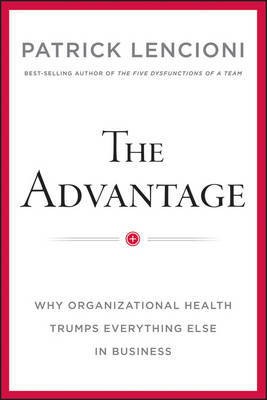
The Advantage by Patrick Lencioni is a 2012 business book about organizational health, leadership, team cohesion. Organizational health — cohesion, clarity, and consistent communication — is the greatest competitive advantage available to any organization and the most neglected.
Summary
The Advantage is Patrick Lencioni's argument that organizational health — not strategy, technology, or talent — is the single greatest advantage a company can have. He defines organizational health as the condition where a leadership team is cohesive, has clarity about what they're doing and why, and communicates that clarity with over-the-top consistency throughout the organization. In healthy organizations, politics, confusion, and dysfunction are minimized — and that reduction is worth more than any management tactic or smart strategy.
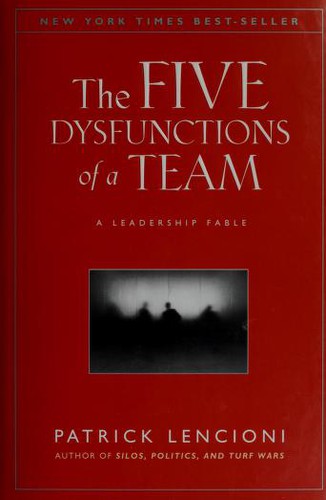
Lencioni builds on his earlier work, particularly The Five Dysfunctions of a Team, by integrating the team model into a broader organizational framework. The book is organized around four disciplines: building a cohesive leadership team, creating clarity (answering six critical questions about the organization), over-communicating that clarity, and reinforcing clarity through human systems — hiring, performance management, and recognition. The first discipline is foundational; without a genuinely cohesive leadership team, the rest is impossible.
The six clarity questions are the operational core of the book: Why do we exist? How do we behave? What do we do? How will we succeed? What is most important right now? Who must do what? Lencioni argues that most leadership teams cannot answer all six consistently — and that the inconsistency cascades through the entire organization as people fill the gaps with their own assumptions.
The book is direct about the leader's role: CEOs who claim they don't have time for organizational health work are prioritizing the wrong things. Meetings, communication, and culture are not soft activities to be delegated while the leader works on strategy. They are the leader's core job, and organizations that treat them as such consistently outperform those that don't.
Talk to The Advantage like its author wrote you back.
Get the ideas that fit your life — not generic summaries.
- Chat with the book
- Audiobook-style main ideas
- Adapts to your life and goals
- Helps you take action
Key takeaways
- 1.
Organizational health — cohesion, clarity, and consistent communication — is the greatest competitive advantage available to any organization and the most neglected.
- 2.
The four disciplines of organizational health: build a cohesive leadership team, create clarity, over-communicate clarity, and reinforce clarity through systems.
- 3.
A leadership team is not truly cohesive until members trust each other enough to engage in genuine unfiltered conflict about ideas — not artificial harmony.
- 4.
The six clarity questions must be answered consistently by every member of the leadership team: why exist, how to behave, what to do, how to succeed, what matters most now, and who does what.
- 5.
Most organizational dysfunction traces to a failure at the top of the organization, not the middle. Cascading problems have cascading sources.
- 6.
Over-communication of priorities is not repetition — it's necessary because people need to hear something multiple times and from multiple sources before they act on it consistently.
- 7.
HR systems — hiring, performance management, rewards — should be designed around the organization's answers to the six clarity questions, not around industry best practices imported without customization.
- 8.
Organizational health work is the CEO's job, not a program to be delegated to HR. Leaders who treat culture as an HR problem have misdiagnosed the source of their organization's issues.
Discussion questions
Use these on your own, with a book club, or as chat starters in Superbook. Book club version, ready to copy or print →
- 1.
Can every member of your leadership team answer all six clarity questions consistently? Test it — ask two colleagues separately. What do you find?
- 2.
Lencioni says organizational health is the greatest competitive advantage. What's the counterargument? Are there organizations that succeed despite significant dysfunction?
- 3.
Where in your organization is there real clarity — and where is there confusion or inconsistency that people have just learned to live with?
- 4.
The book says leadership teams that don't engage in genuine conflict aren't really cohesive — they're avoiding something. What do you know about your leadership team that it pretends not to know?
- 5.
Lencioni argues that over-communicating priorities is necessary, not excessive. How do you currently communicate what matters most? Is it enough?
- 6.
What's the gap between the values your organization posts on the wall and the values it actually enforces in performance management and promotion decisions?
- 7.
If you had to answer 'What is most important right now?' for your team in one sentence, what would you say? Does your team know that's your answer?
- 8.
Who in your organization makes decisions that contradict the stated strategy — not because they're bad actors but because they don't know the strategy well enough to apply it?
- 9.
Lencioni says organizational health work falls to the CEO. If you're not the CEO, whose job is it in your organization — and is anyone actually doing it?
- 10.
What would 'reinforcing clarity through human systems' look like concretely for your organization? What would change in your hiring, reviews, or recognition if you did this consistently?
- 11.
What's the biggest source of organizational dysfunction in your company? Trace it back to its source — where does it originate?
Themes
Frequently asked questions
-
Is The Advantage worth reading if I've already read The Five Dysfunctions of a Team?
Yes. The Advantage synthesizes and extends the dysfunctions model into a broader organizational health framework. It also adds the six clarity questions and the reinforcement systems model, which are not in the earlier book. It's more useful as a leadership guide; The Five Dysfunctions is more useful as a team diagnostic.
-
How long does it take to read The Advantage?
Around four hours for the 240-page book. Lencioni writes clearly with short chapters, making it readable in a weekend.
-
What are the six clarity questions?
Why do we exist? How do we behave? What do we do? How will we succeed? What is most important right now? Who must do what? Lencioni argues that consistency in answering all six across the leadership team is the foundation of organizational clarity.
-
Who should read The Advantage?
CEOs, founders, and senior executives who want a framework for thinking about organizational health as a leadership priority. Also useful for management teams preparing for strategic planning who want to address the people and culture dimensions alongside the strategic ones.
-
What's the biggest mistake leadership teams make according to Lencioni?
Treating organizational health as less important than smart strategy, technology, or operational excellence. Lencioni argues this is backwards: even brilliant strategy fails when the organization implementing it is confused, political, and incoherent. Health is the foundation; everything else is built on top.