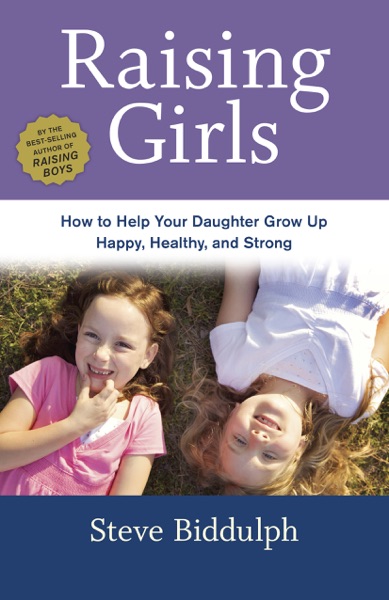
Raising Girls by Steve Biddulph is a 2013 self-help book about parenting, adolescence, gender. Girls' development unfolds in five distinct stages, each with different emotional needs and different parental roles. What works in early childhood can actively undermine growth in adolescence.
Summary
Raising Girls is Steve Biddulph's guide to the specific challenges of raising daughters in the contemporary world. Biddulph, an Australian psychologist who previously wrote the influential Raising Boys, argues that girls face a distinct set of pressures that have intensified over the past two decades — earlier sexualization, social media, peer cruelty, and a shrinking window of protected childhood — and that parents need more specific tools than general parenting advice provides.
The book is organized around five developmental stages: building security in the first two years, developing spark and exploration from ages two through five, building a sense of self from five through ten, navigating the turbulence of ten through fourteen, and finding purpose and direction from fourteen through adulthood. Each stage has its own characteristic challenges, and Biddulph identifies what girls need from parents at each phase — both what kind of closeness and what kind of progressive autonomy. He is particularly focused on the father-daughter relationship, arguing that a girl's relationship with her father has an underappreciated effect on her later sense of self-worth and her choices in relationships.
The sections on early adolescence are the most urgent. Biddulph argues that the age ten to fourteen window is a period of heightened vulnerability — girls are forming identity, are exquisitely sensitive to peer judgment, and are simultaneously being bombarded by sexual imagery, social media pressures, and competitive social dynamics that previous generations didn't face in the same form. His recommendations here are concrete: delay smartphone access, maintain family meals, monitor friendships without surveilling, and ensure girls have at least one relationship with a trusted adult outside the immediate family.
Biddulph is prescriptive in ways some readers will find old-fashioned. He has strong views about the damage done by too much screen time, too-early emphasis on academic performance, and commercial culture's effect on girls' self-image. These views are grounded in clinical observation and research, but they carry values that not all readers will share. The book is most useful read as a clinical perspective informed by decades of work with families, with readers deciding which specific recommendations fit their context.
Talk to Raising Girls like its author wrote you back.
Get the ideas that fit your life — not generic summaries.
- Chat with the book
- Audiobook-style main ideas
- Adapts to your life and goals
- Helps you take action
Key takeaways
- 1.
Girls' development unfolds in five distinct stages, each with different emotional needs and different parental roles. What works in early childhood can actively undermine growth in adolescence.
- 2.
The father-daughter relationship has a specific and underappreciated influence on a girl's sense of self-worth and her later relationship choices. Fathers who are emotionally present, not just physically present, make a measurable difference.
- 3.
The ten-to-fourteen window is the highest-risk period for girls. Identity formation, peer sensitivity, and early exposure to sexual imagery coincide in ways that can be destabilizing without strong parental anchoring.
- 4.
Girls need both closeness and progressive autonomy from their parents — but the balance shifts at each developmental stage. Holding on too long and letting go too early both create predictable problems.
- 5.
Social cruelty among girls — relational aggression, exclusion, gossip — is a distinct phenomenon from the physical aggression more common among boys, and it requires a different parental response.
- 6.
Commercial culture, social media, and early sexualization create pressures on girls' self-image that did not exist for previous generations at the same intensity or starting at the same age.
- 7.
Resilience in girls comes primarily from strong relationships — with parents, mentors, and peers — rather than from explicit resilience training. Isolation is the main enemy of wellbeing.
Discussion questions
Use these on your own, with a book club, or as chat starters in Superbook. Book club version, ready to copy or print →
- 1.
Biddulph organizes the book around five developmental stages. Looking back at your own childhood or the childhood of girls you know, does the stage framework reflect what you observed?
- 2.
He argues that the father-daughter relationship has a specific influence on daughters' self-worth that mothers can't replicate. Is that claim supported by what you've seen, or does it feel overstated?
- 3.
The book is critical of smartphones for children under fourteen. Where do you draw the line in your own household or in families you know, and how did you arrive at that position?
- 4.
Biddulph says girls' social cruelty — exclusion, gossip, relational aggression — requires a different response than physical aggression. What response does he recommend, and does it match your experience or intuition?
- 5.
He argues that girls need at least one trusted adult outside the immediate family — a mentor, aunt, teacher, coach. Was there such a person in your own life, and what role did they play?
- 6.
The book was published in 2013. Social media platforms have changed significantly since then. Which of Biddulph's observations about digital media do you think still apply, and which have been overtaken by events?
- 7.
Biddulph is writing specifically about girls, but some of his developmental framework seems like it would apply to children generally. Where does the gender-specific framing add the most value, and where does it seem to over-separate?
- 8.
He is concerned about early sexualization of girls in commercial culture. Is this concern well-founded, or does it risk over-protecting girls in ways that limit their autonomy?
- 9.
The book's recommendations for early adolescence — delayed smartphones, maintained family meals, monitored friendships — require significant parental involvement. How realistic are these for families with limited time or resources?
- 10.
Biddulph is prescriptive about what good parenting looks like. How do you distinguish clinical guidance from values preferences in books like this?
- 11.
If you were to add a sixth developmental stage to cover adulthood (eighteen and beyond), what do you think daughters most need from their parents during that phase?
Themes
Frequently asked questions
-
Is Raising Girls relevant for parents of boys?
Partly. The developmental stage framework and the emphasis on emotional presence apply across genders. But the sections specific to girls — social cruelty, sexualization, the father-daughter dynamic — are gender-specific, and those are a substantial portion of the book.
-
Does the book have a political or ideological slant?
Biddulph is a social progressive who is critical of commercialism and early sexualization. His tone is clinical rather than ideological, but readers who disagree with the premise that commercial culture harms girls may find parts of the book feel like advocacy rather than evidence.
-
Is this based on research or just clinical observation?
Both. Biddulph draws on developmental psychology research throughout, with references, but also relies heavily on clinical cases and his own experience. It's rigorous popular psychology rather than a systematic literature review.
-
What age group of parents is this book most useful for?
Parents of daughters from infancy through early adulthood will find relevant material. The adolescence chapters are probably the most valuable for most readers, since that period tends to feel least predictable. Parents of young children will also benefit from understanding where things are heading.
-
How does Raising Girls compare to Raising Boys?
The structure is similar, and both books emphasize the father relationship. Raising Girls is more focused on social dynamics, self-image, and the specific pressures girls face from commercial culture. Raising Boys is more concerned with emotional expression and risk-taking. Both reward reading together.
Similar books

Behave: The Biology of Humans at Our Best and Worst
Robert M. Sapolsky
Quiet: The Power of Introverts in a World That Can't Stop Talking
Susan Cain
Grit: The Power of Passion and Perseverance
Angela Duckworth

The Coddling of the American Mind
Greg Lukianoff and Jonathan Haidt
