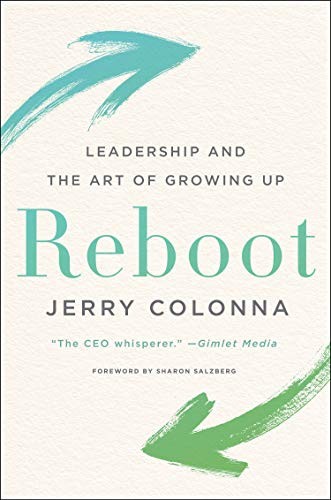
Reboot by Jerry Colonna is a 2019 business book about leadership, self-awareness, coaching. How you lead others is shaped by who you are — your histories, fears, and unexamined patterns — more than by your skills and techniques.
Summary
Reboot is Jerry Colonna's examination of the connection between a leader's inner life and their organizational behavior — the argument that how you lead others is shaped by who you are, and that who you are is shaped by experiences, traumas, and stories that most people carry unexamined into leadership. Colonna, a former VC turned executive coach, writes from decades of working with CEOs and founders who were technically accomplished but internally struggling in ways that affected their organizations.
The book's organizing question is: "How are you complicit in creating the conditions you say you don't want?" It's a deliberately uncomfortable question, and Colonna applies it to the leaders he works with who find themselves in painful situations — toxic team dynamics, disconnected co-founders, organizations that feel more like prisons than places of purpose. In almost every case, his answer is that the leader's own unexamined patterns are contributing to the problem they're blaming on others.
Colonna draws on his own difficult history — a challenging childhood, professional failure, depression, and recovery — to model the kind of self-examination he asks of his clients. This is unusual for a leadership book: the author's vulnerability is structural, not incidental. The book is as much memoir as management, and the combination creates a different tone from most leadership books — more honest about the emotional cost of leadership and more direct about what genuine development requires.
The leadership model Colonna advocates is built on "radical self-inquiry" — the practice of asking hard questions about your own motivations, patterns, and histories rather than optimizing your techniques. His premise is that leaders who do this work are more effective not because they've acquired new skills but because they're less driven by unacknowledged fears and childhood patterns that distort their decisions under pressure.
Talk to Reboot like its author wrote you back.
Get the ideas that fit your life — not generic summaries.
- Chat with the book
- Audiobook-style main ideas
- Adapts to your life and goals
- Helps you take action
Key takeaways
- 1.
How you lead others is shaped by who you are — your histories, fears, and unexamined patterns — more than by your skills and techniques.
- 2.
The key question for any leader in a difficult situation: 'How are you complicit in creating the conditions you say you don't want?'
- 3.
Radical self-inquiry is not therapy — it's the deliberate practice of asking hard questions about your own motivations so they don't drive you unconsciously.
- 4.
Most leadership crises are not primarily business problems. They're places where the leader's internal story is playing out in organizational form.
- 5.
The cost of not doing the inner work shows up in your leadership: in the team dynamics you can't explain, the conflict you can't resolve, the pattern you keep repeating.
- 6.
Vulnerability is not weakness in leadership — it's the precondition for genuine trust. Leaders who can't show their own humanity build cultures where others can't either.
- 7.
Loneliness is the defining condition of leadership at the top. Acknowledging it is the first step to addressing it; pretending it doesn't exist makes it worse.
- 8.
Leadership development is personal development. The techniques and frameworks are secondary to the question of who you're becoming through the process of leading.
Discussion questions
Use these on your own, with a book club, or as chat starters in Superbook. Book club version, ready to copy or print →
- 1.
Colonna's central question is 'how are you complicit in creating the conditions you say you don't want?' Apply it honestly to your most difficult current work situation.
- 2.
What's the most significant thing from your personal history that you carry into your leadership without consciously intending to? How does it show up?
- 3.
Have you experienced the loneliness Colonna describes as specific to leadership? What did you do with it?
- 4.
What's a leadership pattern you repeat that you've been unable to explain or change through skill-building? What might radical self-inquiry reveal about it?
- 5.
Colonna shares his own history of depression and failure openly. How does a leader's public vulnerability affect the culture around them? What are the risks as well as the benefits?
- 6.
What stories about yourself — as a leader, as a professional, as a person — are you most invested in protecting? How might those stories be limiting you?
- 7.
The book argues that leadership development is personal development. Do you agree? Or is there a meaningful distinction between the two that the book collapses?
- 8.
What would it take for you to do the kind of inner work Colonna describes? What's the obstacle — time, willingness, or something else?
- 9.
Colonna writes about working with founders and CEOs who are technically accomplished but internally struggling. What does 'internally struggling' look like from the outside, and what does it cost organizations?
- 10.
What's the difference between self-awareness and self-absorption in a leader? Where does the inner work become indulgent rather than productive?
- 11.
If you could ask yourself Colonna's central question about one specific situation in your professional life right now, what would you ask — and what would the honest answer be?
Themes
Frequently asked questions
-
Is Reboot worth reading?
Yes, particularly for founders and executives who feel that the standard leadership playbook isn't addressing what's actually hard about their situation. Colonna is unusually honest about the inner dimensions of leadership, and the book reaches parts of the leadership experience that most management books don't touch.
-
How long does it take to read Reboot?
Around five hours for the 256-page book. It blends memoir and coaching in a way that reads faster than either alone.
-
Is this a therapy book or a leadership book?
It's a leadership book that takes the psychological dimensions of leadership seriously — more seriously than most. It's not clinical and doesn't prescribe therapeutic interventions, but it encourages the kind of self-examination that most leadership books avoid. Some readers find this exactly what they need; others find it more personal than they were expecting.
-
Who should read Reboot?
Founders, CEOs, and senior leaders who feel that something important is missing from how they're thinking about their leadership challenges, and who are open to the possibility that the inner work is relevant. Also useful for coaches and advisors who work with high-performing leaders.
-
What's the most important idea in Reboot?
The complicity question: 'How are you complicit in creating the conditions you say you don't want?' It's discomforting, not because it assigns blame, but because it opens the possibility that the leader's patterns — not just the external situation — are a factor. That opening is where genuine change becomes possible.