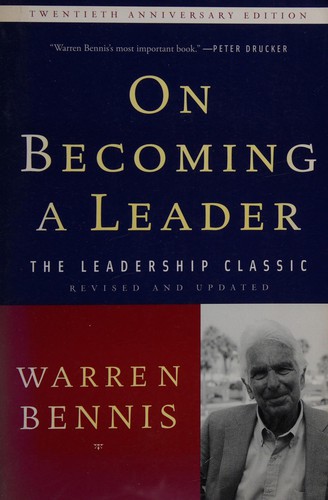
On Becoming a Leader by Warren Bennis is a 1989 business book about leadership, self-knowledge, character. Managers do things right; leaders do the right things. Leadership is about direction and purpose; management is about optimization within given constraints.
Summary
On Becoming a Leader is Warren Bennis's argument that leadership is not a set of techniques to be mastered but a continuous process of self-discovery — and that the most important leadership development work is inner rather than outer. Written in 1989 and updated in subsequent editions, the book draws on extended interviews with ninety leaders across business, government, academia, and the arts. The through-line is that leadership emerges from knowing who you are, not from learning what leaders do.
Bennis makes a distinction that became influential: managers do things right; leaders do the right things. Managers optimize within given constraints; leaders question the constraints. He argues that most organizations over-manage and under-lead, producing organizations that are efficient at executing strategies that are wrong. The leader's role is to create a compelling vision of reality and build the social architecture that enables people to pursue it.
The book is organized around what Bennis calls the four qualities of leaders: guiding vision (knowing what you want to accomplish), passion (genuine engagement with the work), integrity (knowing your values and acting on them consistently), and trust (the consistency that makes you predictable to others). These aren't techniques. They emerge from self-knowledge, and self-knowledge emerges from experience — particularly from the experience of navigating adversity, failure, and ambiguity.
Where the book is most distinctive is in its insistence that learning from experience requires reflection, not just exposure. Leaders who go from one experience to the next without making meaning of what happened don't develop — they just accumulate events. Bennis argues that the capacity to learn from your own experience is the fundamental developmental skill, and that it distinguishes leaders who grow over time from those who plateau.
Talk to On Becoming a Leader like its author wrote you back.
Get the ideas that fit your life — not generic summaries.
- Chat with the book
- Audiobook-style main ideas
- Adapts to your life and goals
- Helps you take action
Key takeaways
- 1.
Managers do things right; leaders do the right things. Leadership is about direction and purpose; management is about optimization within given constraints.
- 2.
Leadership cannot be taught from the outside. It emerges from self-knowledge — knowing your values, your strengths, your purpose, and your style.
- 3.
Experience alone doesn't develop leaders. Reflecting on experience and making meaning from it is what separates leaders who grow from those who plateau.
- 4.
The four qualities Bennis identifies in effective leaders: guiding vision, passion, integrity, and trust. None of these are techniques — all emerge from character.
- 5.
Organizations over-manage and under-lead. The cost is efficient execution of the wrong priorities.
- 6.
Adversity is the primary school of leadership. How you handle failure, betrayal, and ambiguity reveals more about your character than success does.
- 7.
Trust is built through consistency. People need to predict your behavior; unpredictability, even when clever, erodes the social architecture of leadership.
- 8.
The most dangerous organizational phrase is 'we've always done it this way.' Leaders question the constraints that managers optimize within.
Discussion questions
Use these on your own, with a book club, or as chat starters in Superbook. Book club version, ready to copy or print →
- 1.
Bennis says leadership emerges from self-knowledge. What do you know about yourself — your values, your purpose, your working style — that you didn't know five years ago? What taught you that?
- 2.
Think about a leader you admired. Was it their vision, their passion, their integrity, or their consistency that you most respected? Did they have all four, or was one especially strong?
- 3.
The managers-do-things-right, leaders-do-the-right-things distinction is clean but is it real? Have you worked for someone who was genuinely both? Can you be both?
- 4.
Bennis argues that reflection on experience is the essential learning mechanism for leaders. Do you build deliberate reflection into your work? What does that look like in practice?
- 5.
What's the most significant failure you've experienced in your career? What did you learn from it? How deliberately did you process it?
- 6.
Where in your organization is the biggest gap between managing and leading? What's the cost of that gap?
- 7.
Bennis says trust requires consistency. Where in your leadership are you least consistent, and what does that inconsistency cost you with your team?
- 8.
The book was written in 1989. What's changed about the leadership context since then? What's the same?
- 9.
Who in your current organization or career has the four qualities Bennis describes — vision, passion, integrity, trust — most fully? What makes them stand out?
- 10.
What adversity in your professional life has shaped you most as a leader? Would you have grown without it?
- 11.
If you were to articulate your guiding vision — for your team, your organization, or your career — what would it be? Can you say it in a single sentence?
Themes
Frequently asked questions
-
Is On Becoming a Leader worth reading today?
Yes, particularly for its emphasis on self-knowledge and reflection as the core leadership disciplines. The observations about over-management and the dangers of leader-less organizations feel as relevant in 2025 as they did in 1989. Some of the interview quotes are dated, but the arguments have held up.
-
How long does it take to read On Becoming a Leader?
Around four hours for the 256-page book. It's essay-like rather than framework-driven, so it reads more like a thoughtful mentor's observations than a management textbook.
-
What's the main difference between On Becoming a Leader and other leadership books?
Most leadership books focus on what effective leaders do — techniques, habits, frameworks. Bennis focuses on what effective leaders are, and argues that the doing follows from the being. It's more philosophical and less prescriptive than most, which some readers find frustrating and others find more honest.
-
Who should read On Becoming a Leader?
People early in their leadership journey who want a framework for thinking about development rather than a list of skills to acquire. Also useful for experienced leaders who feel they've absorbed many techniques but want to reconnect with the question of why they lead.
-
What's the most important idea in the book?
The argument that reflection is the essential mechanism of leadership development. Leaders who move from experience to experience without making meaning of what happened don't grow — they just accumulate time. Building a deliberate reflective practice is the most underinvested development activity most leaders have.