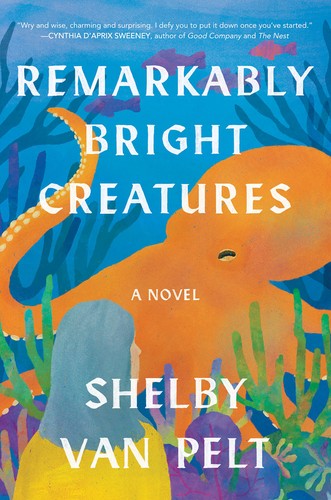
Remarkably Bright Creatures by Shelby Van Pelt is a 2022 contemporary fiction book about grief and loss, connection across difference, animal intelligence. The octopus narrator is the novel's central formal innovation: chapters from Marcellus's perspective are written with genuine specificity about octopus cognition, then extended into personality and observation.
Summary
Marcellus is a giant Pacific octopus living in the Sowell Bay Aquarium. He observes the staff, the visitors, and the aquarium's systems with the kind of patient, lateral intelligence his species is documented to possess — and, in the novel, narrates chapters from his perspective with dry, precise wit. Tova Sullivan, the overnight cleaning woman, develops a relationship with him. She is seventy-something, recently widowed, methodical, and quietly devastated by the thirty-year-old disappearance of her son Erik. Cameron Cassmore, young and drifting, arrives in Sowell Bay looking for something he can't quite name. These three trajectories converge.
Remarkably Bright Creatures is easier to describe by what it isn't than what it is. It isn't coy about Marcellus's chapters — the octopus narration is played straight and earnestly, with genuine personality behind it. It isn't a mystery novel, though there is a missing person at its center. It isn't grief literature in the heavy, deliberate mode; the grief is present throughout but the book maintains an unlikely lightness that comes partly from Marcellus's perspective and partly from the warmth Shelby Van Pelt clearly feels for her characters.
Van Pelt's prose is accessible and moves quickly, with the aquarium setting used to ground the novel in consistent, vivid atmosphere. The resolution of the family mystery is signaled earlier than the narrative pretends, which some readers will find satisfying (confirmation of a sense they had) and others will find too neat. The book doesn't ask hard questions about animal captivity — Marcellus is content enough at the aquarium that the novel sidesteps the ethical complications his situation actually raises.
This is fundamentally comfort fiction that uses unconventional architecture. The octopus POV is the structural gambit that turned a quiet novel about an elderly widow's grief into a word-of-mouth phenomenon. It works because Marcellus is genuinely well-rendered — scientifically grounded in what octopuses actually do, emotionally resonant in ways the reader is invited to project. Readers who want unsentimental realism or literary challenge will bounce off it. Readers who want warmth, intelligence, and a story that ends well should be more than satisfied.
Talk to Remarkably Bright Creatures like its author wrote you back.
Get the ideas that fit your life — not generic summaries.
- Chat with the book
- Audiobook-style main ideas
- Adapts to your life and goals
- Helps you take action
Key takeaways
- 1.
The octopus narrator is the novel's central formal innovation: chapters from Marcellus's perspective are written with genuine specificity about octopus cognition, then extended into personality and observation.
- 2.
Tova's grief for her missing son is the novel's emotional core, and Van Pelt is patient with it — thirty years of quiet devastation rendered with more restraint than sentimentality.
- 3.
The found-family structure, familiar from a lot of contemporary fiction, works here because the unlikely connection between Tova and the aquarium creatures feels earned rather than forced.
- 4.
Cameron's storyline is the weakest of the three; his voice is less distinct than Tova's and Marcellus's, and his arc is more predictable.
- 5.
The novel sidesteps the ethical complications of keeping a highly intelligent creature in an aquarium, which is a real choice that limits its seriousness about what it's actually depicting.
- 6.
Van Pelt's pacing is efficient — the book moves through its timeline without dragging, which keeps the emotional weight from becoming oppressive.
- 7.
The mystery resolution is foreshadowed clearly enough that attentive readers will see it coming, which either confirms their investment or deflates the reveal depending on preference.
- 8.
The book's tone — warm, slightly eccentric, fundamentally kind — is its greatest achievement and also its clearest limit: it has decided how things will turn out and takes you there without detours.
Discussion questions
Use these on your own, with a book club, or as chat starters in Superbook. Book club version, ready to copy or print →
- 1.
Marcellus narrates with wit and precision about human behavior. What does the octopus POV allow the novel to observe about people that a human narrator couldn't, or wouldn't?
- 2.
The novel largely declines to engage with the ethics of keeping a giant Pacific octopus in an aquarium. Does that feel like a gap to you, or is it appropriate given the kind of book this is?
- 3.
Tova's grief has shaped her into someone very contained, very routinized. What does her relationship with Marcellus give her that the people in her life haven't?
- 4.
Cameron arrives as something of a wildcard. Does his storyline earn equal weight with Tova's, or does the book struggle to make him as interesting?
- 5.
The mystery of Erik's disappearance drives the plot, but the novel signals the answer fairly early. Did you see it coming? Does it matter?
- 6.
Remarkably Bright Creatures was a word-of-mouth bestseller. What do you think drove that — the subject, the tone, the octopus, or something else?
- 7.
The novel is explicitly kind to its characters. Where does kindness toward characters become a limitation for a novel's truthfulness?
- 8.
Van Pelt draws on documented octopus behavior — the escape artistry, the problem-solving, the color displays. How much does the scientific grounding help you accept Marcellus as a narrator?
- 9.
Tova is elderly and has made peace with a kind of small, quiet life. Is the novel treating that as something to be overcome, or as a valid way to be in the world?
- 10.
How does this compare to other novels with animal narrators you've read — or to fiction that imagines non-human consciousness generally?
- 11.
The ending is unambiguously good news. Does the novel earn that happiness, or does it feel like a reward for reading rather than a consequence of the story?
- 12.
What does it mean that the character who sees Tova most clearly is a cephalopod?
Themes
Frequently asked questions
-
Is Remarkably Bright Creatures worth reading?
Yes, if you enjoy warm, gently unconventional fiction that handles grief without being crushing. The octopus narrator is a genuine novelty that earns its place. If you want literary challenge or moral complexity, look elsewhere.
-
Is the octopus narration gimmicky?
Less gimmicky than it sounds. Van Pelt grounds Marcellus in real octopus behavior and gives him a distinct voice rather than just anthropomorphizing him. Whether it works for you depends on your tolerance for the book's fundamental warmth.
-
How sad is this book?
Grief is central to it, but the novel manages an unusual emotional register — sad events are present throughout, but the overall tone is unexpectedly warm. Most readers finish it feeling better than they expected to.
-
Who shouldn't read this book?
Readers looking for literary ambition, morally serious fiction, or any book that doesn't resolve into warmth and hope. Also possibly readers who will be distracted by the unaddressed ethics of aquarium captivity.
-
Is there an audiobook?
Yes, and it's frequently recommended as the best format for this novel — the multiple narrators, including the voice cast for Marcellus, are cited by many readers as adding significantly to the experience.
Similar books
The Soul of an Octopus: A Surprising Exploration into the Wonder of Consciousness
Sy Montgomery

The Paper Palace
Miranda Cowley Heller

Normal People
Sally Rooney

The Year of Magical Thinking
Joan Didion
