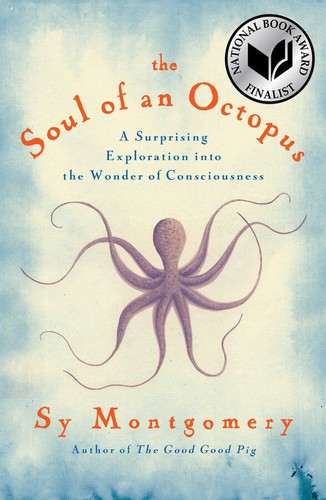
The Soul of an Octopus: A Surprising Exploration into the Wonder of Consciousness by Sy Montgomery is a 2015 science book about animal consciousness, marine life, natural history. Individual octopuses have distinct personalities — some bold, some shy, some playful, some aloof — that aquarium staff recognize reliably across years of handling.
Summary
Sy Montgomery is a naturalist and author who began spending time at the New England Aquarium to get to know a giant Pacific octopus named Athena. The Soul of an Octopus is what she found there over several years: not a scientific monograph on cephalopod cognition but a personal account of developing relationships with individual octopuses, each with a distinct personality, and what those encounters opened up about consciousness, connection, and death.
The book follows four octopuses in sequence — Athena, Octavia, Kali, and Karma — and the aquarium staff and volunteers who cared for them. Montgomery learns to touch and be touched by the animals, describes the way different individuals respond differently to the same handling, and traces the brief, vivid span of an octopus life from the curiosity of a young animal to the decline that precedes death. The writing is warm and specific, rooted in observation rather than abstraction. She is not making a formal scientific argument; she is reporting what she saw and felt.
Threaded through the aquarium visits are broader reflections on octopus biology — the distributed nervous system, the chromatophores, the arms that taste and feel independently — and on the philosophical question of what it means to be conscious in a body so different from a human one. Montgomery draws on conversations with the aquarium's biologists and on research literature, but she wears her learning lightly. The book's primary method is attentiveness rather than analysis.
What sets The Soul of an Octopus apart from more academic treatments of animal cognition is its emotional register. Montgomery does not argue that octopuses are conscious; she shows what it is like to act as if they might be, to bring the assumption of inner life to every encounter, and to see what that assumption reveals. The result is a book about animals that is also unmistakably about mortality, friendship, and what we choose to pay attention to.
Talk to The Soul of an Octopus: A Surprising Exploration into the Wonder of Consciousness like its author wrote you back.
Get the ideas that fit your life — not generic summaries.
- Chat with the book
- Audiobook-style main ideas
- Adapts to your life and goals
- Helps you take action
Key takeaways
- 1.
Individual octopuses have distinct personalities — some bold, some shy, some playful, some aloof — that aquarium staff recognize reliably across years of handling.
- 2.
Octopus arms contain two-thirds of their neurons and can act semi-autonomously, tasting and gripping and exploring without direct instruction from the central brain.
- 3.
An octopus can recognize individual human faces and respond differently to different people, even when those people are dressed identically.
- 4.
Giant Pacific octopuses live only three to five years; their brief lives are marked by rapid growth, intense curiosity, and a senescence that arrives suddenly.
- 5.
The chromatophores in octopus skin — pigment cells controlled by muscle and nerve — allow color and pattern changes in under a second, creating a real-time external representation of neural state.
- 6.
Montgomery argues that consciousness, or something like it, may be a more distributed and variable property than human-centric definitions allow.
- 7.
Caring for animals in captivity raises genuine ethical questions about the trade-off between individual welfare and public education or conservation awareness.
- 8.
Attentiveness — sustained, non-instrumental observation — is itself a way of knowing, not just a precursor to scientific measurement.
Discussion questions
Use these on your own, with a book club, or as chat starters in Superbook. Book club version, ready to copy or print →
- 1.
Montgomery develops real affection for individual octopuses. Is that a methodological problem for understanding them accurately, or does it enable a different kind of knowledge?
- 2.
The book reports that octopuses recognize individual human faces and treat people differently based on past interactions. What would you need to see to conclude that an animal has something like a social self?
- 3.
Montgomery is explicitly not making a scientific argument but a personal one. What are the limits and strengths of that approach for exploring questions about animal consciousness?
- 4.
Each octopus in the book has a distinct personality. How does that evidence change how you think about the assumption that animal behavior is uniform within a species?
- 5.
The octopuses in the book all die, and Montgomery describes each death. How did reading those passages affect your sense of what the book is really about?
- 6.
Aquariums hold individual animals in captivity partly to educate the public about conservation. Do you find that trade-off acceptable? What would change your view?
- 7.
Montgomery describes the practice of simply sitting with an octopus and noticing. What is something in your own life you've come to understand better through sustained observation rather than analysis?
- 8.
The book's title refers to the soul of an octopus. What do you think Montgomery means by that word, and do you find it appropriate or sentimental?
- 9.
Octopus lives are very short. Does the brevity of a life change its moral weight, or only our emotional response to it?
- 10.
Montgomery weaves together the aquarium visits with reflections on loss and death among the human characters too. Did you find that parallel illuminating or distracting?
- 11.
What's the strongest argument against the idea that octopuses have any form of inner experience? How did reading the book affect your confidence in that argument?
- 12.
If an octopus can recognize you and remember how you've treated it, does that create an obligation toward that individual animal? Where does that obligation begin and end?
Themes
Frequently asked questions
-
Is The Soul of an Octopus worth reading?
Yes, particularly if you're drawn to personal natural history writing and questions about animal consciousness. It's warm, specific, and emotionally honest. Readers looking for a rigorous scientific treatment will want to pair it with something like Peter Godfrey-Smith's Other Minds.
-
How long does it take to read The Soul of an Octopus?
About four to five hours at a comfortable pace. The chapters are organized around individual octopuses and read almost like interconnected essays, so it's easy to pick up and set down.
-
What is the book really about?
On the surface, it's about octopuses at an aquarium. Underneath, it's about paying close attention to other forms of life, the nature of consciousness, and how mortality looks when experienced across species.
-
How does this book differ from Other Minds by Peter Godfrey-Smith?
Montgomery's approach is personal and emotional — she builds relationships with individual octopuses and reports what she observes. Godfrey-Smith uses cephalopods to make philosophical arguments about the evolution of consciousness. They complement each other well but are quite different in tone and method.
-
Who should read this book?
Natural history readers, animal lovers, and anyone interested in consciousness who doesn't want a purely academic approach. It's also a good choice for book clubs because the questions it raises — about personality, death, and what makes a life matter — apply well beyond octopuses.
Similar books
Other Minds: The Octopus, the Sea, and the Deep Origins of Consciousness
Peter Godfrey-Smith
Are We Smart Enough to Know How Smart Animals Are?
Frans de Waal

The Sixth Extinction: An Unnatural History
Elizabeth Kolbert
The Omnivore's Dilemma
Michael Pollan
