Science · Book club
Rest: Why You Get More Done When You Work Less book club questions
Here are 12 book club questions for Rest: Why You Get More Done When You Work Less by Alex Soojung-Kim Pang, ordered to open easily and end somewhere worth arguing about. Copy them, print them, or bring them up one at a time.
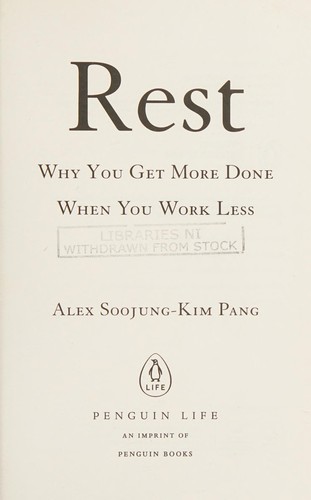
Rest makes a case that most of what we think of as productive work is actually counterproductive when pushed past certain thresholds, and that deliberate, well-structured rest is not the opposite of work but a necessary component of it.
Alex Soojung-Kim Pang · 2016 · 5h 15m
Full summary and key takeaways →The 12 questions
- 1.
Pang argues elite creative workers typically did four to five hours of serious work a day. How does that compare to what your workday actually looks like?
- 2.
When do your best ideas tend to arrive — in front of a screen, or during a walk, a shower, or just before sleep? What does that suggest about your working habits?
- 3.
What does rest actually look like in your life right now? Is it genuinely restorative, or is it passive consumption that leaves you as depleted as before?
- 4.
Have you ever noticed your judgment deteriorating late in a workday or after a string of short nights? What did you do about it?
- 5.
Pang describes 'deep play' as an absorbing hobby that requires genuine skill and attention. Do you have one? If not, what's in the way?
- 6.
Think of the most productive period of your life. How did you structure your time, and how much deliberate rest did it include?
- 7.
The biographical examples in the book span Darwin, Dickens, and others who had control over their schedules in a way most people don't. What parts of the framework are actually transferable to your situation?
- 8.
Do you nap? If not, what prevents you — culture, logistics, or the belief that napping is unproductive?
- 9.
Where in your work environment is rest implicitly discouraged or associated with weakness? What would it take to change that?
- 10.
What would a sabbatical look like for you? What would you need in place to make it possible in the next five years?
- 11.
Pang argues that vacations spent fully disconnected produce better returns than vacations where you stay partly connected. Does your experience match that?
- 12.
Which form of rest described in the book — sleep, naps, walks, hobbies, sabbaticals — is most underused in your life right now?
How to run the discussion
- Pick six to eight, not all of them. An hour of real discussion covers fewer questions than anyone expects, and racing the list is what makes a book club feel like homework.
- Open with what people noticed, not what they concluded. Asking for a verdict first hardens opinions before anyone has heard each other.
- Let the disagreement run. The questions below that split a room are the ones worth the time; the ones everyone answers the same way can be skipped.
- Ask the quiet person a specific question. A direct, narrow question is far easier to answer than an open invitation to contribute.
Themes worth steering toward
If the conversation stalls, these are the threads that usually restart it.
Common questions
What are good book club questions for Rest: Why You Get More Done When You Work Less?
Here are 12 book club questions for Rest: Why You Get More Done When You Work Less by Alex Soojung-Kim Pang, ordered to open easily and end somewhere worth arguing about. The strongest openers ask what each reader noticed rather than what they concluded, and the discussion usually turns on rest, creativity, productivity.
How long should a book club discussion of Rest: Why You Get More Done When You Work Less last?
Most groups run 60 to 90 minutes of actual discussion. That is roughly six to eight questions, not all of them, so pick the ones that suit your group rather than working down the list in order.
What are the main themes in Rest: Why You Get More Done When You Work Less?
Rest, Creativity, Productivity, Work habits, Recovery. Those are the threads most likely to divide a room, which makes them the useful places to steer a discussion that has gone quiet.
Picking the next one? See books like Rest: Why You Get More Done When You Work Less or questions for other book club picks.
