Self-help · Book club
Rich Dad Poor Dad book club questions
Here are 12 book club questions for Rich Dad Poor Dad by Robert T. Kiyosaki, ordered to open easily and end somewhere worth arguing about. Copy them, print them, or bring them up one at a time.
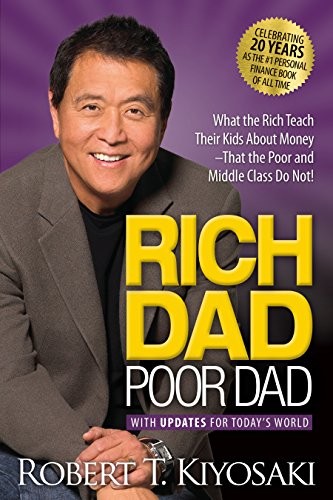
Rich Dad Poor Dad is Robert Kiyosaki's semi-autobiographical argument that the financial education most people receive — from schools, from parents, from conventional wisdom — prepares them for the wrong life.
Robert T. Kiyosaki · 1997 · 3h 45m
Full summary and key takeaways →The 12 questions
- 1.
Kiyosaki defines assets and liabilities in a non-standard way — by cash flow rather than accounting convention. Do you find this framing useful, misleading, or both?
- 2.
Think about your largest financial holding — your home, your retirement account, your car. Does it put money in your pocket or take money out each month?
- 3.
The book argues that employees and the self-employed trade time for money in a fundamentally limited way. Do you agree with that framing of employment? Where does it break down?
- 4.
Kiyosaki is vague on specific implementation throughout. Is that a feature (it forces you to figure out the path for yourself) or a flaw (it leaves readers inspired but without usable guidance)?
- 5.
The book has been criticized for overstating the achievability of its path and for factual inaccuracies in the story. Does that criticism change how you read it, or does the core framework stand independently of the biography?
- 6.
What financial concepts did you first encounter in this book that you had not learned from school, parents, or conventional sources?
- 7.
Kiyosaki argues that fear of losing money keeps people poor. What specific fears about money shape your financial decisions right now?
- 8.
The cash flow quadrant argument suggests that the path to wealth requires moving from employee or self-employed to business owner or investor. Is that transition realistic for most people, or does it describe a narrow path available to relatively few?
- 9.
Have you ever identified an opportunity that required taking financial risk and passed on it because of fear? Looking back, was the fear justified by the actual downside?
- 10.
Rich Dad Poor Dad recommends real estate as a vehicle for wealth building. Given what you know about your local housing market, leverage, and management complexity, does that still seem like the right asset class for most people?
- 11.
The book was first published in 1997. Has the income inequality landscape changed enough since then that its prescriptions need to be updated?
- 12.
What does 'financial education' mean to you now compared to what it meant before you read this book?
How to run the discussion
- Pick six to eight, not all of them. An hour of real discussion covers fewer questions than anyone expects, and racing the list is what makes a book club feel like homework.
- Open with what people noticed, not what they concluded. Asking for a verdict first hardens opinions before anyone has heard each other.
- Let the disagreement run. The questions below that split a room are the ones worth the time; the ones everyone answers the same way can be skipped.
- Ask the quiet person a specific question. A direct, narrow question is far easier to answer than an open invitation to contribute.
Themes worth steering toward
If the conversation stalls, these are the threads that usually restart it.
Common questions
What are good book club questions for Rich Dad Poor Dad?
Here are 12 book club questions for Rich Dad Poor Dad by Robert T. Kiyosaki, ordered to open easily and end somewhere worth arguing about. The strongest openers ask what each reader noticed rather than what they concluded, and the discussion usually turns on financial education, assets vs. liabilities, entrepreneurship.
How long should a book club discussion of Rich Dad Poor Dad last?
Most groups run 60 to 90 minutes of actual discussion. That is roughly six to eight questions, not all of them, so pick the ones that suit your group rather than working down the list in order.
What are the main themes in Rich Dad Poor Dad?
Financial education, Assets vs. liabilities, Entrepreneurship, Passive income, Wealth mindset. Those are the threads most likely to divide a room, which makes them the useful places to steer a discussion that has gone quiet.
Picking the next one? See books like Rich Dad Poor Dad or questions for other book club picks.
