Talk to Salt, Fat, Acid, Heat like its author wrote you back.
Get the ideas that fit your life — not generic summaries.
- Chat with the book
- Audiobook-style main ideas
- Adapts to your life and goals
- Helps you take action
What it argues
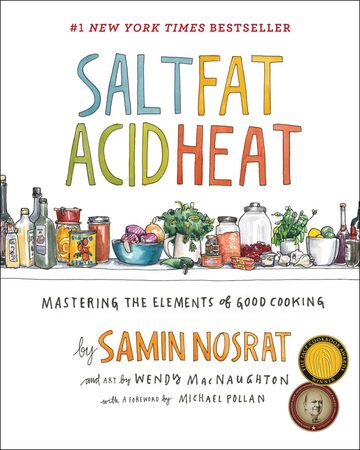
Salt, Fat, Acid, Heat is Samin Nosrat's argument that four basic elements govern whether food tastes good — salt, which amplifies flavor; fat, which carries flavor and creates texture; acid, which balances and brightens; and heat, which determines how food transforms. Master when and how to use each, she contends, and you can cook almost anything well without a recipe. The book grew out of years of teaching and out of her own training at Chez Panisse in Berkeley and in Italy, distilled into a single mental model any home cook can carry into any kitchen.
The first half takes each element in turn and explains not just what to do but why it works: how salt moves into food by diffusion, so timing matters as much as quantity; how fat delivers five distinct textures from crisp to creamy; how acid works like contrast in a painting, keeping richness from going flat; and how reading the sensory cues of heat — the sizzle, the color, the smell — beats obeying a timer. Wendy MacNaughton's illustrations and Nosrat's charts map how these elements show up across the world's cuisines.
What it gets right
- 1.
When you salt matters as much as how much. Salting early lets salt diffuse into food and season from within; a late pinch only seasons the surface.
- 2.
Salt does more than make food salty — it amplifies aromas and suppresses our perception of bitterness, which is why a pinch can improve even sweet dishes.
- 3.
Fat is not just richness. It delivers texture, and the same ingredient can be made crisp, creamy, flaky, tender, or light depending on how fat is used.
What it covers
Who wrote it
Samin Nosrat is a cook, teacher, and writer who trained at Chez Panisse in Berkeley and studied cooking in Italy. She spent years teaching home cooks before distilling her approach into Salt, Fat, Acid, Heat, her first book, which won a 2018 James Beard Award and became a Netflix docuseries she hosted. She has written for The New York Times Magazine and co-hosted the podcast Home Cooking. Her teaching centers on the principles behind good food rather than rote recipe-following.
