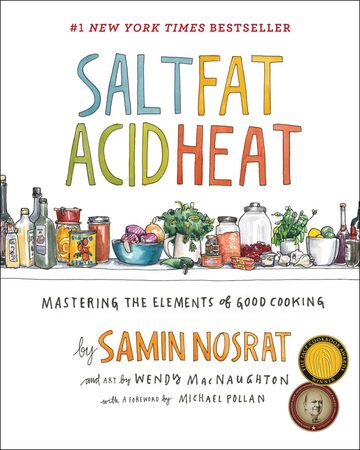
Salt, Fat, Acid, Heat by Samin Nosrat is a 2017 cooking book about cooking fundamentals, culinary intuition, flavor. When you salt matters as much as how much. Salting early lets salt diffuse into food and season from within; a late pinch only seasons the surface.
Summary
Salt, Fat, Acid, Heat is Samin Nosrat's argument that four basic elements govern whether food tastes good — salt, which amplifies flavor; fat, which carries flavor and creates texture; acid, which balances and brightens; and heat, which determines how food transforms. Master when and how to use each, she contends, and you can cook almost anything well without a recipe. The book grew out of years of teaching and out of her own training at Chez Panisse in Berkeley and in Italy, distilled into a single mental model any home cook can carry into any kitchen.
The first half takes each element in turn and explains not just what to do but why it works: how salt moves into food by diffusion, so timing matters as much as quantity; how fat delivers five distinct textures from crisp to creamy; how acid works like contrast in a painting, keeping richness from going flat; and how reading the sensory cues of heat — the sizzle, the color, the smell — beats obeying a timer. Wendy MacNaughton's illustrations and Nosrat's charts map how these elements show up across the world's cuisines.
The second half turns theory into practice with recipes and kitchen basics. They function less as rules to memorize than as demonstrations of the four elements in action — a vinaigrette for emulsion and acid, a roast chicken for salting ahead and reading heat. The through-line is decision-making: taste constantly, adjust, and trust that a good cook is really just someone making a series of small, informed choices about salt, fat, acid, and heat.
It is aimed at cooks who want to graduate from following recipes to cooking by feel, and it welcomes beginners while staying useful to the experienced. It is not a quick-reference recipe collection — the first half asks you to read and absorb ideas, and the hand-drawn illustrations stand in for the glossy photos some cooks want. But as a book that teaches understanding rather than obedience, it is a rare and durable one.
The four elements of good cooking
Nosrat’s claim is that behind every good dish are four variables you can learn to control. Get them right and the recipe almost doesn’t matter; get them wrong and no recipe can save you.
Salt — the element of seasoning
- Salt amplifies flavor. Used well it doesn’t make food taste salty; it makes food taste more like itself and softens our perception of bitterness.
- When you salt matters as much as how much. Salt moves into food slowly, so salting early — even a day ahead for meat — seasons from within, while a late pinch only sits on the surface.
- Season in layers and taste as you go, rather than adding it all at the end.
- Measure by taste, not by the spoon. Kosher, table, and flaky salts have very different crystal sizes, so equal volumes deliver very different amounts.
Fat — the element of texture and richness
- Fat carries flavor and is the vehicle for aromatics; it also decides mouthfeel.
- It creates five textures — crisp, creamy, flaky, tender, and light — depending on how it’s handled.
- Fat is a flavor signature. Reaching for olive oil, butter, lard, or coconut oil places a dish in a cuisine.
- Emulsions — vinaigrette, mayonnaise, pan sauces — are fat and water persuaded to combine, and they’re a skill worth learning.
Acid — the element of balance
- Acid brightens and balances, cutting through richness and waking up flavors that taste flat.
- Sources are everywhere: citrus, vinegar, wine, tomatoes, and dairy like yogurt and buttermilk.
- Add it in layers, often at the end — a final squeeze or splash is frequently what a finished dish is missing.
- Acid also transforms texture, curdling dairy, firming fish in ceviche, and tenderizing.
Heat — the element of transformation
- Heat decides texture — the same ingredient can end up tender, crisp, or tough depending on how energy is applied.
- Learn to read sensory cues — the pitch of a sizzle, the color of browning, the smell — instead of trusting a timer alone.
- Browning builds flavor through the Maillard reaction and caramelization, which need a dry surface and enough heat.
- Match the method to the goal: gentle, moist heat (poaching, braising, steaming) for tenderness; hot, dry heat (searing, roasting, grilling, frying) for color and crust.
Cooking by feel, not by recipe
Naming the four elements is meant to make you a decision-maker rather than an instruction-follower. Every recipe, Nosrat argues, is just a set of choices about salt, fat, acid, and heat — and once you can taste a dish and know which of the four it needs, you can improvise, substitute, and fix mistakes on your own.
- Taste constantly and adjust in small steps.
- Ask which element is missing when something is off — often it’s acid or salt, not more time or more ingredients.
- Trust that the goal is understanding, so the same knowledge transfers to any cuisine or kitchen.
The second half: recipes as demonstrations
Roughly half the book is recipes and kitchen basics, illustrated by Wendy MacNaughton. They work less as rules to memorize than as worked examples of the four elements — a vinaigrette to show emulsion and acid, a roast chicken to show salting ahead and reading heat. Charts map how salt, fat, acid, and heat show up across the world’s cuisines.
How to read the book
- Read the first half properly. It’s the argument, and skimming straight to the recipes misses the point.
- Expect illustrations, not photographs. The hand-drawn art is charming but won’t show you exactly what a finished dish should look like.
- It’s a teacher, not a reference. For a quick answer to a single technique, another book may be faster; for learning to cook, this is the rare one that changes how you think.
Talk to Salt, Fat, Acid, Heat like its author wrote you back.
Get the ideas that fit your life — not generic summaries.
- Chat with the book
- Audiobook-style main ideas
- Adapts to your life and goals
- Helps you take action
Key takeaways
- 1.
When you salt matters as much as how much. Salting early lets salt diffuse into food and season from within; a late pinch only seasons the surface.
- 2.
Salt does more than make food salty — it amplifies aromas and suppresses our perception of bitterness, which is why a pinch can improve even sweet dishes.
- 3.
Fat is not just richness. It delivers texture, and the same ingredient can be made crisp, creamy, flaky, tender, or light depending on how fat is used.
- 4.
Acid balances everything else. A squeeze of lemon or splash of vinegar at the end brightens a dish and keeps richness from tasting flat.
- 5.
Heat governs texture and the browning that builds flavor. Learn to read sensory cues — sound, color, aroma — instead of relying only on times and temperatures.
- 6.
Taste as you go and season in layers. Adjusting salt, fat, and acid throughout cooking beats trying to rescue a dish once at the end.
- 7.
Measure salt by taste, not volume. Kosher, table, and flaky salts have different crystal sizes, so the same teaspoon delivers very different amounts.
- 8.
Every recipe is just a set of decisions about salt, fat, acid, and heat. Once you understand the four, you can improvise and cook without a recipe.
Discussion questions
Use these on your own, with a book club, or as chat starters in Superbook. Book club version, ready to copy or print →
- 1.
Nosrat says most home cooks under-salt. When you think about food you have cooked, do you salt early enough, or mostly at the table?
- 2.
Which of the four elements — salt, fat, acid, or heat — do you feel least confident about, and how does that show up in your cooking?
- 3.
Think about a dish you make that tastes flat or heavy. Could adding acid, rather than more salt, be what it actually needs?
- 4.
Nosrat argues you should taste constantly and adjust. Do you really taste your food as you cook, or do you follow the recipe and hope?
- 5.
What fat is the flavor signature of the food you love most, and what would the dish lose if you swapped it out?
- 6.
When you cook meat or vegetables, do you read sensory cues or rely on the timer? What would change if you trusted your senses more?
- 7.
Recall a recipe that failed for you. In hindsight, which of the four elements was probably off?
- 8.
Nosrat learned to cook by feel before she could name why things worked. Where in your cooking do you have intuition you cannot yet explain?
- 9.
The book claims anyone can cook anything and make it delicious. Do you believe that about yourself? What belief holds you back?
- 10.
Salting in advance requires planning ahead. What is one dish where seasoning earlier would meaningfully improve the result?
- 11.
If you cooked one meal this week without a recipe, using only the four elements as your guide, what would you make?
- 12.
Which cuisine's flavor logic do you understand least? How might mapping its salt, fat, acid, and heat help you cook it?
Themes
Frequently asked questions
-
What is Salt, Fat, Acid, Heat about?
It argues that four elements — salt, fat, acid, and heat — determine whether food tastes good. Samin Nosrat explains why each works so you can cook by feel and adjust as you go, rather than following recipes step by step.
-
Is Salt, Fat, Acid, Heat good for beginners?
Yes. It assumes no prior skill and teaches the fundamentals from the ground up, so beginners gain confidence quickly. It is equally useful to experienced cooks who can execute recipes but want to understand why techniques work.
-
Is Salt, Fat, Acid, Heat worth reading if I already own a lot of cookbooks?
Probably, because it is not really a recipe collection. It teaches a mental model that makes every other cookbook easier to use and lets you improvise and fix dishes on your own.
-
Do I need to watch the Netflix show to get the book?
No. The book stands on its own and goes far deeper than the four-episode series. The show is a good visual companion, but the instructional heart of the method is in the book's first half.
-
How is it different from The Food Lab?
Both explain the why behind cooking, but Salt, Fat, Acid, Heat teaches intuition and taste through four guiding elements, while The Food Lab runs controlled experiments to optimize specific recipes and bust myths. They complement each other well.