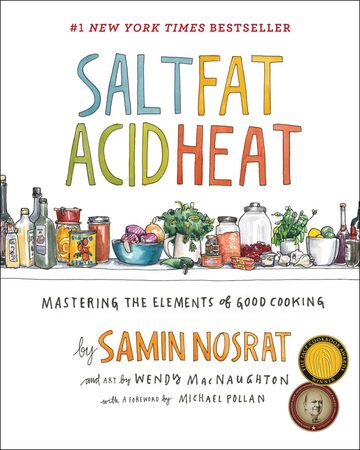
Talk to Salt, Fat, Acid, Heat like its author wrote you back.
Get the ideas that fit your life — not generic summaries.
- Chat with the book
- Audiobook-style main ideas
- Adapts to your life and goals
- Helps you take action
Salt, Fat, Acid, Heat, in detail
Salt, Fat, Acid, Heat is Samin Nosrat's argument that four basic elements govern whether food tastes good — salt, which amplifies flavor; fat, which carries flavor and creates texture; acid, which balances and brightens; and heat, which determines how food transforms. Master when and how to use each, she contends, and you can cook almost anything well without a recipe. The book grew out of years of teaching and out of her own training at Chez Panisse in Berkeley and in Italy, distilled into a single mental model any home cook can carry into any kitchen.
The first half takes each element in turn and explains not just what to do but why it works: how salt moves into food by diffusion, so timing matters as much as quantity; how fat delivers five distinct textures from crisp to creamy; how acid works like contrast in a painting, keeping richness from going flat; and how reading the sensory cues of heat — the sizzle, the color, the smell — beats obeying a timer. Wendy MacNaughton's illustrations and Nosrat's charts map how these elements show up across the world's cuisines.
The second half turns theory into practice with recipes and kitchen basics. They function less as rules to memorize than as demonstrations of the four elements in action — a vinaigrette for emulsion and acid, a roast chicken for salting ahead and reading heat. The through-line is decision-making: taste constantly, adjust, and trust that a good cook is really just someone making a series of small, informed choices about salt, fat, acid, and heat.
It is aimed at cooks who want to graduate from following recipes to cooking by feel, and it welcomes beginners while staying useful to the experienced. It is not a quick-reference recipe collection — the first half asks you to read and absorb ideas, and the hand-drawn illustrations stand in for the glossy photos some cooks want. But as a book that teaches understanding rather than obedience, it is a rare and durable one.
The big ideas
- 1.
When you salt matters as much as how much. Salting early lets salt diffuse into food and season from within; a late pinch only seasons the surface.
- 2.
Salt does more than make food salty — it amplifies aromas and suppresses our perception of bitterness, which is why a pinch can improve even sweet dishes.
- 3.
Fat is not just richness. It delivers texture, and the same ingredient can be made crisp, creamy, flaky, tender, or light depending on how fat is used.
