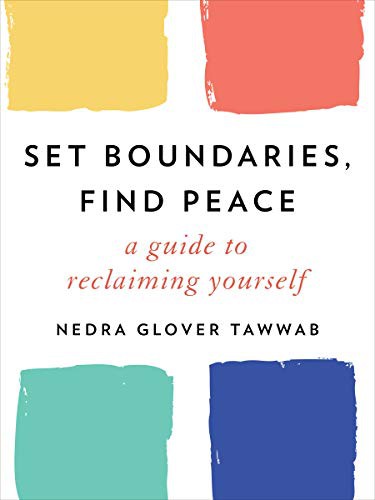
Set Boundaries, Find Peace by Nedra Glover Tawwab is a 2021 self-help book about boundaries, relationships, mental health. A boundary is a statement of your own needs, not a restriction on others' behavior. Framing it this way changes both how you communicate limits and how they are received.
Summary
Set Boundaries, Find Peace is therapist Nedra Glover Tawwab's practical guide to identifying and communicating personal boundaries in work, family, friendship, and romantic relationships. Published in 2021, the book emerged from Tawwab's popular Instagram presence and her clinical practice as a licensed therapist. Its tone is warm but direct: boundaries are not about controlling others, she argues, but about communicating your own needs clearly enough that relationships can function without resentment accumulating on both sides.
The book starts with a fundamental reframe. Many people understand boundaries as walls — things that push others away, create conflict, or signal distrust. Tawwab argues the opposite: a boundary is a statement about what you need, not a restriction on what others can do. The absence of clear boundaries tends not to produce harmony but resentment. People who never say no, who absorb others' distress without limit, who feel responsible for managing other people's emotions, typically do not feel free — they feel trapped and exhausted, and their relationships suffer from the accumulated weight of unspoken expectations.
The middle sections of the book are organized by relationship type: family, romantic partners, friendships, coworkers, and digital relationships. Tawwab is especially useful on family dynamics — the particular difficulty of setting limits with parents, siblings, or extended family when no one has modeled doing so, and when the alternative to engagement is not freedom but guilt. She provides example language throughout: actual sentences people can use to state a limit, redirect a conversation, or respond to pushback without apologizing or capitulating.
The book's strength is its accessibility and its lack of jargon. Tawwab is a therapist who writes for general readers, and she resists the temptation to pathologize ordinary relationship difficulties. She is also honest about the cost: setting clear limits reliably produces discomfort, conflict, and sometimes the loss of relationships that depended on one person's compliance. That honesty makes the book more credible than the cheerful "just say no" literature it superficially resembles. Set Boundaries, Find Peace is a practical tool, not a manifesto.
Talk to Set Boundaries, Find Peace like its author wrote you back.
Get the ideas that fit your life — not generic summaries.
- Chat with the book
- Audiobook-style main ideas
- Adapts to your life and goals
- Helps you take action
Key takeaways
- 1.
A boundary is a statement of your own needs, not a restriction on others' behavior. Framing it this way changes both how you communicate limits and how they are received.
- 2.
The absence of clear limits does not produce harmony — it produces resentment. Unexpressed needs accumulate silently until they come out as anger, withdrawal, or burnout.
- 3.
Porous boundaries — difficulty saying no, absorbing others' emotions, feeling responsible for others' comfort — are not generosity. They are a pattern with costs that eventually become unsustainable.
- 4.
Family systems are the most difficult context for new limits because they rely on established dynamics and because deviating from them tends to produce the most intense pushback.
- 5.
Saying no is a complete sentence. Much of the work of limit-setting is learning to resist the pull toward justification, apology, and BATNA-type negotiation that weakens the communication.
- 6.
Limits need to be communicated, not assumed. Most relationship problems that look like violations of limits are actually failures to communicate them in the first place.
- 7.
Digital relationships — social media, messaging, constant availability — require limits as much as in-person relationships, but the norms are newer and less settled.
- 8.
Setting clear limits will cost something. Some relationships depend on one person's compliance or silence, and making needs explicit reveals that. Tawwab does not minimize this.
Discussion questions
Use these on your own, with a book club, or as chat starters in Superbook. Book club version, ready to copy or print →
- 1.
Tawwab argues that unexpressed limits produce resentment rather than harmony. Can you identify a current relationship where an unspoken limit is causing friction?
- 2.
What is the difference between a limit that protects your needs and one that controls another person's behavior? Where is the line in practice?
- 3.
Many people report that the idea of limits sounds straightforward but is very difficult in practice. What makes it hard for you specifically — the conversation itself, the anticipated reaction, or something else?
- 4.
Tawwab is particularly useful on family dynamics. What makes setting limits with family members feel categorically different from doing so with friends or colleagues?
- 5.
The book provides example language — actual sentences — for communicating limits. How useful is scripted language in practice, and what are its limitations?
- 6.
Setting limits often involves a period of discomfort and even conflict before relationships improve. How do you distinguish between productive discomfort in a relationship and a genuine signal that the relationship isn't working?
- 7.
Tawwab argues that people with porous limits are not being generous — they are paying a cost that will eventually become unsustainable. Do you agree, or are there forms of selflessness that are genuinely good even at personal cost?
- 8.
Digital relationships — constant availability, social media, being reachable at all hours — require limits that most people don't have explicit norms for. What limits have you tried to set in digital contexts, and how have they been received?
- 9.
The book says limits in romantic relationships are particularly difficult because intimacy is partly defined by not having them. How do you think about the relationship between intimacy and limits in a close relationship?
- 10.
Tawwab is honest that setting clear limits will sometimes end relationships. Is that a cost worth paying, and how do you know in advance which relationships can accommodate explicit needs and which cannot?
- 11.
How does your workplace culture support or undermine the limits Tawwab describes? What are the institutional and professional norms that make certain kinds of limits very hard to enforce?
Themes
Frequently asked questions
-
What is Set Boundaries, Find Peace about?
A therapist's practical guide to identifying what you need in relationships and communicating it clearly, across family, friendship, romantic, and work contexts. The central argument is that the absence of clear limits produces resentment, and that stating your needs directly is a form of respect for both yourself and others.
-
Is Set Boundaries, Find Peace worth reading?
Yes, particularly if you struggle with saying no, feel responsible for managing others' emotions, or experience chronic resentment in relationships without understanding why. It is accessible, practical, and notably free of therapy jargon. Some readers will find it covers familiar ground; for others it will be genuinely clarifying.
-
How long does Set Boundaries, Find Peace take to read?
About four to five hours. The chapters are short and organized by relationship type, making it easy to read the sections most relevant to your situation and return to others later.
-
Is this book only for people with serious relationship problems?
No. Tawwab writes for people who are functioning but noticing friction — relationships where unspoken expectations have accumulated, where they say yes when they mean no, or where they feel chronically responsible for others' emotional states. It is not a crisis intervention book but a practical framework for ordinary relationship improvement.
-
Does the book address setting limits in professional settings?
Yes. There are specific chapters on workplace limits — dealing with overwork, managing digital availability, handling colleagues who make inappropriate demands. These sections are useful though somewhat less detailed than the personal relationship material.
Similar books
The Body Keeps the Score
Bessel van der Kolk
Never Split the Difference
Chris Voss
Quiet: The Power of Introverts in a World That Can't Stop Talking
Susan Cain
Crucial Conversations: Tools for Talking When Stakes Are High
Kerry Patterson, Joseph Grenny, Ron McMillan, and Al Switzler
