Science · Book club
Seven Brief Lessons on Physics book club questions
Here are 11 book club questions for Seven Brief Lessons on Physics by Carlo Rovelli, ordered to open easily and end somewhere worth arguing about. Copy them, print them, or bring them up one at a time.
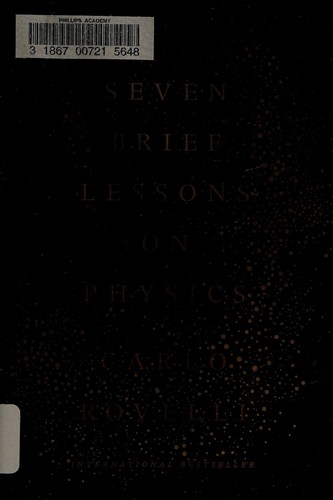
Carlo Rovelli, a theoretical physicist best known for his work on loop quantum gravity, wrote this book originally as a series of essays for an Italian Sunday newspaper.
Carlo Rovelli · 2014 · 1h 45m
Full summary and key takeaways →The 11 questions
- 1.
Rovelli calls general relativity the most beautiful theory in science. What makes a scientific theory beautiful, and does beauty matter for truth?
- 2.
Rovelli writes for a general newspaper audience. Does that origin show in the book, and is it a strength or a limitation?
- 3.
The book is explicit about what physics does not yet know — the unification of general relativity and quantum mechanics being the main gap. Does emphasizing the open questions make physics feel more exciting or more uncertain?
- 4.
Rovelli's final essay turns philosophical: he reflects on human curiosity in a universe indifferent to us. Did you find that turn satisfying or out of place in a physics book?
- 5.
The standard model describes almost all known physics but doesn't include gravity and doesn't explain dark matter. How do you feel about the idea that our best theory is still fundamentally incomplete?
- 6.
Rovelli suggests that time's direction is a statistical consequence of low initial entropy, not a fundamental feature of physical law. What are the implications of that for how we think about the past and future?
- 7.
The book is very short for its subject matter. Did Rovelli cover enough for you to understand the ideas, or did the brevity frustrate?
- 8.
Rovelli uses the word 'beautiful' repeatedly about physical theories. Is beauty a meaningful criterion in science, or does it risk leading physicists in the wrong direction?
- 9.
Black holes are predicted by the equations but their centers are where the equations break down. What does it mean for a theory to predict something it can't actually describe?
- 10.
Rovelli is Italian and writes with a continental philosophical sensibility. Does that make the book feel different from Anglo-American popular science?
- 11.
If you could spend an hour asking a physicist one question about the universe, what would it be, and did this book suggest that question or a different one?
How to run the discussion
- Pick six to eight, not all of them. An hour of real discussion covers fewer questions than anyone expects, and racing the list is what makes a book club feel like homework.
- Open with what people noticed, not what they concluded. Asking for a verdict first hardens opinions before anyone has heard each other.
- Let the disagreement run. The questions below that split a room are the ones worth the time; the ones everyone answers the same way can be skipped.
- Ask the quiet person a specific question. A direct, narrow question is far easier to answer than an open invitation to contribute.
Themes worth steering toward
If the conversation stalls, these are the threads that usually restart it.
Common questions
What are good book club questions for Seven Brief Lessons on Physics?
Here are 11 book club questions for Seven Brief Lessons on Physics by Carlo Rovelli, ordered to open easily and end somewhere worth arguing about. The strongest openers ask what each reader noticed rather than what they concluded, and the discussion usually turns on physics, general relativity, quantum mechanics.
How long should a book club discussion of Seven Brief Lessons on Physics last?
Most groups run 60 to 90 minutes of actual discussion. That is roughly six to eight questions, not all of them, so pick the ones that suit your group rather than working down the list in order.
What are the main themes in Seven Brief Lessons on Physics?
Physics, General relativity, Quantum mechanics, Cosmology, Wonder. Those are the threads most likely to divide a room, which makes them the useful places to steer a discussion that has gone quiet.
Picking the next one? See books like Seven Brief Lessons on Physics or questions for other book club picks.
