Talk to Shop Class as Soulcraft like its author wrote you back.
Get the ideas that fit your life — not generic summaries.
- Chat with the book
- Audiobook-style main ideas
- Adapts to your life and goals
- Helps you take action
What it argues
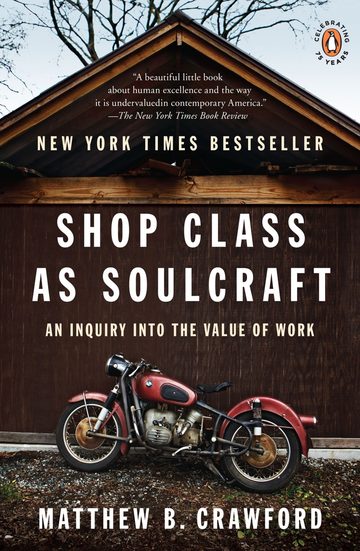
Shop Class as Soulcraft grew out of a paradox in its author's life: Matthew Crawford earned a PhD in political philosophy, briefly ran a Washington think tank he found soul-deadening, and then opened a motorcycle repair shop — and found the shop more intellectually alive than the office. From that double life he mounts a defense of skilled manual work and a critique of a culture that funnels everyone toward abstract knowledge work while dismantling shop class as if working with your hands were beneath thinking people.
His central argument is that the trades are cognitively demanding in ways white-collar work often is not. A mechanic diagnoses, forms hypotheses, and troubleshoots against a reality that will not flatter him: the engine either runs or it doesn't. That objective standard is the book's key idea. It disciplines the ego and produces a kind of earned, unfakeable pride, because the work answers to the thing itself rather than to a manager's impression or a shifting consensus. Crawford draws on Aristotle, Hannah Arendt, Heidegger, Alasdair MacIntyre, and Robert Pirsig to argue that meaningful work requires both agency and a hard external check.
What it gets right
- 1.
Manual trades are intellectually demanding. A mechanic diagnoses, hypothesizes, and troubleshoots; manual competence is a form of thinking, not the absence of it.
- 2.
The trades answer to an objective standard: the engine runs or it doesn't. That hard external check disciplines the ego and produces earned, unfakeable pride.
- 3.
Knowledge work is not automatically richer than manual work. Following Braverman, Crawford argues white-collar jobs suffer their own deskilling and abstraction.
What it covers
Who wrote it
Matthew B. Crawford holds a PhD in political philosophy from the University of Chicago and is a fellow at the University of Virginia's Institute for Advanced Studies in Culture. After a brief, dispiriting stint directing a Washington think tank, he opened Shockoe Moto, a motorcycle repair shop in Richmond, Virginia, and writes from that double life as scholar and mechanic. Shop Class as Soulcraft (2009) grew out of an essay in The New Atlantis and became a surprise bestseller. He followed it with The World Beyond Your Head (2015) and Why We Drive (2020).
