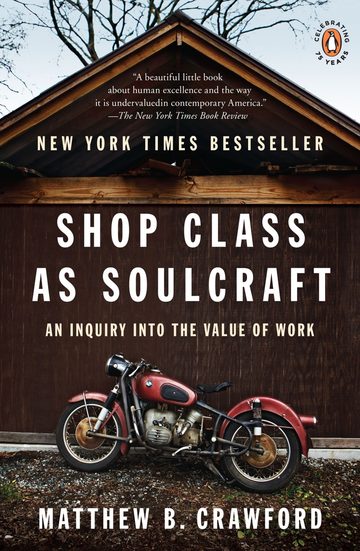
Shop Class as Soulcraft by Matthew B. Crawford is a 2009 philosophy book about meaningful work, manual trades, craftsmanship. Manual trades are intellectually demanding. A mechanic diagnoses, hypothesizes, and troubleshoots; manual competence is a form of thinking, not the absence of it.
Summary
Shop Class as Soulcraft grew out of a paradox in its author's life: Matthew Crawford earned a PhD in political philosophy, briefly ran a Washington think tank he found soul-deadening, and then opened a motorcycle repair shop — and found the shop more intellectually alive than the office. From that double life he mounts a defense of skilled manual work and a critique of a culture that funnels everyone toward abstract knowledge work while dismantling shop class as if working with your hands were beneath thinking people.
His central argument is that the trades are cognitively demanding in ways white-collar work often is not. A mechanic diagnoses, forms hypotheses, and troubleshoots against a reality that will not flatter him: the engine either runs or it doesn't. That objective standard is the book's key idea. It disciplines the ego and produces a kind of earned, unfakeable pride, because the work answers to the thing itself rather than to a manager's impression or a shifting consensus. Crawford draws on Aristotle, Hannah Arendt, Heidegger, Alasdair MacIntyre, and Robert Pirsig to argue that meaningful work requires both agency and a hard external check.
He turns the same lens on office life. Following Harry Braverman, he argues that knowledge work suffers its own deskilling and abstraction, its judgments softened into teamwork and impression-management with no clear standard of success. Meanwhile consumer culture engineers our helplessness: sealed hoods, glued-shut devices, and appliances built not to be repaired turn us into passive users who cannot understand or maintain our own things. Reclaiming manual competence, he argues, is a form of freedom and self-reliance — and, practically, trade work resists outsourcing in a way many desk jobs do not.
The book is popular philosophy and cultural criticism rather than a memoir or a how-to manual; the workshop scenes serve an argument built from the history of ideas. It is best for anyone questioning cubicle life, weighing a trade, or curious about the ethics of work. Its limits are worth naming: critics fault Crawford for romanticizing the trades, underplaying their drudgery, low pay, and physical toll, and for a somewhat masculine, individualist frame. Read as a provocation about where meaning in work comes from, it is sharp and durable.
From the think tank to the motorcycle shop
The book’s authority comes from the author’s own detour. Crawford has a doctorate in political philosophy, yet the white-collar jobs it opened to him — including running a Washington think tank where he wrote position papers whose purpose was murky — left him feeling useless. His motorcycle shop, by contrast, demanded constant judgment and gave unambiguous feedback. That contrast is the engine of the whole argument: the “knowledge job” looked prestigious and felt empty; the “manual job” looked humble and felt intellectually alive.
Manual work is cognitive work
Crawford’s first move is to demolish the assumption that manual labor is mindless. Fixing an old motorcycle means reading faint clues, forming and discarding hypotheses, improvising with limited information, and drawing on tacit, hard-won knowledge that can’t be fully written down. Diagnosis is genuine reasoning under uncertainty. The trades, done well, are a school for practical wisdom — Aristotle’s phronesis — not a fallback for people who can’t think.
The objective standard, and why it’s good for you
The heart of the book is the value of answering to something outside yourself:
- The engine runs or it doesn’t. A leak is a leak. You cannot spin your way out.
- That hard standard disciplines the ego — reality, not your self-image, has the last word.
- It also makes pride possible. Praise you can’t verify is hollow; a machine you fixed is proof.
This is why Crawford calls the work “soulcraft.” Submitting to the demands of the object forms the person doing the work.
The degradation of knowledge work
Crawford refuses to let office work off the hook. Borrowing from Harry Braverman’s account of how industrial labor was deskilled — broken into planned pieces so workers no longer owned the whole task — he argues the same thing has happened to white-collar work. Judgment gets abstracted upward, standards blur into teamwork and personality, and the worker loses a clear line between effort and result. The cubicle can be as alienating as the assembly line, just harder to see.
Consumer culture and the loss of agency
A parallel thread is what happens to us as consumers. Modern goods are increasingly sealed against understanding — glued shut, warranty-voided, designed to be replaced rather than repaired. Crawford reads the disappearing car hood and the disposable appliance as a quiet training in helplessness. To learn to fix your own things is to push back: it restores agency, reduces dependence, and reconnects you to the material world you actually live in.
Who it’s for, and where it overreaches
Read this if you have ever suspected your job manufactures nothing real, if you are weighing a trade, or if you care about what makes work meaningful. Read it critically, too. Crawford idealizes the shop and says little about the aching back, the thin margins, the boredom of routine repairs, and the narrow, largely male world he describes. The honest way to take the book is as a bracing argument about where dignity in work comes from — not as a full accounting of working life.
Talk to Shop Class as Soulcraft like its author wrote you back.
Get the ideas that fit your life — not generic summaries.
- Chat with the book
- Audiobook-style main ideas
- Adapts to your life and goals
- Helps you take action
Key takeaways
- 1.
Manual trades are intellectually demanding. A mechanic diagnoses, hypothesizes, and troubleshoots; manual competence is a form of thinking, not the absence of it.
- 2.
The trades answer to an objective standard: the engine runs or it doesn't. That hard external check disciplines the ego and produces earned, unfakeable pride.
- 3.
Knowledge work is not automatically richer than manual work. Following Braverman, Crawford argues white-collar jobs suffer their own deskilling and abstraction.
- 4.
Consumer culture separates us from the material world. Sealed hoods and unrepairable devices turn us into passive users who cannot maintain our own things.
- 5.
Fixing your own things is a form of freedom. Manual competence reduces dependence and restores agency in a world engineered for helpless consumption.
- 6.
Craftsmanship forms character through submission to reality. You serve the demands of the material rather than your self-expression, and that discipline is the satisfaction.
- 7.
The manual trades cannot be outsourced. You cannot offshore a plumber or an electrician, which makes them durable work in a globalized economy.
- 8.
Meaningful work needs both agency and an objective standard. Jobs offering neither — where you manage impressions toward ambiguous ends — corrode the worker over time.
Discussion questions
Use these on your own, with a book club, or as chat starters in Superbook. Book club version, ready to copy or print →
- 1.
Crawford left prestigious knowledge work for a motorcycle shop. Is there a form of hands-on work you are drawn to but have talked yourself out of, and why?
- 2.
The book argues trade work answers to an objective standard. Where in your own work is it genuinely clear whether you did well, and where is success just impressions?
- 3.
When something you own breaks, do you fix it, replace it, or pay someone? What does your answer say about your relationship to the material world?
- 4.
Crawford says manual competence is a form of thinking. What skill have you dismissed as merely manual that actually demands judgment?
- 5.
Where in your working life do you feel like a passive user of systems you don't understand, and where do you feel real agency?
- 6.
The book claims consumer culture engineers our helplessness. Which of your possessions are you deliberately kept from understanding or repairing?
- 7.
Crawford prizes the pride that comes from work others can objectively judge. When did you last feel that kind of earned pride, and what produced it?
- 8.
Do you agree that knowledge work can be as deskilled and alienating as factory work? What have you seen that supports or contradicts this?
- 9.
Critics say Crawford romanticizes the trades and downplays their drudgery and low pay. Where is his argument strongest, and where does it overreach?
- 10.
Crawford ties good work to submitting to the demands of reality rather than expressing yourself. Does that match your experience of doing work well?
- 11.
If you could apprentice in a single trade for a year, which would you choose, and what draws you to it?
- 12.
What would it change about your life to become materially self-reliant in one domain — your home, your car, or your tools?
Themes
Frequently asked questions
-
What is Shop Class as Soulcraft about?
It argues that skilled manual work — the mechanic, electrician, carpenter — is cognitively demanding and deeply meaningful, and that our culture wrongly pushes everyone toward abstract office work. Part philosophy, part cultural criticism, part reflection on Crawford's path from think tank to motorcycle shop.
-
Is Shop Class as Soulcraft a memoir or a how-to guide?
Neither, really. It is a work of popular philosophy that uses Crawford's experience as a mechanic to make an argument. There are vivid workshop scenes, but it draws on Aristotle, Arendt, and Heidegger rather than teaching you to turn a wrench.
-
Should I read this if I'm considering a career in the trades?
It is a strong philosophical case for why trade work can be worthy and satisfying, and why it resists outsourcing. But it is deliberately idealized; pair it with honest accounts of the physical toll, pay, and grind before making a decision.
-
What are the main criticisms of the book?
That it romanticizes manual labor, glosses over drudgery, injury, and low wages, and frames work in a somewhat masculine, individualist way. The argument is a provocation about meaning, not a balanced labor-market analysis.
-
How does it relate to The Craftsman by Richard Sennett?
Both defend craftsmanship as a source of meaning and thinking. Sennett is the broader, more academic sociologist; Crawford is punchier and more personal. Read together, they make a strong case for the dignity of skilled work.