Talk to Shop Class as Soulcraft like its author wrote you back.
Get the ideas that fit your life — not generic summaries.
- Chat with the book
- Audiobook-style main ideas
- Adapts to your life and goals
- Helps you take action
Shop Class as Soulcraft, in detail
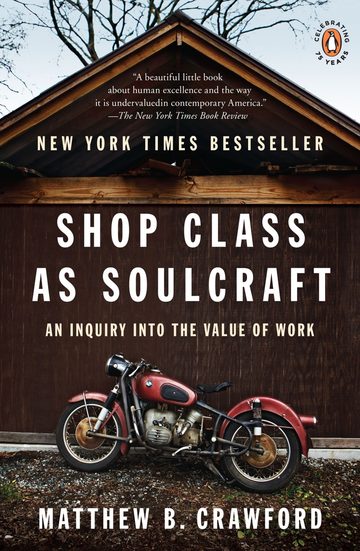
Shop Class as Soulcraft grew out of a paradox in its author's life: Matthew Crawford earned a PhD in political philosophy, briefly ran a Washington think tank he found soul-deadening, and then opened a motorcycle repair shop — and found the shop more intellectually alive than the office. From that double life he mounts a defense of skilled manual work and a critique of a culture that funnels everyone toward abstract knowledge work while dismantling shop class as if working with your hands were beneath thinking people.
His central argument is that the trades are cognitively demanding in ways white-collar work often is not. A mechanic diagnoses, forms hypotheses, and troubleshoots against a reality that will not flatter him: the engine either runs or it doesn't. That objective standard is the book's key idea. It disciplines the ego and produces a kind of earned, unfakeable pride, because the work answers to the thing itself rather than to a manager's impression or a shifting consensus. Crawford draws on Aristotle, Hannah Arendt, Heidegger, Alasdair MacIntyre, and Robert Pirsig to argue that meaningful work requires both agency and a hard external check.
He turns the same lens on office life. Following Harry Braverman, he argues that knowledge work suffers its own deskilling and abstraction, its judgments softened into teamwork and impression-management with no clear standard of success. Meanwhile consumer culture engineers our helplessness: sealed hoods, glued-shut devices, and appliances built not to be repaired turn us into passive users who cannot understand or maintain our own things. Reclaiming manual competence, he argues, is a form of freedom and self-reliance — and, practically, trade work resists outsourcing in a way many desk jobs do not.
The book is popular philosophy and cultural criticism rather than a memoir or a how-to manual; the workshop scenes serve an argument built from the history of ideas. It is best for anyone questioning cubicle life, weighing a trade, or curious about the ethics of work. Its limits are worth naming: critics fault Crawford for romanticizing the trades, underplaying their drudgery, low pay, and physical toll, and for a somewhat masculine, individualist frame. Read as a provocation about where meaning in work comes from, it is sharp and durable.
The big ideas
- 1.
Manual trades are intellectually demanding. A mechanic diagnoses, hypothesizes, and troubleshoots; manual competence is a form of thinking, not the absence of it.
- 2.
The trades answer to an objective standard: the engine runs or it doesn't. That hard external check disciplines the ego and produces earned, unfakeable pride.
- 3.
Knowledge work is not automatically richer than manual work. Following Braverman, Crawford argues white-collar jobs suffer their own deskilling and abstraction.
