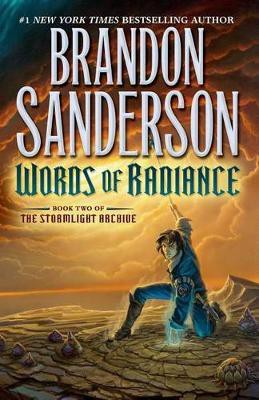
The Stormlight Archive: Words of Radiance by Brandon Sanderson is a 2014 fantasy book about oaths and self-deception, trauma and identity, leadership and sacrifice. The Stormlight oaths are both a magic system and a psychological framework — you cannot speak the words truthfully until you have done the internal work they require.
Summary
Words of Radiance is the second volume of Brandon Sanderson's Stormlight Archive, a planned ten-book epic fantasy set on the storm-ravaged world of Roshar. The first book, The Way of Kings, established the world and the characters — the slave-turned-soldier Kaladin, the scholar-princess Shallan, the disgraced general Dalinar. Words of Radiance deepens all three and then detonates them. At more than 380,000 words, it is one of the longest novels in mainstream fantasy publishing, and it earns most of that length.
The dual protagonists are Kaladin and Shallan, and Sanderson is explicit about the symmetry: both are survivors of serious trauma, both are developing magical abilities tied to the Knights Radiant of Roshar's history, and both are running from true self-understanding in ways the magic system will force them to confront. The Stormlight magic — Stormlight invested in gemstones, manipulated through oaths — is mechanically precise in a way Sanderson's fans expect, but here the mechanics serve the psychology. The oaths are not just power unlocks; they are articulations of self-understanding that the characters have to earn. "I will protect those who cannot protect themselves" only works when Kaladin has actually reckoned with why that oath keeps failing him.
Sanderson is a systematic writer who maps his plots architecturally. The book has chapters from multiple points of view, each with its own arc; it has interlude chapters that expand the world without advancing the main plot; it has a climax that pays off threads from 300 pages earlier. It is not subtle about any of this — Sanderson is a craftsman, not a stylist, and the prose is functional rather than beautiful. For readers who love his approach, the architecture is the pleasure. For readers who want voice and lyric prose, it will feel mechanical.
This is a serious commitment. The Way of Kings is required reading first; Words of Radiance is not an entry point. But for readers who have been with the series from the beginning, this is the book where the Stormlight Archive stops being a promise and becomes a delivery — where the emotional and narrative investment of the first book turns into payoff.
Talk to The Stormlight Archive: Words of Radiance like its author wrote you back.
Get the ideas that fit your life — not generic summaries.
- Chat with the book
- Audiobook-style main ideas
- Adapts to your life and goals
- Helps you take action
Key takeaways
- 1.
The Stormlight oaths are both a magic system and a psychological framework — you cannot speak the words truthfully until you have done the internal work they require.
- 2.
Shallan's arc in Words of Radiance is the book's emotional core. Her history of trauma and self-protective forgetting is handled with more care than Sanderson's work is usually given credit for.
- 3.
Kaladin struggles with leadership not because he lacks ability but because he cannot reconcile protecting others with the losses he has already accumulated. The book doesn't resolve this; it complicates it.
- 4.
Dalinar's chapters introduce the concept of the Blackthorn — a version of himself he has suppressed — and the tension between past violence and present redemption runs through the whole series.
- 5.
Roshar's ecology and history are not background: the highstorms, the Parshendi, the ancient Knights Radiant all turn out to be load-bearing elements. Sanderson's worldbuilding is almost entirely functional.
- 6.
The Cosmere — Sanderson's connected universe — has visible edges in this book. Readers who track it will find clues; readers who don't will miss nothing essential to Stormlight.
- 7.
The villain's motivations are given more complexity here than in the first book. Szeth's arc begins to separate from simple antagonism.
- 8.
Sanderson structures his climaxes to pay off multiple emotional threads simultaneously. The ending of Words of Radiance is one of the most architecturally satisfying in epic fantasy.
Discussion questions
Use these on your own, with a book club, or as chat starters in Superbook.
- 1.
Kaladin's oath keeps breaking on the same obstacle: he cannot protect everyone. Does the novel answer whether that is a flaw in him or a flaw in the oath?
- 2.
Shallan uses humor and deflection as trauma responses. The book is sympathetic to this — but is it honest about the cost?
- 3.
Dalinar is trying to be a better man than the Blackthorn was. Can you admire someone for their growth without excusing what they grew from? Does the book want you to?
- 4.
The Parshendi are revealed to have a different perspective on the war than the Alethi assume. At what point did you start to revise your read of who the enemy was?
- 5.
Sanderson's prose is often described as functional rather than literary. Did that affect your experience of the emotional scenes, or did it not matter?
- 6.
The oaths require truth-telling that the character must genuinely mean. Is this a metaphor for anything outside of fantasy, or is it best read as pure system?
- 7.
Adolin is arguably the most stable character in the cast. What role does a stable person play in a story full of broken protagonists?
- 8.
Words of Radiance is 380,000 words. What would be lost if it were half that length? What structural function do the interlude chapters serve?
- 9.
Szeth appears briefly but his arc is positioned for later payoff. How did Sanderson's management of secondary characters affect your read of the main cast?
- 10.
The series is planned for ten books. How does that scale affect how you read individual volumes — do you find yourself investing in long payoffs, or frustrated by their deferral?
- 11.
What does Roshar's world — designed around constant catastrophe, with an ecology built to survive it — say thematically about the characters who live there?
- 12.
Compared to other epic fantasy series you've read, where does Stormlight's approach to female protagonists land?
Themes
Frequently asked questions
-
Do I need to read The Way of Kings first?
Yes — completely. Words of Radiance is not a standalone. It picks up directly where The Way of Kings ends and assumes full knowledge of characters, world, and magic systems. Reading it first would be incoherent.
-
How long does Words of Radiance take to read?
At average reading pace, around 25-27 hours — roughly a week of evening reading or a long vacation. The audiobook is over 48 hours. It is a serious time commitment, not a casual pick-up.
-
Is the Stormlight Archive worth starting?
If you like epic fantasy with systematic magic, deep worldbuilding, and long payoffs, yes — the series is among the best-constructed in the genre. If you want terse, lyric prose or tight plots, Sanderson is not your writer.
-
What order should I read the Cosmere in?
Stormlight is best read as a standalone series first. Connections to the wider Cosmere become more meaningful later. Reading Mistborn (the original trilogy) before or alongside Stormlight adds context but isn't required.
-
Who shouldn't read this?
Readers who find very long books with complex magic systems and many named characters more exhausting than immersive. Also readers who need elegant prose — Sanderson's style is clear and efficient but not beautiful. If those are dealbreakers, this isn't for you.