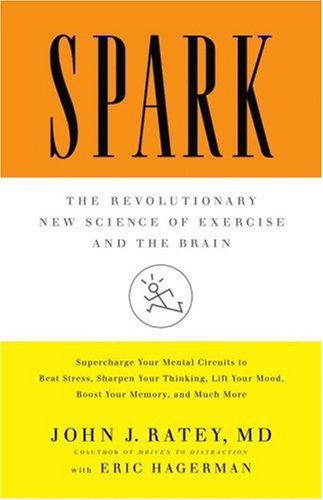
Spark by John J. Ratey is a 2008 health book about exercise, brain health, mental health. Aerobic exercise increases production of BDNF, a protein Ratey calls 'Miracle-Gro for the brain,' which supports the growth of new neurons and the formation of new connections.
Summary
Spark is John Ratey's argument, grounded in neuroscience, that aerobic exercise is the single most powerful thing most people can do for their brain. Ratey is a clinical psychiatrist at Harvard Medical School who has spent decades at the intersection of brain science and behavior, and the book is a synthesis of research showing that exercise doesn't just benefit the body — it restructures the brain, generates new neurons, and functions as an effective treatment for depression, anxiety, ADHD, addiction, aging, and even hormonal stress responses.
The book opens with the story of Naperville Central High School in Illinois, which moved PE to the beginning of the school day and shifted from performance measurement to cardiovascular conditioning. The academic results were striking: Naperville students outperformed the rest of Illinois and ranked among the top students in international science and math comparisons. The PE-academic connection set the tone for a book that treats exercise primarily as a cognitive and psychiatric intervention.
Ratey covers specific conditions chapter by chapter: stress, anxiety, depression, ADHD, addiction, hormonal changes, and aging. In each case he reviews the neuroscience — how exercise affects BDNF (brain-derived neurotrophic factor, which he calls "Miracle-Gro for the brain"), dopamine, serotonin, norepinephrine, and cortisol — and shows how that mechanism explains the therapeutic effect. The evidence base is not uniform: the research on exercise and depression is among the strongest in psychiatry; the evidence for exercise and ADHD, while promising, is thinner. Ratey presents the stronger and weaker cases with similar enthusiasm, which some readers find inspiring and others find credulous.
The practical prescriptions are specific: aerobic exercise, at moderate to high intensity, for at least twenty to thirty minutes most days, with variation in intensity to challenge the brain's adaptive response. Ratey argues strongly against the idea that exercise needs to be formal gym time — walking, dancing, and active daily movement produce cognitive benefits. The book's thesis is ultimately that the sedentary life is not just a cardiovascular risk; it is a direct assault on the organ that makes us who we are.
Talk to Spark like its author wrote you back.
Get the ideas that fit your life — not generic summaries.
- Chat with the book
- Audiobook-style main ideas
- Adapts to your life and goals
- Helps you take action
Key takeaways
- 1.
Aerobic exercise increases production of BDNF, a protein Ratey calls 'Miracle-Gro for the brain,' which supports the growth of new neurons and the formation of new connections.
- 2.
Exercise is an effective treatment for depression, comparable in outcome to antidepressant medication in multiple trials, and may have more durable effects by changing the brain's structure.
- 3.
The Naperville Central High School experiment showed that moving PE to the beginning of the day and focusing on cardiovascular fitness rather than performance dramatically improved academic results.
- 4.
Exercise regulates mood by elevating dopamine, serotonin, and norepinephrine — the same neurotransmitter systems targeted by most psychiatric medications.
- 5.
For children with ADHD, aerobic exercise before learning tasks reduces symptoms and improves focus, attention, and impulse control — without the side effects of stimulant medication.
- 6.
Exercise reduces the cortisol stress response and builds stress resilience: regular exercisers have a more modulated cortisol reaction to stressors and recover more quickly.
- 7.
Neurogenesis — the growth of new neurons — occurs throughout life, primarily in the hippocampus, and is strongly stimulated by aerobic exercise. This has implications for memory, learning, and protection against dementia.
- 8.
The sedentary lifestyle is not a neutral baseline: physical inactivity actively degrades brain function, emotional regulation, and cognitive performance over time.
Discussion questions
Use these on your own, with a book club, or as chat starters in Superbook. Book club version, ready to copy or print →
- 1.
Ratey argues that exercise is as effective as antidepressants for depression. If that's true, why do you think it's not standard first-line treatment in psychiatry?
- 2.
The Naperville school moved PE to first period and saw academic results improve. What would it take to adopt that model in schools near you? What are the obstacles?
- 3.
He makes a strong case that exercise generates new neurons. Does knowing that physical movement literally builds brain tissue change your motivation to exercise? Why or why not?
- 4.
Ratey covers exercise as treatment for anxiety, ADHD, addiction, and aging. Which application is most personally relevant to you, and does the evidence he presents convince you?
- 5.
The book is written with infectious enthusiasm. Did you notice it presenting weaker evidence with the same confidence as stronger evidence? How did that affect your trust in the overall argument?
- 6.
Ratey argues that the human body evolved to move and that sedentary life is biologically aberrant. What would your life look like if movement were as natural as it was for your ancestors?
- 7.
Exercise is a free, accessible intervention with no side effects and evidence of broad benefit. What actually prevents most people from doing enough of it?
- 8.
He covers the cognitive benefits of play — varied, spontaneous movement — versus structured exercise. How much of your physical activity involves genuine play versus obligation?
- 9.
BDNF is elevated by vigorous aerobic exercise but also by learning new physical skills (dance, martial arts, sport). Does that change what kind of exercise you would choose?
- 10.
Ratey covers the role of exercise in aging, particularly in protecting against Alzheimer's and cognitive decline. Does that long-term framing change how you think about exercise in your current life?
- 11.
The book opens with privileged high-school students in suburban Illinois. Are the benefits of exercise equally accessible across income and health status?
- 12.
If you could take a pill that produced all the brain benefits of thirty minutes of aerobic exercise, would you take it instead? What does your answer tell you about your relationship with physical activity?
Themes
Frequently asked questions
-
Is Spark worth reading for someone who already exercises regularly?
Yes — the neuroscience of why exercise benefits the brain is worth understanding even if you exercise regularly. Knowing that BDNF production is stimulated by vigorous aerobic intervals, for example, might change how you structure your workouts. And the chapters on depression, ADHD, and aging are relevant regardless of your current fitness level.
-
What kind of exercise does Spark recommend?
Primarily aerobic exercise at moderate to high intensity, for at least twenty to thirty minutes most days. Ratey also emphasizes varying intensity — including some high-intensity intervals — to stimulate maximum BDNF production. He is not prescriptive about the specific activity; running, cycling, swimming, and vigorous walking all qualify.
-
Is the evidence in Spark reliable?
The core claims about exercise and depression, learning, and stress are well-supported. Some of the evidence for exercise treating ADHD and addiction specifically is promising but thinner. Ratey writes enthusiastically and the book does not always signal the difference in evidential strength between chapters. The overall direction of the research is more reliable than every specific claim.
-
Does Spark address why people struggle to exercise despite knowing the benefits?
Somewhat. Ratey is better at explaining why exercise is beneficial than at solving the motivation and behavior change problem. For practical frameworks on building the exercise habit, books like Atomic Habits are more useful. Spark's value is primarily in shifting how you think about what exercise is doing, which may change motivation indirectly.
-
How does Spark's argument compare to other exercise science books?
Most exercise books focus on physical performance or body composition. Spark is unusual in centering the brain as the primary beneficiary of exercise. It is complementary to books about running or strength training rather than competing with them — it answers a different question.