Flourish: A Visionary New Understanding of Happiness and Well-being by Martin E. P. Seligman is a 2011 psychology book about well-being, positive psychology, meaning. PERMA: Positive emotion, Engagement, Relationships, Meaning, and Accomplishment are the five elements of well-being. Each is pursued for its own sake, not as a means to happiness.
Summary
Martin Seligman founded the positive psychology movement and published Authentic Happiness in 2002. Flourish, published in 2011, is his revision of that earlier framework, driven by his recognition that happiness — the single focus of Authentic Happiness — was too narrow. People want more than to feel good. They want to engage deeply, to achieve things that matter, to maintain relationships of genuine value, and to connect to something larger than themselves.
The new framework is called PERMA: Positive emotion, Engagement, Relationships, Meaning, and Accomplishment. These five elements are not instruments to happiness — they are ends in themselves. This is the key conceptual move from the earlier work. You do not engage in deep work because it makes you happy; you value engagement for its own sake. You do not maintain relationships because they boost your mood; you value them independently. The PERMA model describes what people pursue when they pursue a life that goes well, not just a life that feels good.
Seligman applies the framework to education, therapy, the military, and broader social policy. The Comprehensive Soldier Fitness program, which he helped design for the US Army, is described at length — an attempt to apply positive psychology principles to resilience and mental health at scale. He also describes the Penn Resiliency Program in schools and argues that well-being should be a formal educational goal.
The book is part conceptual refinement, part memoir, and part policy argument. Seligman writes about his own evolution as a scientist and practitioner, his early work on learned helplessness, and his shift from a disorder-focused to a strength-focused psychology. His case for flourishing as a policy goal — not just economic growth or the absence of illness — is ambitious and argues for something like a science of the good life. The book is more programmatic than Authentic Happiness and less intimate than the earlier work, but it is the clearer statement of where positive psychology has landed.
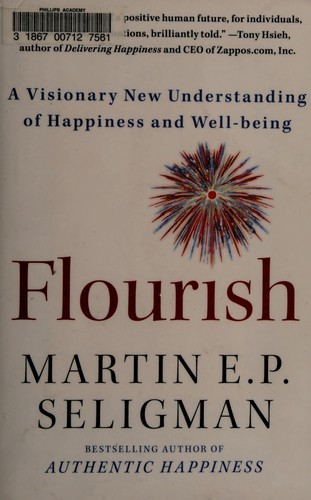
Talk to Flourish: A Visionary New Understanding of Happiness and Well-being like its author wrote you back.
Get the ideas that fit your life — not generic summaries.
- Chat with the book
- Audiobook-style main ideas
- Adapts to your life and goals
- Helps you take action
Key takeaways
- 1.
PERMA: Positive emotion, Engagement, Relationships, Meaning, and Accomplishment are the five elements of well-being. Each is pursued for its own sake, not as a means to happiness.
- 2.
Happiness is necessary but insufficient for well-being. A good life requires engagement, relationships, meaning, and achievement in addition to positive emotion.
- 3.
Flourishing is a better goal than happiness because it is more complete and more honest about what people actually value when they reflect on their lives.
- 4.
Learned helplessness — the response to uncontrollable negative events that generalizes to controllable situations — is the psychological foundation of depression and the starting point of Seligman's career.
- 5.
Resilience is teachable. Programs that build the cognitive and emotional skills associated with resilience have measurable effects on mental health outcomes in children and adults.
- 6.
Accomplishment — the pursuit of achievement for its own sake — is a genuine component of well-being, not reducible to pleasure or meaning. People pursue mastery and winning for the intrinsic satisfaction of both.
- 7.
Well-being should be a goal of institutions — schools, military units, governments — not only health care. Seligman argues for flourishing as a legitimate policy target alongside economic productivity and the absence of illness.
Discussion questions
Use these on your own, with a book club, or as chat starters in Superbook. Book club version, ready to copy or print →
- 1.
The PERMA model proposes five separate components of well-being. Which of the five is currently most alive in your own life, and which is most absent?
- 2.
Seligman distinguishes flourishing from happiness. Does that distinction resonate with you? Is there something you value that positive emotion alone does not capture?
- 3.
He argues that accomplishment is valued for its own sake, not as a means to feeling good. Can you identify a goal you are pursuing that is not primarily about how it will make you feel?
- 4.
The positive psychology movement has been criticized for being primarily applicable to already-privileged people. How do you evaluate that critique?
- 5.
Seligman describes the Comprehensive Soldier Fitness program as an application of positive psychology principles to the military at scale. What is your reaction to psychological well-being programs in military contexts?
- 6.
He argues that well-being should be a goal of schools alongside academic achievement. What would that look like in practice, and what would be the tradeoffs?
- 7.
Flourish was written partly to revise Authentic Happiness. What does the revision itself suggest about how Seligman thinks about his own work?
- 8.
Learned helplessness — the generalization of uncontrollability to situations where control is actually possible — is the foundation of the book's clinical framework. Have you experienced or observed this pattern?
- 9.
PERMA gives relationships their own category, separate from positive emotion. What relationships in your life contribute most to your sense of well-being, and what makes them different from others?
- 10.
Meaning, in this framework, comes from belonging to and serving something beyond the individual self. What serves that function in your life?
- 11.
Seligman has been prominent in arguing that positive psychology should influence policy. What policies would look different if flourishing were a primary goal?
Themes
Frequently asked questions
-
What is positive psychology?
The scientific study of what makes life worth living, focusing on strengths, virtues, and positive experiences rather than deficits, disorders, and dysfunction. Seligman launched it as a field in his 1998 APA presidential address.
-
What is PERMA?
The five elements of well-being in Seligman's updated framework: Positive emotion, Engagement, Relationships, Meaning, and Accomplishment. He argues each is pursued for its own sake and that a complete account of the good life requires all five.
-
How does Flourish differ from Authentic Happiness?
Authentic Happiness made happiness (positive emotion plus life satisfaction) the goal; Flourish expands the goal to well-being across all five PERMA elements. Seligman considered the earlier framework too narrow and wrote Flourish partly as a correction.
-
Has positive psychology research held up?
Mixed. The core claims about the benefits of positive emotion, engagement, and meaning are well-supported. Some specific interventions — gratitude journaling, strengths exercises — have had replication challenges in the detail of their effect sizes, though not in their basic direction.
-
Is this book too optimistic?
That is a fair critique of positive psychology broadly. Seligman takes it seriously, acknowledges that not all bad things can be reframed as growth opportunities, and spends considerable space on learned helplessness and depression. But the book's orientation is explicitly toward cultivation of the positive, which some find insufficiently attentive to structural suffering.
Similar books

Man's Search for Meaning
Viktor E. Frankl
Learned Optimism: How to Change Your Mind and Your Life
Martin E. P. Seligman
The Happiness Hypothesis
Jonathan Haidt
Stumbling on Happiness
Daniel Gilbert
