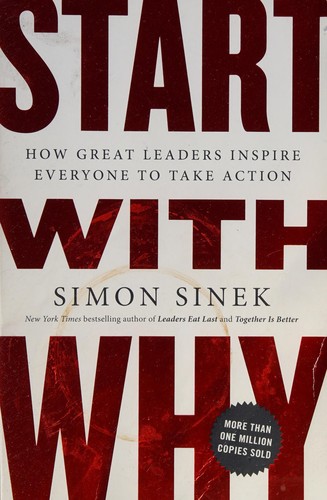
Start with Why by Simon Sinek is a 2009 business book about leadership, purpose, motivation. People don't buy what you do, they buy why you do it. The Why is the belief or purpose that drives an organization, not its products or features.
Summary
Start with Why is Simon Sinek's argument that the most influential leaders and organizations in history didn't succeed because they made better products or ran smarter campaigns. They succeeded because they were clear on why they existed — the purpose, cause, or belief that drove everything — and communicated that belief before anything else. Sinek calls this the Golden Circle: Why at the center, How surrounding it, What on the outside. Most organizations work from the outside in, leading with What they do. The ones that inspire loyalty and movement work from the inside out.
The case rests on neuroscience as much as business history. Sinek argues that the Why speaks to the limbic brain — the part that governs feelings, trust, and decision-making — while What and How speak to the neocortex, which handles rational thought. People can articulate the features of a product but can't easily say why they trust a brand or follow a leader. That gut feeling, Sinek says, is the limbic brain responding to a clear Why. Apple, Martin Luther King Jr., and the Wright Brothers aren't grouped together because of luck. They are grouped together because all three communicated from the inside out.
The second half of the book examines how a clear Why scales — and how it gets lost. Sinek introduces the concept of the Celery Test: before acting on advice or opportunity, organizations should filter decisions through their Why. He also describes the split between early adopters, who buy for belief, and the early majority, who need social proof. Crossing that gap requires a Why strong enough to earn genuine evangelists, not just satisfied customers. The failure mode Sinek documents most carefully is "the split" — when a founding leader's Why becomes decoupled from the company's operations after growth or succession, leaving an organization that knows What it does but has forgotten Why.
The book is persuasive on the macro argument and thinner on the mechanics. Sinek tells you that knowing your Why matters enormously but gives less guidance on discovering or articulating one if it isn't already obvious to you. The case studies are well chosen — Apple, Southwest, Harley-Davidson, TiVo's failure — and the core framework is genuinely useful for thinking about organizational identity, hiring, and positioning. Leaders who feel their teams are executing well but not pulling in the same direction will find this a clarifying read.
Talk to Start with Why like its author wrote you back.
Get the ideas that fit your life — not generic summaries.
- Chat with the book
- Audiobook-style main ideas
- Adapts to your life and goals
- Helps you take action
Key takeaways
- 1.
People don't buy what you do, they buy why you do it. The Why is the belief or purpose that drives an organization, not its products or features.
- 2.
The Golden Circle works from the inside out: Why first, then How, then What. Most organizations default to the reverse and miss the chance to inspire.
- 3.
The limbic brain governs trust and decision-making but doesn't process language well. A clear Why communicates at that level; feature lists don't.
- 4.
The Celery Test: before any decision, ask whether it fits your Why. This filters out moves that dilute purpose even when they seem strategically attractive.
- 5.
Early adopters buy for belief. They spread the message before the majority arrives. Earning them requires authenticity, not marketing.
- 6.
Leadership and authority are not the same thing. Authority is given; leadership is earned when people follow because they want to, not because they have to.
- 7.
Organizations lose their Why through growth and succession. A founder's instinct doesn't automatically transfer — it has to be made explicit and embedded in culture.
- 8.
Manipulation tactics — price cuts, promotions, fear — work in the short run but don't build loyalty. They attract customers who leave when the deal ends.
Discussion questions
Use these on your own, with a book club, or as chat starters in Superbook. Book club version, ready to copy or print →
- 1.
Sinek claims most organizations lead with What and rarely articulate Why. Can you identify the Why of a company you buy from or work for — and does it match how they actually behave?
- 2.
What is your personal Why — the belief or purpose that drives the choices you're most proud of? How often does it show up in how you introduce yourself or your work?
- 3.
Sinek separates leadership from authority. Think of someone in your life you follow because you want to. What makes them different from someone with formal authority you merely comply with?
- 4.
The Celery Test filters decisions through the Why. Apply it to a recent decision you made: did the choice actually reflect what you say you believe?
- 5.
Sinek argues manipulation — discounts, fear, peer pressure — produces transactions but not loyalty. Where have you personally used or experienced manipulation as a substitute for a real Why?
- 6.
Apple is Sinek's central example of Why-driven marketing. Can you think of a company that inspires similar loyalty without any obvious Why — and what explains it?
- 7.
The book describes the split between a founder's personal Why and the organization's culture after the founder leaves. Have you witnessed that split in a company, team, or institution you care about?
- 8.
Early adopters buy for belief and take on risk because the idea resonates with their own Why. When have you been an early adopter in that sense — not just for a product, but for an idea or movement?
- 9.
Sinek says trust is built when words and behavior are consistent. Pick an area of your life where you feel trusted. What behavior has made that trust possible?
- 10.
The book uses Martin Luther King Jr.'s 'I Have a Dream' speech as a model. What makes it different from a policy statement? What does that say about how purpose needs to be communicated?
- 11.
Where in your professional life are you leading with What instead of Why — and what would change if you led with Why first?
- 12.
Sinek argues that hiring for Why alignment produces more cohesive teams than hiring for skills alone. Have you seen that play out — or fail — in practice?
Themes
Frequently asked questions
-
What is Start with Why about?
Sinek's core claim is that great leaders and organizations succeed because they communicate their purpose — their Why — before explaining what they do or how they do it. The book argues that starting with purpose builds trust, inspires loyalty, and attracts people who share your beliefs rather than just your products.
-
Is Start with Why worth reading?
Yes, if you're thinking about leadership, organizational culture, or personal purpose. The central framework is genuinely clarifying. The limitation is that Sinek is better at showing you why Why matters than at helping you find yours if it isn't already visible to you.
-
How long does it take to read Start with Why?
About four hours at average reading pace. The chapters are short and the writing is accessible. The core argument is clear by the halfway point; the second half reinforces and extends it with additional case studies.
-
Who should read Start with Why?
Founders, managers, and team leads who feel their organizations are executing well but pulling in different directions. Also useful for anyone building a brand or trying to attract people — employees, customers, collaborators — based on alignment rather than incentives.
-
What's the most useful idea in Start with Why?
The Celery Test: before acting on any opportunity, filter it through your Why. If it doesn't fit, decline it even if it looks attractive on its own terms. The discipline of that filter is what keeps organizations coherent as they grow.
Similar books
Drive: The Surprising Truth About What Motivates Us
Daniel H. Pink
Good to Great
Jim Collins
Zero to One: Notes on Startups, or How to Build the Future
Peter Thiel
Measure What Matters
John Doerr
