Health · Book club
The 4-Hour Body book club questions
Here are 12 book club questions for The 4-Hour Body by Timothy Ferriss, ordered to open easily and end somewhere worth arguing about. Copy them, print them, or bring them up one at a time.
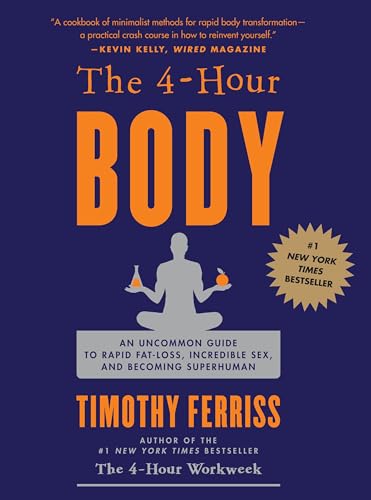
The 4-Hour Body is Timothy Ferriss's account of a decade of self-experimentation with his own body — tracking every measurable variable of diet, training, sleep, and recovery to find the minimum effective dose of each intervention that produces maximum results.
Timothy Ferriss · 2010 · 9h 40m
Full summary and key takeaways →The 12 questions
- 1.
Ferriss frames the book as self-experimentation. How much do you trust individual self-tracking as evidence versus population-level research? What's the value of each?
- 2.
The Slow-Carb Diet has helped many readers lose fat but doesn't work for everyone. What does the variability in dietary response suggest about universal nutritional prescriptions?
- 3.
He applies the minimum effective dose principle to everything. Is there a domain in your health where you're investing far more than the minimum effective dose without proportional return?
- 4.
The cheat day is the most psychologically interesting part of the Slow-Carb Diet. Does the idea of a scheduled break from restriction seem effective or counterproductive to you?
- 5.
Ferriss is explicit that the book is partly n=1 experimentation. How does knowing that change how you weight specific claims?
- 6.
He covers cold exposure extensively. Have you tried cold showers or ice baths? What was the experience, and does the science as he presents it convince you the benefits are real?
- 7.
The book covers a huge range of topics — fat loss, muscle gain, sleep, sexual performance, sports improvement. Does the breadth make it more or less useful than a focused book on any one topic?
- 8.
Ferriss is an enthusiastic self-quantifier. How much do you track about your own body? Is more tracking always useful, or is there a point of diminishing returns?
- 9.
He positions himself as a guinea pig rather than an expert. Does that rhetorical positioning increase or decrease your confidence in his recommendations?
- 10.
Some claims in the book have not held up to replication. How do you navigate a book where some content is solid and some is speculative without knowing which is which?
- 11.
The book is aimed partly at people who want maximum results with minimum time investment. Is that a legitimate optimization, or does it reflect the wrong relationship with physical discipline?
- 12.
If you were to design one self-experiment based on the book's approach, what would you measure and what would you test?
How to run the discussion
- Pick six to eight, not all of them. An hour of real discussion covers fewer questions than anyone expects, and racing the list is what makes a book club feel like homework.
- Open with what people noticed, not what they concluded. Asking for a verdict first hardens opinions before anyone has heard each other.
- Let the disagreement run. The questions below that split a room are the ones worth the time; the ones everyone answers the same way can be skipped.
- Ask the quiet person a specific question. A direct, narrow question is far easier to answer than an open invitation to contribute.
Themes worth steering toward
If the conversation stalls, these are the threads that usually restart it.
Common questions
What are good book club questions for The 4-Hour Body?
Here are 12 book club questions for The 4-Hour Body by Timothy Ferriss, ordered to open easily and end somewhere worth arguing about. The strongest openers ask what each reader noticed rather than what they concluded, and the discussion usually turns on body composition, self-experimentation, fat loss.
How long should a book club discussion of The 4-Hour Body last?
Most groups run 60 to 90 minutes of actual discussion. That is roughly six to eight questions, not all of them, so pick the ones that suit your group rather than working down the list in order.
What are the main themes in The 4-Hour Body?
Body composition, Self-experimentation, Fat loss, Strength, Sleep optimization. Those are the threads most likely to divide a room, which makes them the useful places to steer a discussion that has gone quiet.
Picking the next one? See books like The 4-Hour Body or questions for other book club picks.
