History · Book club
The Anatomy of Fascism book club questions
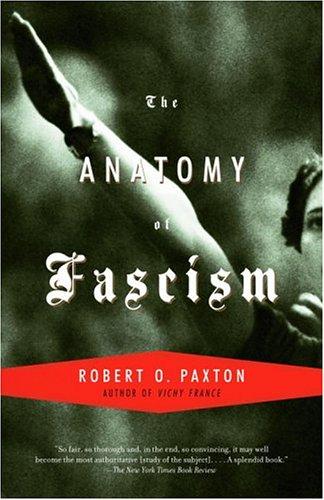
Here are 12 book club questions for The Anatomy of Fascism by Robert O. Paxton, ordered to open easily and end somewhere worth arguing about. Copy them, print them, or bring them up one at a time.
The 12 questions
- 1.
Paxton argues that fascism's emotional mobilizing passions matter more than its ideology. What does that imply about how to debate or counter fascist movements?
- 2.
The conservative elites who brought Mussolini and Hitler into government believed they could control them. What made that miscalculation so easy to make, and what would have had to be different for them to see it?
- 3.
Paxton's five-stage model suggests fascism rarely seizes power alone. Which stage do you find most surprising, and why?
- 4.
The book treats fascism as a form of politics, not a fixed ideology. How does that change what you look for when identifying fascist tendencies in a contemporary movement?
- 5.
Paxton distinguishes between fascist movements that seized power and those that failed to. What made the successful ones different?
- 6.
The cult of action and violence as regenerative forces appears across fascist movements. Where else in politics do you see action valued more for its emotional effect than its practical result?
- 7.
Paxton notes that democracies under serious stress are the most vulnerable to fascism. Which stresses matter most, in his account?
- 8.
How does Paxton's account of Vichy France challenge the French self-image of the Resistance era?
- 9.
The book argues that fascism in a new setting will not look like 1930s fascism. What aspects of the original phenomenon do you think are most likely to resurface in different dress?
- 10.
Paxton is skeptical that fascism can be defined by its ideology alone. Do you find his functional, behavioral definition more or less satisfying than an ideological one?
- 11.
The book ends without reassurance. How do you read that as a rhetorical and scholarly choice?
- 12.
If the preconditions Paxton identifies are not historical accidents, which of them do you see as most present in contemporary democracies?
How to run the discussion
- Pick six to eight, not all of them. An hour of real discussion covers fewer questions than anyone expects, and racing the list is what makes a book club feel like homework.
- Open with what people noticed, not what they concluded. Asking for a verdict first hardens opinions before anyone has heard each other.
- Let the disagreement run. The questions below that split a room are the ones worth the time; the ones everyone answers the same way can be skipped.
- Ask the quiet person a specific question. A direct, narrow question is far easier to answer than an open invitation to contribute.
Themes worth steering toward
If the conversation stalls, these are the threads that usually restart it.
Common questions
What are good book club questions for The Anatomy of Fascism?
Here are 12 book club questions for The Anatomy of Fascism by Robert O. Paxton, ordered to open easily and end somewhere worth arguing about. The strongest openers ask what each reader noticed rather than what they concluded, and the discussion usually turns on fascism, political violence, nationalism.
How long should a book club discussion of The Anatomy of Fascism last?
Most groups run 60 to 90 minutes of actual discussion. That is roughly six to eight questions, not all of them, so pick the ones that suit your group rather than working down the list in order.
What are the main themes in The Anatomy of Fascism?
Fascism, Political violence, Nationalism, Authoritarianism, Ideology. Those are the threads most likely to divide a room, which makes them the useful places to steer a discussion that has gone quiet.
Picking the next one? See books like The Anatomy of Fascism or questions for other book club picks.
