Psychology · Book club
The Anxious Generation book club questions
Here are 12 book club questions for The Anxious Generation by Jonathan Haidt, ordered to open easily and end somewhere worth arguing about. Copy them, print them, or bring them up one at a time.
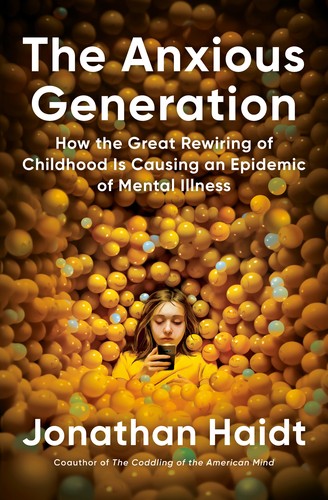
The Anxious Generation is Jonathan Haidt's argument that a phone-based childhood — shaped above all by smartphones and social media arriving in the early 2010s — has caused a serious and measurable deterioration in the mental health of adolescents in the United States, the United Kingdom, Canada, and Australia.
Jonathan Haidt · 2024 · 5h 15m
Full summary and key takeaways →The 12 questions
- 1.
Haidt distinguishes between the play-based childhood of earlier generations and today's phone-based childhood. How does your own childhood compare to the one he describes — and to what you observe in children today?
- 2.
He argues that smartphones are a coordination problem, not just a parenting choice. Does that framing change how you think about your own household's rules or your community's norms?
- 3.
The data show a much sharper mental health decline in girls than boys. What does that asymmetry suggest about the specific ways different platforms are designed?
- 4.
Some researchers dispute the size of the smartphone effect. How do you weigh contested epidemiological evidence when the proposed policy is relatively low-cost? How would you apply that same standard to other contested public-health debates?
- 5.
Haidt proposes phone-free schools as achievable in the near term. What would be lost as well as gained if your child's school went fully phone-free during the school day?
- 6.
The book criticizes the 'safetyism' culture that replaced free outdoor play with supervised, liability-conscious activities. Where do you see that dynamic in your community? Who benefits from it?
- 7.
Haidt suggests social media companies designed these products knowing they were harmful to adolescents. What responsibility, if any, should governments, schools, or parents have for enforcing limits that companies won't impose themselves?
- 8.
The book focuses almost entirely on the Global North, primarily the US, UK, Canada, and Australia. How might the same dynamics play out differently in other cultural or economic contexts?
- 9.
Think about a teenager you know. What in their online life seems genuinely good — connection, creativity, information — and what seems to cost them more than they realize?
- 10.
Haidt argues that the years 2012–2015 were the inflection point. What else changed in that period — economically, politically, culturally — that might also explain rising adolescent distress?
- 11.
He frames unsupervised outdoor play as developmentally essential. What specific skills or experiences did you gain from childhood risk and independence that you think are harder to get today?
- 12.
The book proposes collective norms around technology. What other aspects of modern childhood might benefit from a similar collective-action framing rather than individual parental choice?
How to run the discussion
- Pick six to eight, not all of them. An hour of real discussion covers fewer questions than anyone expects, and racing the list is what makes a book club feel like homework.
- Open with what people noticed, not what they concluded. Asking for a verdict first hardens opinions before anyone has heard each other.
- Let the disagreement run. The questions below that split a room are the ones worth the time; the ones everyone answers the same way can be skipped.
- Ask the quiet person a specific question. A direct, narrow question is far easier to answer than an open invitation to contribute.
Themes worth steering toward
If the conversation stalls, these are the threads that usually restart it.
Common questions
What are good book club questions for The Anxious Generation?
Here are 12 book club questions for The Anxious Generation by Jonathan Haidt, ordered to open easily and end somewhere worth arguing about. The strongest openers ask what each reader noticed rather than what they concluded, and the discussion usually turns on mental health, social media, adolescence.
How long should a book club discussion of The Anxious Generation last?
Most groups run 60 to 90 minutes of actual discussion. That is roughly six to eight questions, not all of them, so pick the ones that suit your group rather than working down the list in order.
What are the main themes in The Anxious Generation?
Mental health, Social media, Adolescence, Technology and society, Parenting. Those are the threads most likely to divide a room, which makes them the useful places to steer a discussion that has gone quiet.
Picking the next one? See books like The Anxious Generation or questions for other book club picks.
